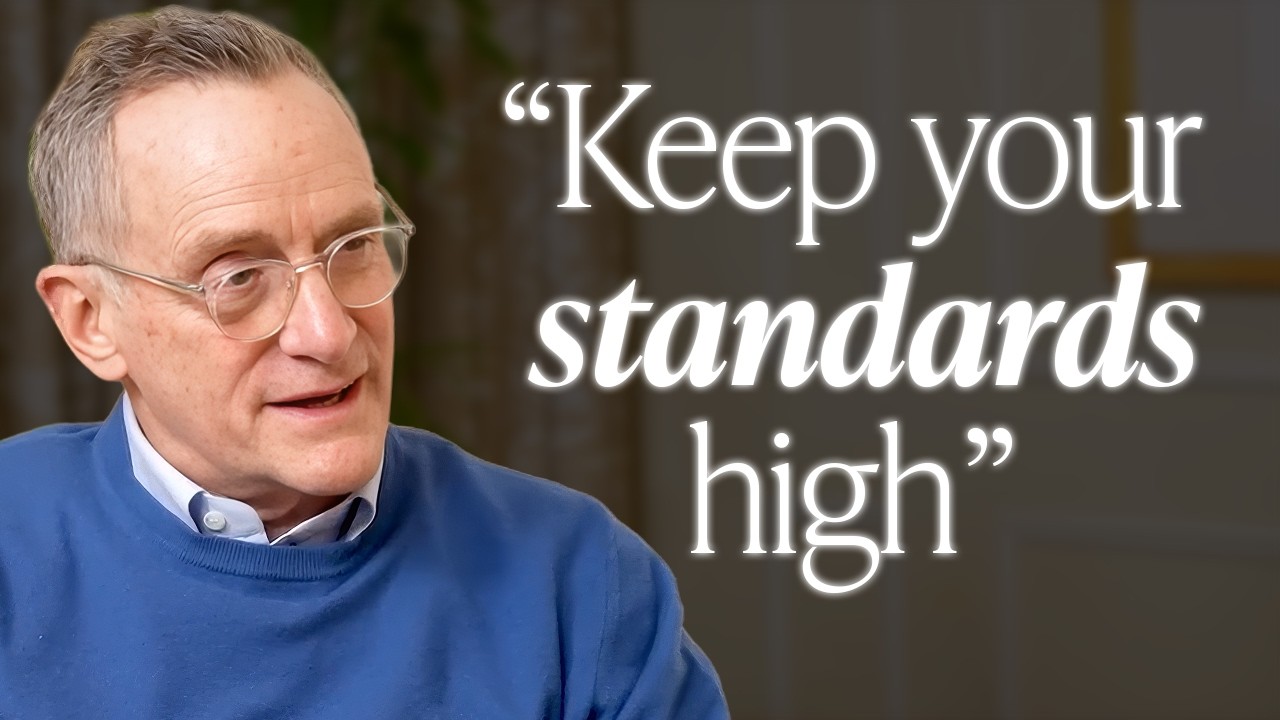
Howard Marks is a legendary investor and writer who has spent 35 years crafting memos that distill complex investment ideas into clear, accessible language. Starting with just 100 clients in 1990, his memos now reach over 300,000 subscribers, and he manages more than $190 billion in assets. His success stems from a rare combination of intellectual rigor, creative process, and a deep commitment to simplicity.
The goal of writing: changing how people think
Marks measures the success of his writing not by agreement but by disruption. His ideal response is “I never thought of it that way,” meaning the reader has encountered a genuinely new perspective.
He rejects confirmation bias in writing. If a piece merely reinforces what readers already believe, it hasn’t contributed much.
His aspiration is what he calls “simplicity on the far side of complexity,” a concept borrowed from Oliver Wendell Holmes: the ability to make something clear only after deeply understanding its complexity, not by glossing over it.
How the memos are created
Marks writes only when he feels inspired, never on a fixed schedule, though he aims for at least quarterly output. This freedom from obligation is central to his process.
Ideas accumulate serendipitously: he clips articles, saves videos, jots down thoughts, and lets them pile up. When the pile reaches critical mass, connections between seemingly unrelated things spark a memo.
The “Getting Lucky” memo, for example, was triggered by a quote from Jack Dorsey in a hotel magazine claiming success is never accidental. Marks disagreed and built an entire essay around the role of randomness.
He does not start with a formal outline. He thinks extensively about organization, then writes a rough draft and revises it roughly five times, each pass yielding diminishing but meaningful improvements.
He relies on a small group of trusted readers, including one person who catches 200 tiny errors (hyphens, comma types), so that feedback from others can focus on substance rather than mechanics.
Distillation and simplicity
Marks’s writing is simple because his thinking is logical and left-brain dominant, allowing him to break processes into orderly steps.
He aims to write exactly as he speaks: using contractions, common language, and a conversational tone. He explicitly rejects the impulse to impress readers with erudition.
He often waits for the right clarifying phrase to emerge before writing extensively. The phrases that simplify are integral to the process, not afterthoughts.
He admires Warren Buffett’s turn of phrase, such as “It’s only when the tide goes out that you find out who’s been swimming naked,” which conveys a complex idea about luck versus skill in just 15 words.
Why he gives away his “secrets”
Marks is unafraid of sharing his investment philosophy because knowing the principles is not the same as being able to implement them. Most people who agree with his ideas still won’t be able to execute them.
Writing is his recreation and creative outlet, not a marketing exercise. He wrote for years before anyone noticed, purely because he enjoyed it.
The benefits of writing, in his view, far outweigh any competitive risk.
The early years and formative influences
Marks attended the Wharton School, where two requirements shaped him: a semester of foreign literature in English and a non-business minor. He chose Japanese literature, studying under Professor E. Dale Saunders, a demanding teacher who marked papers with “WW” (wrong word), “REP” (repetitive), and “AHH” (for good work).
Saunders transformed Marks from an indifferent student into a serious one and gave him the foundational writing discipline he carried into his career.
Marks later attended the University of Chicago, where he was exposed to the quantitative, efficient-market “Chicago School” of thought. This created a lasting intellectual tension with Wharton’s qualitative, practical approach.
Reconciling these two worldviews, theory and practice, became the central intellectual project of his career and the engine of his best writing.
What makes a good memo or annual letter
Don’t write until you have something to say. Marks started in 1990 after 21 years in the business. A 28-year-old, in his view, has no wisdom to impart.
Focus on lasting principles, not daily news or forecasts. Most writers who predict tomorrow’s market are right only half the time.
Develop a creed: a clear investment philosophy about what you believe will work, what you’ll refuse to do, and the rules that govern your decisions.
Draw from eclectic sources. Marks returns repeatedly to writers like Nassim Taleb (randomness), John Kenneth Galbraith (futility of forecasting), Charles Ellis (avoiding losers), and especially Peter Bernstein, whom he considers his greatest intellectual hero.
Bernstein’s memo “Can We Reduce Risk to a Number?” profoundly shaped Marks’s thinking on risk. Marks later reissued his own “Risk Revisited” memo with Bernstein’s insights added in italics, openly crediting the source, which he called an act of intellectual honesty.
Thinking visually and by analogy
Marks thinks in pictures and graphs. One of his favorite analogies is a ball held aloft by a water spout: the ball is the economy or a stock price, and the spout is a temporary stimulus. When the stimulus stops, the ball falls. This makes the abstract concept of temporal versus permanent influences vivid and intuitive.
He is cautious about analogies, often warning that they can mislead, but uses them because they make ideas accessible and memorable.
He admires Jeff Bezos’s annual letters, particularly the handstand analogy: learning a handstand takes months of committed practice, just as building a business requires patience and long-term commitment.
The role of randomness and luck
Marks believes deeply in the role of randomness in success. He rejects the idea that “success is never accidental,” arguing that luck is unevenly distributed and that many capable, hardworking people never get lucky, while others succeed without those qualities.
This belief informs his broader philosophy: since so much is outside your control, the one thing you can control is the quality of your output. If you produce the best work you’re capable of, you can relax.
Writing as a lifelong practice
Marks’s memos have grown from 1.5 pages in 1990 to a consistent 12–14 pages, though he never targets a specific length. He believes anything longer becomes laborious.
He finds that returning to old memos reassures him: when he still believes what he wrote 25 or 30 years ago, it confirms the solidity of his ideas.
Writing, unlike speaking, enforces rigor. Readers can revisit and scrutinize every claim, so the logic must be airtight.
He sees writing as a way to stay intellectually alive. After 55 years in the business, he still thinks of new things, and that ongoing growth is what keeps him engaged.
The most important thing about writing
When asked to name the single most important thing about writing, Marks refuses to pick one, just as his book The Most Important Thing lists 21 different “most important things” about investing.
The key qualities he identifies include clarity, humor, interesting topics, and the ability to challenge readers to learn something new.
The ultimate test: if a reader finishes a nonfiction book and says “I already knew all that,” the writer has failed. The goal is to make the reader think differently.