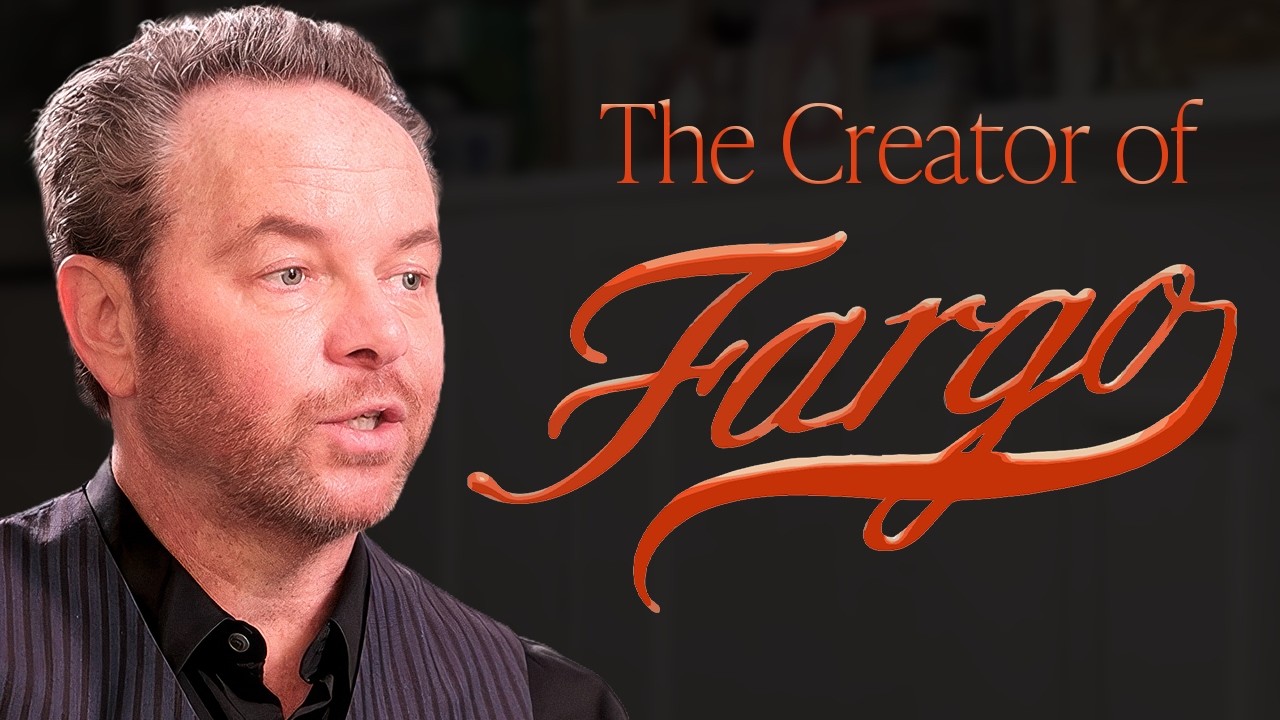
Noah Hawley is a writer and showrunner behind Fargo, Legion, Alien: Earth, and several novels. He’s built a career not just on storytelling talent but on a professional fluency in how the industry works—how to pitch, collaborate, manage networks, and deliver ambitious projects on time and on budget. This interview covers his creative process, his philosophy on genre, and the practical realities of sustaining a career in film, TV, and fiction.
Writers’ rooms: useful but limited
Hawley has a love-hate relationship with writers’ rooms. They’re collections of people with very different brains who only share one language: plot. This makes them great for breaking story beats (“this happens, then this happens”) but poor for deeper thematic or character work.
He sees the writing brain and the outlining brain as fundamentally different. A writers’ room works best when he’s in it driving it, steering conversations toward theme rather than just plot mechanics.
He’ll sometimes tell writers not to talk about “what happens next” and instead explore a theme—like assimilation in Fargo—so the story is grounded in ideas, not just narrative momentum.
He resists movie-style twists in Fargo because the show is built on many moving pieces on a collision course. The audience doesn’t know which will collide or when, and that unexpectedness is central to the experience.
Fargo deliberately puts the audience in morally uncomfortable positions—rooting for violence because that’s what stories train us to want, then making us confront why we wanted it when the violence arrives and it’s awful.
TV writing vs. movie writing
The original Fargo movie is more comedic than people remember, but the TV show needed higher dramatic stakes because a 10-hour story requires constant threat levels for everyone. In the movie, Frances McDormand’s character has almost no threat until the very end.
Hawley watches movies first as an audience member, then afterward analyzes how the storytelling worked. He noticed in One Battle After Another that the women were in a drama and the men were in a farce—two different movies sewn together.
He starts stories with a question or an image that contains a question. The first season of Fargo began with an image of two men meeting in an emergency room—one civilized, the opposite of the other. His first novel grew from the question: what are Americans so afraid of that we keep cycling through paranoia?
He thinks about what he’s taking for granted in a story. For Lucy in the Sky, he realized the movie theater itself could be a tool—using the full screen and sound for space, then shrinking the image and sound when the character returns to mundane life.
On Legion, the surrealism of a psychiatric hospital setting let him personify things you couldn’t do in a straight drama, like trapping a character in his own mind or sitting in an ice cube with Jemaine Clement.
Adapting to how people watch now
During “peak TV” (around 2018–2019), the number of shows doubled and platforms competed by making splashy, experimental content. This gave creators room to take risks.
By the time he returned to Fargo for season 5, Hawley noticed attention spans had shifted. He made concentrated episodes no longer than 44 minutes—“verb-driven” and action-oriented, as opposed to lingering on atmospheric shots or slow character moments where nothing plot-relevant happens.
He still values slow, experiential shows like Mad Men or The Sopranos, where very little happens for long stretches and then something explosive lands with enormous weight. But as a viewer, he now prefers a great story well told.
The second-season trap
Hawley identifies a structural problem with ongoing TV: the first season is organic because you create a story and populate it with characters meaningful to that story. In season two, you’re forced to service characters simply because they exist, leading to filler storylines that exist only because actors need something to do.
He refuses to do this. For each season, he figures out which characters fit the new story and sidelines or drops the others. He’d rather tell a great story than service every character.
He contrasts this with movies, which have a pyramid structure—wide at the base for setup, narrowing to the point. Long-form anthology TV lets him digress all the way to the end, like doing a whole episode from the villain’s point of view.
Lost is a cautionary tale: the showrunners didn’t get an end date, so by season three characters were literally trapped in a cage because the creator didn’t know how much runway he had. Hawley sells Fargo as an anthology so every season is self-contained and he always knows where the ending is.
What makes horror work
Hawley loves horror because it’s the most cinematic genre—it relies on visuals and lingering camera work rather than dialogue. It produces the biggest emotion (fear) for the least money by engaging the audience’s imagination.
Constraints lead to innovation: horror often has one location (a house), forcing inventive filmmaking. Comedy and horror are the same mechanism—tension, tension, tension, release—just with different payoffs.
The key tool is patience. Linger on a wide shot where the audience can see what the character can’t. Let them work themselves up. Paranormal Activity worked by simply showing a couple sleeping with a door open, making the audience feel vulnerable for eight hours.
Subtlety matters: when stress levels are elevated, tiny things—a drawer sliding on its own—cause adrenaline spikes. You don’t need much to happen.
Hawley can’t feel fear when watching his own work because he knows what’s coming. That’s why test screenings matter: you watch the audience to calibrate how long to hold anticipation before the payoff.
Scriptwriting and pitching
Hawley writes scripts the way he sees them in his mind, including camera directions like “angle on him” or “close-up on the glass.” This helps readers visualize the story and serves as a communication tool for department heads.
The experience of reading a script should match the tone of the story. An irreverent comedy should be irreverent on the page. His pitch for one show was itself a demonstration of the show’s tone—he spent the opening minutes talking about the segue into the pitch, making executives wonder what was happening, then revealed the segue was the pitch.
He rips through first drafts at the speed of thought. For novels, he writes in intense sprints—enough pages (100+) that if he doesn’t return for years, he can see exactly what he was doing, what the voice was, where it was going.
He loves the writing process, which he knows is unusual. Many writers hate it. He thinks if you get to do what you love for a living, you have to take joy in it.
AI and the future of storytelling
Hawley thinks AI could write formulaic procedurals like Law & Order that follow a predictable structure, but struggles with invention, playfulness, or innovation.
He sees AI as a tool, like visual effects—people once said VFX were ruining cinema, but no one thinks that anymore. AI is already being used for de-aging actors more effectively than traditional VFX.
He uses AI for productivity and research, bouncing ideas back and forth, but not to write for him. Seeing something done wrong can trigger his own vision of how it should be done.
He thinks about how audiences will consume fiction in 10–20 years and how the form must evolve. He adjusted Fargo’s episode length based on where he sensed audience attention spans were shifting.
Navigating Hollywood
Hawley adapts his work to the moment—making longer episodes in 2018 when audiences wanted more, shorter ones in 2024 when they wanted concision. He loves both versions.
He operates in the tension between being an original storyteller and working within a corporate system that needs to turn a profit. His pitch to studios is that he’s the safest risk: he experiments and innovates but delivers on time and on budget.
Networks always give the same note on new Fargo seasons: “It doesn’t feel like last time.” His response is that it’s a different story but will produce the same feelings in different places for different reasons.
He references Derek Thompson’s “most advanced yet acceptable” concept—creative work needs to be beyond where we are but not so far that people can’t process it.
He admires Everything Everywhere All at Once for being a unicorn that Hollywood couldn’t copy. His takeaway from lightning striking is never to just copy—it’s to make something equally original.
He’s built a career adapting existing IP (Fargo, Alien, Legion) while maintaining a reputation for originality by bringing the same creative ambition to adaptations as he would to original work.
Influences and developing voice
Don DeLillo’s White Noise was a revelation—the first novel Hawley read that was truly meta, talking about consumerism and pop culture, with a professor of Hitler studies and a girl saying “Toyota Celica” in her sleep. It expanded his concept of what a book could be.
Kurt Vonnegut does things that shouldn’t work—mixing autobiography, science fiction, and a fictional author (Kilgore Trout) within a WWII narrative—but they work because of a simple, meaningful morality underneath.
Hawley’s voice comes from synthesizing unique inspirations: science fiction, British comedy records (Goon Show, Monty Python), New York Jewish humor (Mel Brooks), and seeing 2001: A Space Odyssey at age seven. These don’t naturally go together, and that’s what makes the synthesis distinctive.
He learned to write by writing a terrible book, then a less terrible one, and reading constantly. He has no MFA and never went to film school.
Working with a team
Hawley is explicit about voice with his team but also relies on a voyage of discovery. He needs everyone to be making the same thing.
When adapting Alien, he didn’t rewatch the film. Instead, asked what feelings it produced in him, then figured out how to produce those same feelings through a different story.
He thinks about emotion like a color wheel—grief and humor are opposites that can enable each other. His favorite thing to create is catharsis: from sadness comes happiness, a complexity of emotions that builds and releases into something transcendent.
He cites a Fargo season 5 scene where a villain shows up for a violent confrontation and the heroine refuses to play his scene—instead forcing him into her world of making dinner, leading to a moment of forgiveness so profound his eyes tear up eating a roll. That complexity makes networks nervous because they prefer clear, singular emotions.
Playfulness as a creative principle
Hawley keeps returning to “playfulness” because it’s an act of imagination—being open to all possibility, like kids playing pretend. On set, he plays with the material even if nothing changes.
Playfulness extends to the business: when a network gives a bad note, the creative solution is to get what you want while making them think they got what they wanted. Yelling is rarely the answer.
He warns against the instinct to be a junkyard dog protecting your work at all costs. Artists who go to war with networks over their first show often never make anything again. The skill is seeming easy to work with while still getting your vision on screen.
Sound and music
Hawley has used the same composer, Jeff Russo, on everything. They start talking before there’s even a script—he had Russo write 10 pieces of music before the first Fargo script existed so he could listen while location scouting.
For Legion, he wanted the soundscape to feel like Dark Side of the Moon—the closest auditory equivalent to mental illness. Russo tracked down a 1979 patch cord synthesizer to get the right sound.
He thinks about where music shouldn’t go. In Fargo season 3, he left a character’s emotional confession unscored, then scored the triumphant moment when the soap dispenser finally works for her—the contrast made the musical moment land much harder.
Most shows use too much music because they don’t trust the audience to have their own emotional journey. When music is everywhere, it becomes meaningless.
Hiring and work ethic
Hawley’s mantra: “Don’t climb four flights of stairs to get to the second floor.” Some people work way too hard to accomplish simple things. He values efficiency and creative problem-solving over brute effort.
Every day on set feels impossible—eight pages to shoot, action scenes, important dialogue—but you lower the stakes and do the work. He tells actors to remember that iconic scenes were shot in a single afternoon. If it doesn’t work, you find another way.
Movies vs. books vs. TV
Movies: You start with all the time in the world and end with none. The danger is letting plot hijack the story—reaching a point where you’re just paying off setup. He writes “emotional thrillers” where the real question is whether the character will be okay, not just whether the mystery gets solved.
TV: A season is a beginning, middle, and end. An episode is a beginning, middle, and end—like Russian nesting dolls. The “late middle problem” is the lull between the mid-season climax and the finale. He solves it by jumping timelines or changing locations to keep the story moving.
Novels: It requires patience. In Hollywood, the phone rings every day telling you someone loves you. In novels, you sit alone in a room and the phone doesn’t ring. You live with a book for two to five years before anyone sees it, and you have to be okay with that long, solitary journey.