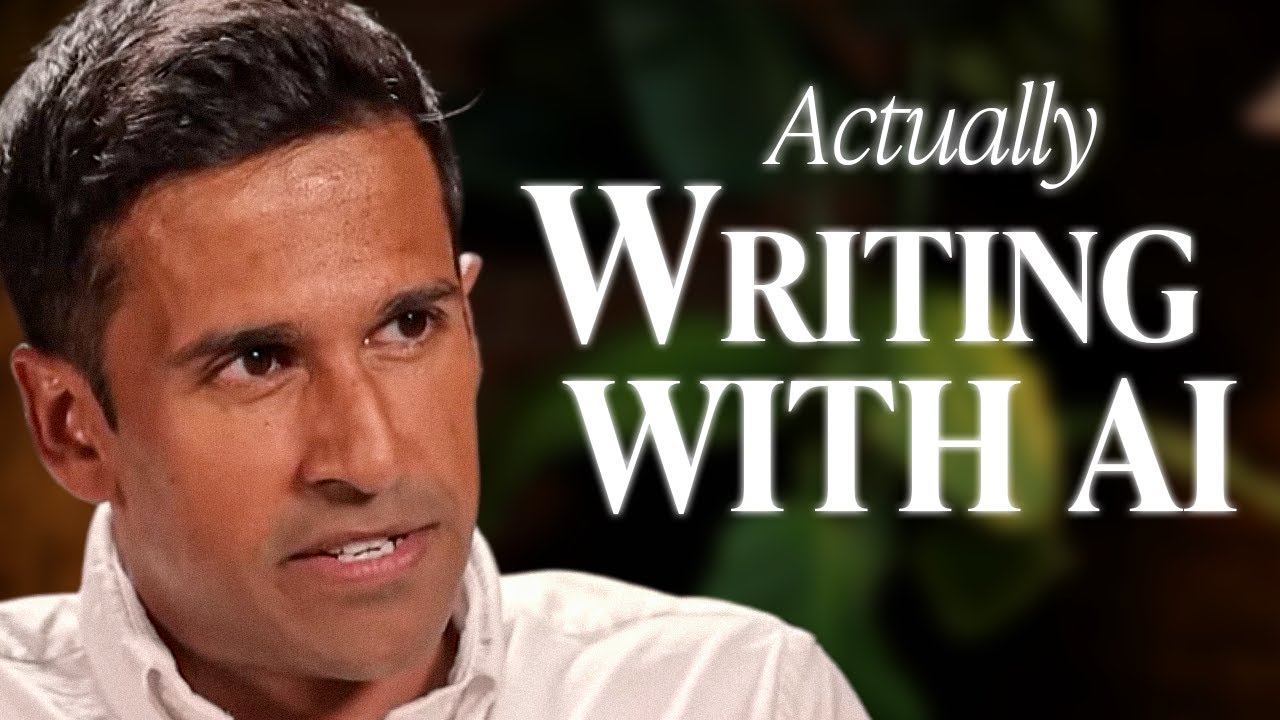
Jimmy Soni is a deeply obsessive writer and researcher who has spent years on projects like a six-year book about PayPal’s origin story and is now working on a book about Kobe Bryant. He’s also the co-founder of Infinite Books, a new publishing company. This conversation covers his writing process, his research methods, his use of AI, and his views on the publishing industry — all grounded in a philosophy that great work comes from love of craft and relentless discipline.
Kobe Bryant: The Storyteller Behind the Athlete
Kobe Bryant wanted to become “the Walt Disney of the 21st century” — not just a celebrity side project, but a genuine, studied commitment to storytelling as a second career.
He journaled every day for 15 years, studied Joseph Campbell and the hero’s journey, read Hemingway, and interviewed writers like George R.R. Martin and studied J.K. Rowling’s work obsessively.
He wrote or conceived of four or five novels, began a Broadway musical, developed screenplays, and built a whole media ecosystem.
He created his own publishing company because traditional publishers wouldn’t invest in the quality he demanded — for example, he spent two weeks with his team rearchitecting the barcode on one of his books so it would blend elegantly into the cover design.
His Oscar-winning short film “Dear Basketball” grew out of a poem he wrote as a love letter to the game, published on The Players’ Tribune when he retired.
He personally recruited legendary composer John Williams and Pixar animator Glenn Keane to turn it into a hand-drawn animated short.
He became the first athlete ever to win an Academy Award.
The film worked because Kobe understood that while basketball is niche, the emotions of obsession, love, and loss are universal — if you do the introspection to get to the core of your own experience, it resonates across cultures.
Kobe’s discipline in writing mirrored his discipline in basketball — after retirement, he kept the same schedule: work out, drop kids off at school, go to the office and write for eight or nine hours.
He described missing the immediate feedback loop of basketball — the crowd’s roar — and wished he could be in the car when his kids watched a movie he made for the first time.
He rejected the typical post-athlete path of TV commentary and endorsements, even when people laughed at his ambitions.
Kobe sought out “fellow obsessives” in every field — people who loved their craft as much as he loved basketball.
He studied Bruce Lee so deeply he learned Jeet Kune Do to get inside his head. He sought out Taylor Swift not for fame but to understand how someone stays at the top of their craft for so long.
When asked if he had friends, he said “not really” — what he had were fellow obsessives, people he could “go full nerd” with and learn from.
The sustaining force behind mastery is love — ambition and revenge burn out, but love endures.
Jimmy’s Writing Process: Protecting the Work
Jimmy writes every day from 4:00 a.m. to around 8 or 9:00 a.m. — this is non-negotiable, seven days a week.
He treats the world as “a conspiracy designed to prevent writing from happening” and sees those early morning hours as the only time when nothing interferes — no inbox, no obligations, no one bothering him.
He front-loads his best mental energy for writing because it’s the hardest thing he does; everything else gets the “regular fuel” later in the day.
He goes to bed early, lives a deliberately unglamorous life, and has become so habituated to the routine that he can physically feel it in his body when he misses a day.
He uses “on-ramps” to get started — he doesn’t just stare at a blank page at 4 a.m.
He spends the first 10–15 minutes reading a “model book” — a book he admires that serves as a template for the project he’s working on. For the PayPal book, it was The Everything Store by Brad Stone, which he read over 20 times. For the Kobe book, it’s The Almanac of Naval Ravikant.
This tricks his brain into thinking he’s just reading (which he loves), while actually teaching him how that author made their book work.
Then he does 30 minutes of timed research, then sets a daily word count goal.
He blends research with writing rather than separating them — research is often just an excuse not to write.
He does 30 minutes of research as a “candy excuse” before writing, then researches while writing — if he needs a fact mid-section, he looks it up and puts it in immediately.
He turns all free time into research time: listening to relevant podcasts while doing groceries, watching YouTube interviews with subjects in the evening instead of Netflix.
He’s seen people spend decades researching books they never write; the key is to start creating and go back to research as needed.
Research as Craft: Finding the Hidden Stories
Jimmy’s “toenail strategy” comes from Michael Lewis: in Renaissance paintings that all look the same, look at the toenails — that’s where the artist’s individuality shows.
He asks himself: what is everyone else missing? What question didn’t they ask?
For the PayPal book, he found a name on an early cap table — Ed Bogus — who wasn’t a famous investor. He tracked down a phone number, left a voicemail, and got a call back within 15 minutes.
Ed Bogus turned out to be a musician and competitive chess player who had faced Peter Thiel in chess tournaments. When Thiel showed up at his house looking for a friends-and-family investment, Ed wrote a check on the spot — because Thiel was so ruthless and merciless at chess that Ed knew he’d make anything successful. It was one of the best investments Ed ever made.
The best anecdotes often come from people on the periphery, not the main characters.
He asks interviewees about what nobody else asks — for example, when interviewing Elon Musk near the end of the research for the PayPal book, he asked about Greg Kouri, a close friend and early advisor who died young. Nobody had asked Elon about this. He paused, said “oh my god,” and gave a minute-long meditation on their friendship that revealed deep grief that shaped everything after.
The technique: find the part of someone’s life that exists outside the narrow frame everyone sees them for, and ask about that.
Jimmy’s Hall of Heroes
Robert Caro is “the Zeus” of non-fiction biography — the Kobe of the craft.
Caro spent 10 years on single books, moved to Texas Hill Country to describe it better, ran from his DC apartment to the Capitol to see the light the same way Lyndon Johnson saw it.
He turned history into literature — his books “vibrate” and have their own frequency.
He treated his work like a professional: wore a suit, worked at a typewriter, showed up every single day.
Jimmy calls himself a “method writer” — for the PayPal book, he walked the actual streets of Palo Alto at different times of day to understand the environment, even though most of those observations didn’t make it into the book.
Michael Lewis is on the hall of heroes for his creative range and courage.
After Liar’s Poker, he could have written 10 more finance books. Instead he wrote about coaching, parenting, baseball, the blind side, and the financial crisis.
He wrote op-eds under his mother’s maiden name, Diana Bleecker, because his bosses at Salomon Brothers told him he couldn’t write about Wall Street — so he kept writing anyway. A publisher tracked down Diana Bleecker and discovered it was Michael Lewis, which led to his first book deal.
Tyler Cowen is admired for the intellectual discipline of arguing the opposite position — a practice Jimmy now uses AI to help with.
AI as a Writing Tool
Jimmy sees AI as “the most unbelievable tool” he’s ever seen to improve every part of his work — comparing it to the first time he connected to the internet.
Research enhancement: While editing a book about grief, he used Claude (his preferred AI over ChatGPT) to quickly understand Jewish burial traditions — sources, quotes, Talmudic references — that would have taken a month of study. He could verify the author’s accuracy and suggest improvements.
Always-on editor: At 4 a.m., when no human editor is available, AI can critique a flabby paragraph, suggest word alternatives, and identify weaknesses. It never complains, never gets tired.
Devil’s advocate: For op-eds, he has Claude write a 700-word takedown of his piece, then doesn’t hold back. Nine times out of ten, the criticisms force him to strengthen the argument by addressing blind spots.
Numerical analysis: For a piece requiring a comparison involving distances and moon orbits, ChatGPT handled the math instantly and accurately — something Jimmy, a self-described “word person,” would have struggled with.
Anxiety antidote: AI helps him short-circuit the self-consciousness and ego that block creation. Using Whisper Flow (voice dictation), he can close his eyes, speak his thoughts, and get a rough transcription — turning months of agonizing over a difficult email into a 10-minute dictation he can then edit and send.
He had to write an apology to a friend he’d been dreading for months. He used Whisper Flow, spoke from the heart, and had a draft ready to edit and send almost immediately.
AI is “middle to middle,” not “end to end” — a framework from Erik Brynjolfsson.
Humans must still set the vision at the beginning and verify, fact-check, and polish at the end. But the middle work — drafting, researching, editing, analyzing — can be dramatically accelerated.
An engineer friend described it as “the sharpest knife an engineer has ever been given — but I’ve still got to cook the meal.”
Jimmy’s daughter writes without self-consciousness; AI helps adult writers recover that unadulterated creative impulse by getting to a bad first draft quickly, then refining from there.
He’s blunt: many critics of AI don’t actually use it. Learning to use these tools effectively is a skill unto itself.
The Publishing Industry and Infinite Books
Traditional publishing is a “Tyrannosaurus Rex” — Jimmy spent 15 years working within it and watched it degrade.
Publishers do less and less: marketing, cover design, editing. Jimmy paid for his own extra editing and his own cover design for the PayPal book because the publisher’s versions weren’t good enough.
Contracts are standardized and rigid: authors get an advance and then earn 10–15% royalties until the advance is earned back. Authors who questioned this were called “problem authors” and told to stay in their lane.
The industry is allergic to AI tools, A/B testing, and technology — tools that digital natives use routinely to improve products.
The business model demands a book be a hit within the first two weeks or the publisher moves on. The Boys in the Boat debuted to crickets, then eight months later hit the New York Times bestseller list and eventually became a Netflix movie. Many books could succeed with longer attention windows.
Publishers often reject projects that don’t fit an author’s established brand — a prominent bestselling author Jimmy knows wrote a memoir, but his publisher refused because “you’re not the memoir guy,” despite the book being excellent.
Jimmy co-founded Infinite Books with Jim Oanish to build a publisher that works differently.
Flexible contracts: some authors get 70% of royalties (no advance), others get advances — the deal is negotiated based on what the author actually wants.
AI-powered plagiarism checking: Jimmy argues there should never be another plagiarism scandal after 2025 because publishers can and should run every manuscript through AI to detect stolen work before publication.
A/B tested cover art: in the digital world, people make snap decisions on Amazon based on covers. Jimmy tests covers with hundreds of people before deciding. Traditional publishers don’t do this because it might upset the designer.
The goal is to treat publishing as a craft that can be improved with tools and data, not as a sacred institution immune to innovation.
The Carousel Book: Obsession in Another Form
Jimmy wrote a coffee table book about Jane’s Carousel in Brooklyn Bridge Park — a project born from riding it over 200 times with his young daughter.
The carousel was hand-restored over 30 years by a woman named Jane, who refused to chemically strip the horses’ paint (which would destroy the original colors). Instead, she used Xacto knives to file away paint layer by layer, color-matched each one, and faithfully restored every detail — including finding a period-accurate organ and hiring the world’s best pin stripers.
Jimmy pitched the book to Phaidon (a premier coffee table publisher) by comparing it to their book about the Highline — and the editor he was pitching to turned out to be the same person who edited the Highline book.
Jane contracted COVID in 2020, was diagnosed with stage four lung cancer, and died before the book was completed. The book is a monument to her work.
The book required completely different skills: extreme word economy in captions, creative design decisions like using tissue paper overlays to show original paint colors on black-and-white images, and foldout pages to display all the horses.
For Jimmy, the project embodies the same theme as everything he does: finding people whose obsession surpasses understanding and turning their stories into something that lasts.