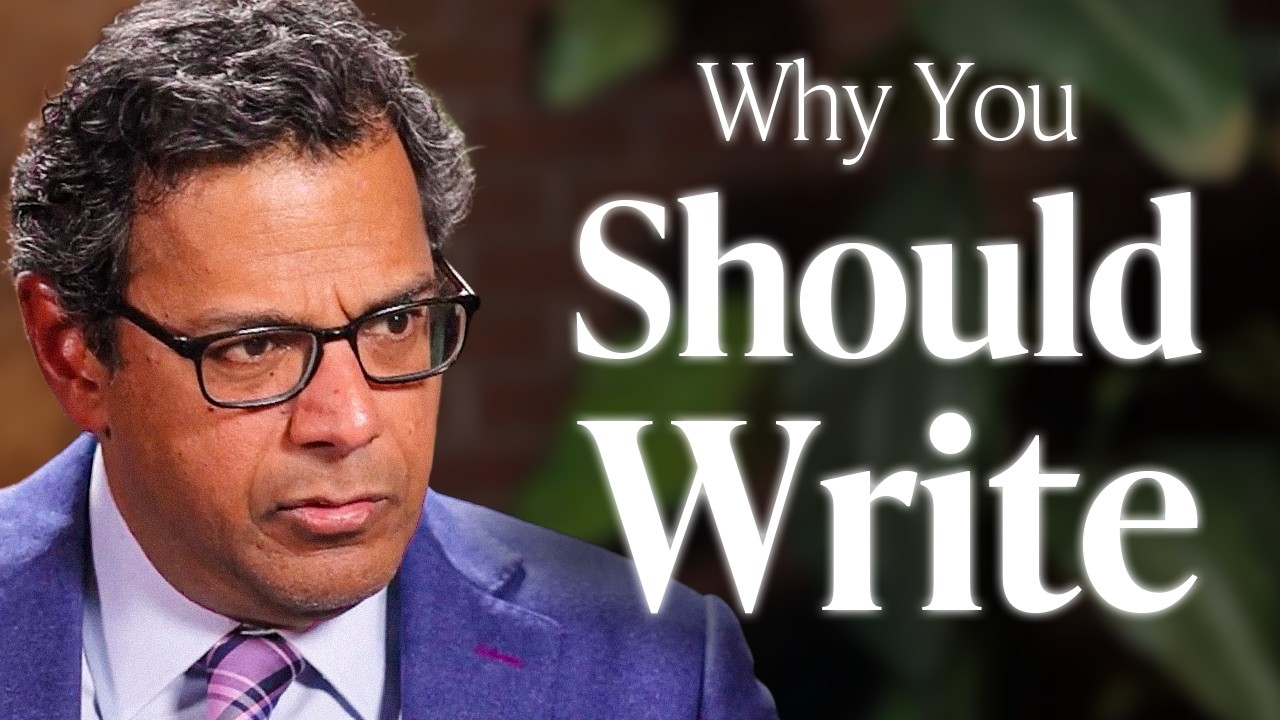
Atul Gawande is a surgeon, public health researcher, and bestselling author of four books and numerous New Yorker articles. Despite coming to writing later in life and not considering himself a natural writer, he has developed a disciplined approach to writing that complements his medical career. This episode explores his philosophy on writing as a tool for thinking, his process for producing high-quality work under intense time constraints, and how he balances clarity, storytelling, and emotional resonance across different formats.
Say “yes” before you’re 40
Gawande’s career strategy has been to say yes to everything before age 40 and no to everything after, based on the idea that you don’t know what truly energizes you until you try many things.
Before 40, he worked on Capitol Hill, played in a band, worked in labs, wrote for an internet magazine, and trained as a surgeon, all of which helped him identify the three things that gave him energy: surgery, public health and policy, and writing.
After 40, he focused exclusively on those three areas, recognizing that long-term mastery requires sustained commitment to a small number of pursuits.
Now at 60, he describes three decades of fascination with understanding humanity through the lens of health, medicine, and the systems that deliver care.
Why a surgeon writes
Gawande did not come to writing naturally. He began writing in 1996 when a friend, Jacob Weisberg, started Slate magazine and asked friends to contribute pieces.
His first piece was a diary-style blog from his surgery residency, written in a stream-of-consciousness style at the end of long days.
He noticed that writing gave him energy rather than exhaustion, which became his guiding principle for how to spend his time.
His early writing was rough, with overwrought and clashing metaphors, but he learned through feedback from Weisberg, who acted as an informal editor.
When he later wrote for The New Yorker, his first piece went through 22 back-and-forths and five complete rewrites over nine months, a process that was anxiety-inducing but taught him that every revision made the piece significantly better.
How to write when you’re busy
During his surgical residency, Gawande set a goal of 30 hours per month for writing, averaging about an hour a day, which felt manageable even with an intense schedule.
He used fragmented time, such as waiting between operating room cases, to do research and jot down ideas, and reserved larger blocks on weekends for drafting.
His first book, a collection of essays, was written largely before he finished surgical training, and he had to push through self-doubt when he realized the scope of what he had committed to.
The key principle was simple: if an activity gives you energy, do more of it; if it exhausts you, do less.
The New Yorker voice and style
Gawande describes The New Yorker style as having a “flare” or “swagger” that combines clarity and direction with a touch of humor and vividness, distinct from the dryness of other publications.
He was allowed to have a personal voice in his pieces, including telling jokes and using techniques from fiction writing in reported pieces.
An example is his piece “The Itch,” about a woman who scratched through her skull due to a severe itch, which aimed to make readers feel itchy themselves while illuminating how the brain processes sensation.
He also wrote about handwashing in hospitals, taking a seemingly boring topic and making it compelling by following an infection control leader and exploring the behavioral science behind why people fail to wash their hands even when the benefits are obvious.
How to write a great opening
Gawande keeps a running list of over 400 potential article ideas, many of which never develop because they are either a cool story without larger meaning or an abstract idea without a compelling narrative vehicle.
The best pieces combine both: a meaningful idea or argument and a story that makes it come alive.
Openings can start with a dramatic case, a surprising idea, or a scene, but the key is avoiding predictability. Starting every chapter with an emergency room scene, for example, becomes mechanically obvious.
His editor at The New Yorker, Henry Finder, taught him to think about structure visually, describing pieces as shapes like “O” (starting where it ends) or “W” (three peaks working left to right).
Writing to improve your thinking
Gawande writes to work through problems that confuse or distress him, particularly where the science, art, and humanity of medicine collide.
Being Mortal grew out of his discomfort with caring for cancer patients he could not cure. He didn’t know what it meant to be great at medicine when the goal was no longer saving lives.
Through 200 interviews with patients, palliative care doctors, nurses, and geriatric specialists, he discovered that people have priorities beyond living longer, and the most effective way to learn those priorities is to ask specific questions rather than broad ones.
Key questions include: What is your understanding of your illness? What are your hopes and fears? What are you willing to sacrifice for more time, and what is the minimum quality of life you would find acceptable?
These questions revealed concrete priorities, such as one patient who said being able to watch football and eat chocolate ice cream was enough to make life worth living.
Applying these insights to his own father’s terminal illness transformed how the family navigated treatment decisions, with his father’s priorities evolving from continuing surgery to connecting with others through community service even as his physical capacities declined.
The emotional, intellectual, and narrative hearts of a piece
Gawande thinks about three “hearts” of a piece: the intellectual heart (the core argument or idea), the narrative heart (the story arc that makes it compelling), and the emotional heart (why it grips the reader).
For his current book on how minds change, he has the technical story of how the surgical checklist was adopted in 75% of operating rooms worldwide, but is still working on the emotional heart, exploring why we want other people to change and whether that desire comes from genuine care or a need for control.
He uses a “Rough Draft Club” where he invites five or six writer friends over for Chinese dinner and wine to discuss a draft that is about three-quarters done, creating a time-boxed, low-pressure setting for feedback.
For Being Mortal, this process led him to cut a lengthy history of nursing homes and expand the personal story of his father’s illness, which he had initially considered too indulgent but which readers found to be the emotional core of the book.
Writing a book is a math problem
Gawande treats book writing as a math problem: a 90,000 to 100,000-word book requires averaging about 2,000 words per week.
He works in 30-minute increments, aiming for at least eight per day, and tries to maintain forward momentum by writing start to finish before doing major revisions.
Research, writing, and editing are not strictly sequential phases but overlap, with ongoing research filling gaps discovered during drafting.
He has come to love revision, which he once hated, because by that stage he has confidence the story is worth telling and that each pass makes it better.
Style: clarity, compression, and visual language
Gawande uses technical medical language rather than dumbing it down, trusting readers to understand terms when they are used clearly and in context.
When writing about complex subjects, he shortens sentences to keep each idea crisp and avoids running multiple complex ideas together.
He aims to make every sentence visual and necessary, ensuring each one adds new information and contributes to an accumulating picture.
A passage about aging and teeth, for example, was likely twice as long in early drafts before being compressed, with run-on sentences shortened and imagery sharpened.
He avoids mixed metaphors and unnecessary figurative language, letting the facts and images speak for themselves.
Storytelling evolution and audience awareness
Early in his career, his editor taught him to write as if wearing a GoPro, showing the reader what is happening rather than telling them, a technique he applied to pieces about EKGs and automated diagnosis.
His typical New Yorker piece now requires three or four revisions rather than the 22 of his first piece, but the learning process was essential.
He is highly conscious of audience, thinking carefully about how much explanation is needed and trusting that readers of The New Yorker or his books are willing to sit with complex material for extended periods.
He writes for people like himself, which he initially assumed would limit his audience but which has proven broadly appealing.
AI in medicine and writing
Gawande sees AI as a valuable tool in both medicine and writing, but cautions against overhyping its capabilities, particularly the idea that AI will replace doctors.
In writing, AI has shortened his research time significantly, such as reducing three months of library research on the history of anesthesia to two weeks by using multiple models to surface 19th-century surgical accounts.
He warns that AI fabricates quotes and should never be trusted for direct citations, but it can efficiently point researchers toward useful primary sources.
AI is also useful for copy editing and identifying where writing can be tightened, and he has used multiple platforms to get different perspectives on cutting a talk from 4,000 to 2,000 words.
He has not found AI useful for drafting original content, as it tends to produce versions that are too short or that eliminate the anecdotes and voice that make writing distinctive.
Future books
Gawande has topics he wants to write about but hasn’t yet figured out how to bring them alive as narratives, particularly policy-oriented subjects that feel important but may not sustain reader interest as books.
He is tempted by fiction and memoir but finds fiction intimidating and hasn’t felt a need for it, preferring to chisel stories from real events and facts.
He continues to puzzle over what kind of fiction would matter most for the current moment but is uncertain whether he could write it.