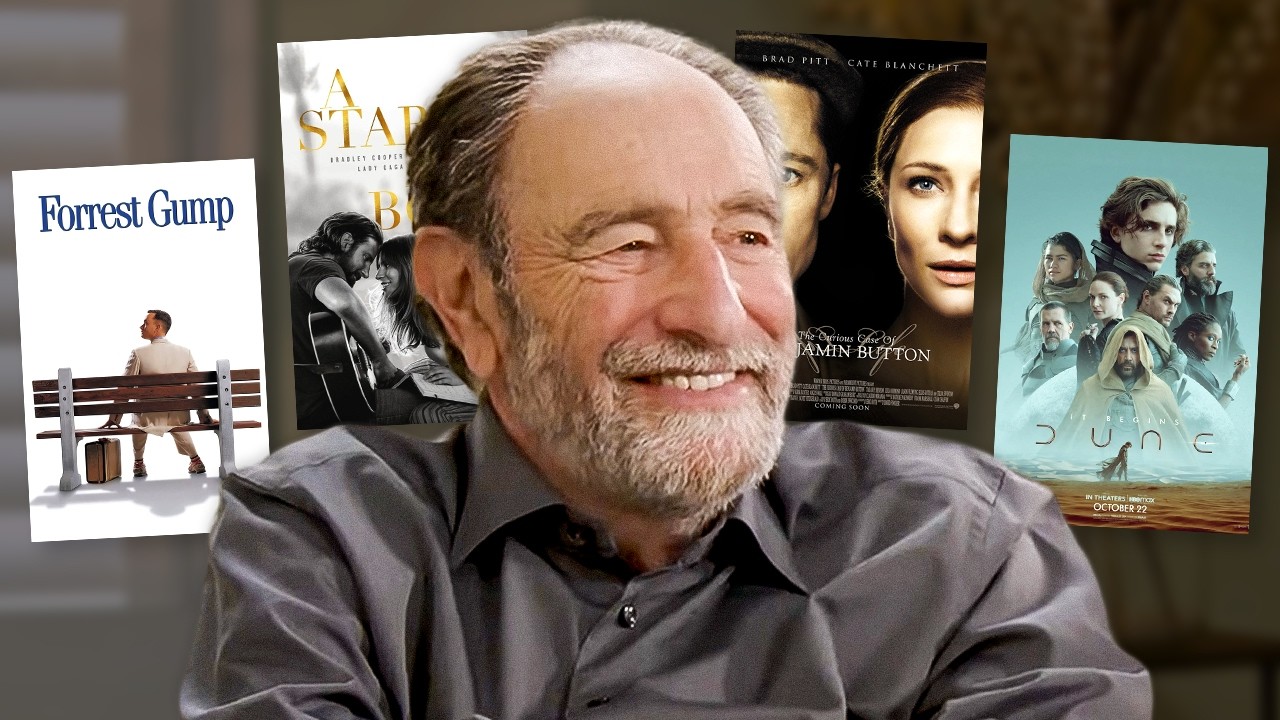
Eric Roth is one of the most celebrated screenwriters alive, with seven Oscar nominations and a win for Best Adapted Screenplay for Forrest Gump. He also wrote Dune, The Curious Case of Benjamin Button, A Star Is Born, Killers of the Flower Moon, and Munich, among many others. In this conversation, he walks through his creative process: how he builds characters, finds themes, writes dialogue, collaborates with legendary directors, and revises relentlessly. The thread running through everything is his commitment to emotional truth, simplicity, and humanity, even inside stories that are structurally fanciful or melodramatic.
Writing Process and Daily Discipline
Roth writes every day, always starting from page one of his script, even after the first draft is done.
He calls this process “erosion” — going back to shore up what’s falling down, fixing what feels tired, and making everything as imaginative and alive as possible.
He never experiences writer’s block. Every day feels like an adventure because he genuinely loves writing.
He sees himself as a frustrated novelist — his screenplays are often long because he writes extensive prose and narration, not just dialogue. Brad Pitt once joked during a Benjamin Button read-through that Roth had a “prose boner.”
He still writes on an old DOS-based program with no internet access, which runs out of memory around 40 pages. He prints constantly to avoid losing work, and his assistant retypes his edits.
Character Psychology and Backstory
Roth builds every character from a detailed psychological backstory, even if most of it never appears on screen.
He learned this from watching Michael Cimino give Mickey Rourke a wallet full of character details for Year of the Dragon — a photo of a supposed daughter, a crumpled phone number, a favorite saying. Rourke may never have looked at it, but he carried that life with him.
Every character must have a distinct voice and psychology. They should feel singular, not interchangeable.
He writes character backstories as aggregate lives — small, specific details that add up to a full human being.
Research and Specificity
Roth is a voracious researcher. Before the internet, he filled sheds with research books. Now he uses the web constantly.
For Benjamin Button, he read books about the Darwin Awards (people who died in absurd ways) and humanized four of those real cases — including a man struck by lightning seven times.
He researched whether a tugboat ever rammed a submarine in World War II. It did. He found a man in Massachusetts who built tugboat models and gave him the details.
For his current Scorsese project about the mafia arriving in New Orleans in 1890, he learned that streetcars existed there as early as 1840 and that Sicilian citrus wars were settled by placing a lemon on top of the victor’s gate.
He doesn’t take obsessive notes — just highlights that remind him what he needs, sometimes single words like “tension.”
Theme as the Backbone
Roth always identifies the theme of a movie before or during writing. It’s the anchor he returns to whenever a scene feels inert.
If a scene isn’t working, he asks: how does this relate to the theme? He can go far afield or stay close, but the connection must be there.
Forrest Gump is about destiny versus randomness — is life guided by fate or just chaos?
Killers of the Flower Moon is about justice — specifically, the absence of justice for the Osage people. One line he’s proud of: a character says you got justice, and the reply is that a jury is more likely to sentence a man for kicking a dog than for killing an Indian.
His current Scorsese project explores how people become what they were raised to be — Sicilians in the 1860s and 70s who were born into the mafia and could never leave it. A recurring line: “We do what we must.”
He has a discipline about themes — he can’t take a simple one and run with it shallowly. He has faith in the theme and sticks with it throughout.
Subtext in Dialogue
Roth believes great writing is subtextual — saying something through metaphor or indirection rather than stating it literally.
He cites Carl Foreman’s High Noon, where a judge tells a story about ancient Athens rather than directly explaining the danger Gary Cooper faces. It’s the same information, but layered and resonant.
He contrasts this with bad exposition, like “Good morning, Mr. Water Commissioner” — a line a director he worked with called the worst exposition ever.
His teaching example: instead of having a character say “I’m upset with my mother,” have them describe a dream. You get the emotional information, a fortune-cookie life lesson, and the possibility of surprise — all in one move.
He acknowledges this is very hard to do without becoming pretentious. The great writers — David Mamet, for instance — do it instinctively.
Creating Memorable Characters and Lines
Memorable characters come from a combination of voice, values, theme, and specific human details.
For Forrest Gump, he heard the character’s voice early — simple, aphoristic, rooted in a few core loves: his mother, Jenny, and something like God and America.
Bubba’s shrimp monologue (“Shrimp is the fruit of the sea. You can barbecue it, boil it, broil it, bake it, sauté it…”) was written collaboratively with his family on a vacation in Canada. He shouted “Give me shrimp dishes” and typed as they called them out.
“Life is like a box of chocolates” was not in the book. The book said “Being an idiot is no box of chocolates.” Roth changed it on instinct, even though he’s not sure it makes strict sense.
He’s proud of a letter Brad Pitt reads to his daughter in Benjamin Button — about how there are no rules, you can start over, you can be anything. People have made it into wall plaques and attributed it to F. Scott Fitzgerald, though Roth wrote it (the original short story was by Fitzgerald, but the speech is Roth’s).
He worries constantly about crossing the line from sentimental to cheesy. He doesn’t want to pollute the emotion.
Fanciful vs. Cartoonish
Roth calls his characters “fanciful” — they’re not realistic, but they take on reality during the two and a half hours you spend with them.
Forrest Gump is like Candide — a simple man moving through life, and what comes comes. It’s not sophisticated, but it feels human.
The line between fanciful and cartoonish is thin. The goal is for audiences to embrace characters as worth caring about, even if they’re not strictly real.
He thinks of characters as living on “the other side of the moon” — they exist in a parallel reality where they’re fully alive, even though they’re fiction.
Making Characters Likable (or Not)
Roth doesn’t believe characters need to be likable. Villains make great movies.
What matters is understanding what makes them tick — their psychology, their damage, their logic.
He admires Jack Thorne (Adolescence) for putting extraordinarily human moments inside dramatic situations — like a father being offered a stick of gum in a car, and the other person saying “You need it” because of his bad breath. That tiny detail makes you understand and care about the character.
Visual Writing and Atmosphere
Roth writes very visually. His scripts include tone, atmosphere, and sensory detail — not just dialogue and action.
He often specifies weather as a tool. If he’s stuck on a scene, he changes the weather — usually to rain. It unlocks new behavior: people put on coats, grab hats, move differently.
He’s deliberate about time of day. Melancholic scenes happen at dusk or dawn. He once quoted Lillian Hellman in a script: “Between the dark and the daylight, when the night begins to lower, comes a pause in the day’s occupation that is known as the Children’s Hour” — to capture that 5 PM moment in Brooklyn when mothers call their kids in for dinner.
He likes wind — clothes ruffling, windows rattling. It stops time and gives a feeling of place. He used this in the opening of Benjamin Button and in a current script set in a windy New Orleans church wedding.
He always knows his opening and ending scenes before writing. The opening must make the audience feel “at home” — comfortable enough to stay for two hours, even if the world is frightening.
Beginnings and Endings
Great openings compel you past page two. He cites “It was the best of times, it was the worst of times” and “Call me Ishmael” as examples of literary hooks that make you want to know more.
The Forrest Gump opening — a feather floating over a city — was tied to the theme of destiny versus randomness. Where will it go next? Just like everyone’s life.
He and Zemeckis considered ending Benjamin Button with newspaper obituaries of all the characters as the credits rolled — “Man killed, hit by lightning seven times” — but Fincher ultimately decided against it.
The only opening scene he ever wrote that changed was in Munich: Spielberg moved it from a Brooklyn street to outside the World Trade Center after the towers were gone.
Dialogue Craft
Roth writes dialogue by carrying the scene forward — presenting issues, moving the story, avoiding “shoe leather” (wasted time).
He learned from The Insider that sometimes one look from an actor (Pacino) can replace a page and a half of monologue. The director shot both versions; the look won.
He’s less interested in sparse, Hemingway-style prose than some writers. He uses more words than necessary, though he admires those who can say more with less — like Jonathan Franzen, whose sentences he finds breathtaking.
He believes the fundamental discipline of writing is putting one word in front of another, and hoping they’re the right words in the right order.
Rewriting and the Adventure of Creation
Roth finds rewriting less adventurous than first drafts. The first draft is the adventure of creating something new. Rewriting is improving what exists — more like work.
He outlines the middle of his scripts minimally — just one-word scene descriptions: “wedding,” “shootout,” etc. He discovers the story as he writes.
He always ends a writing day with a scene he likes, so he doesn’t face a blank wall the next morning.
He leaves himself notes constantly — in emails, texts, scraps of paper — because the writing is always evolving in his mind, even away from the desk.
Collaboration with Directors
Roth has worked with Spielberg, Scorsese, Fincher, Michael Mann, Bradley Cooper, Robert Zemeckis, and many others. He sees each collaboration as a marriage.
He links up with directors because they’re the ones who get movies made. He’s learned to find a “third way” — a solution both he and the director can agree on.
Spielberg has an incredible sense of entertainment and can orchestrate Rube Goldberg-like sequences where one action triggers a chain of consequences. He’s quiet and lives in his own world.
Fincher is tougher and colder but has a deep humanity. He took on Benjamin Button — an unusual project for him — possibly because of his own father’s death.
Roth recently ran a writers’ room for Ben Affleck (modeled on old Hollywood studio rooms), serving as “Yoda” to four TV writers. Guests included Fincher, Michael Mann, David O. Russell, Bradley Cooper, and Rob Reiner. The one thing every guest emphasized was authenticity — even in a Marvel movie, the emotions and behavior must feel real within that world.
Personal Life Feeding the Work
Roth’s films are deeply informed by his own emotional life — loneliness, grief, love, loss.
He lost both parents while writing Benjamin Button, and that grief permeates the film. A friend told him Gump and Button are the two movies that make him weep every time.
A critic once told him all his movies are about loneliness. He thinks that’s probably true.
He’s been divorced multiple times, has many children, and has had cancer three times. At a Writers’ Guild panel, the moderator opened by saying “I want to be Eric Roth,” and Roth replied that to do so, you’d need to have had cancer three times, been divorced, and suffered other tragedies — and the room laughed.
He doesn’t know if suffering makes the grief in his films more real, but he is moved by his own work. He wept watching Benjamin Button clips while preparing for this interview.
He never drinks coffee or liquor. He’s tried every hallucinogenic except LSD. He describes his life as a series of adventures, and he’s behaved badly at times, but he’s learned what he’s learned.
Creating Art That Lasts
Roth doesn’t know if you can design a film to last, but he has theories about why some do.
Forrest Gump endures partly because parents show it to their 11-year-olds, and the kids love it. (He didn’t realize until recently that Gump’s mother has sex with the principal to get Forrest into school — a detail most viewers miss.)
A Star Is Born has lasted because of the music and Lady Gaga’s performance. It outlasted Green Book, which won Best Picture the same year.
He’s uncertain whether Dune will endure the same way.
He believes certain things last because they tap into something primal — they stay in your soul.
Current Projects and Premises
He’s writing a script for Scorsese about the mafia arriving in New Orleans in 1890 — the origin of the American mafia. It includes a scene where the hero slits a rival’s throat during an opera performance, and the opera singer becomes a key witness.
He’s developing a Sydney Sweeney film based on a short story called I Pretended to Be a Missing Girl — about a down-and-out 20-year-old who scams a grieving family by pretending to be their missing daughter, only to discover the father is the actual villain who has the real daughter locked in the basement. He wants the father to be intelligently evil, like Hannibal Lecter.
He looks for premises that are juicy and buildable — ideas he can expand into something emotionally and dramatically rich. He’s also aware of his age (80) and wants to write things that can get made quickly.
What He Teaches Writers
The most important thing is to make the reader feel invited into the story — like they’ve found a home. If a script pushes the reader away, it fails regardless of its other qualities.
He encourages writers to write subtextually — to find indirect, metaphorical ways to convey emotion and information.
He tells writers to put one word in front of another and hope they’re the right words in the right order. That’s the whole game.