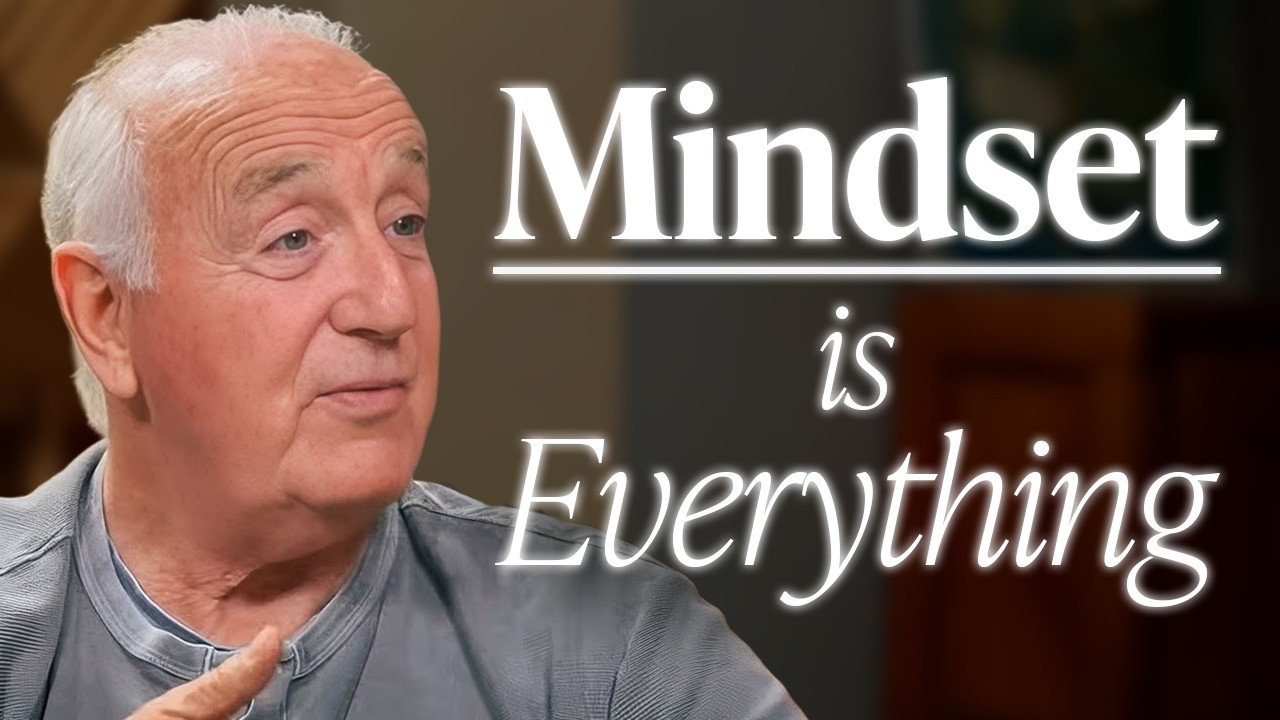
Steven Pressfield is a prolific author of 24 books, including The War of Art, Gates of Fire, and The Legend of Bagger Vance, who spent decades struggling in obscurity before finding his voice. This conversation covers his philosophy on writing, creativity, discipline, and the spiritual dimensions of the artistic process, drawing on his experiences as a failed novelist, screenwriter, and advertising copywriter.
The role of discipline over talent
Pressfield believes discipline matters far more than talent: someone with discipline but no talent is better off than someone with giant talent but no discipline.
Writing is a seven-day-a-week commitment for him; he works until he starts making typos, which signals mental exhaustion and diminishing returns.
He estimates a first draft takes about 400 hours, spread across roughly 20 weeks of focused work, and emphasizes that no one teaches the mental toughness required to sustain that effort.
He argues that writing is ten times harder than people expect, and that self-doubt throughout the process is not a bad sign—it’s a necessary companion.
First drafts and forward movement
His mantra for first drafts is “cover the canvas”—get paint on every part of it, no matter how bad it is.
He compares first drafts to blitzkrieg warfare: never slow down, go around obstacles, keep advancing even if you leave your rear exposed. Stopping to fight a war of attrition is the worst thing that can happen in both combat and writing.
He lets the “schmutz” pour out in early drafts, resisting the urge to delete or correct as he goes, because mistakes and detours can lead to unexpected creative breakthroughs.
Finding your authentic voice
Pressfield uses the metaphor of the “authentic swing” from The Legend of Bagger Vance: just as every golfer is born with a unique swing, every writer must find the voice they were born with, not some externally imposed ideal.
He spent years trying to write like other authors before realizing he had to surrender to his own nature—even if what came out seemed crazy or unmarketable.
He worries that the internet era, with its abundance of advice and comparison, makes it harder for writers to marinate in their own experience and develop truly distinctive voices, much like how modern golf instruction has made swings more uniform and less individualistic.
The spiritual dimension: Neshamah and the Muse
Pressfield draws on the Kabbalistic concept of Neshamah—the soul or higher self—to describe the source of creative inspiration. He believes inspiration comes from a higher plane and that the artist’s job is to be a ready instrument for it.
He recites the Invocation of the Muse from Homer’s Odyssey before each work session, putting himself in service of whatever higher force is at work.
He sees a reciprocal relationship: when the artist reaches up in prayer, the Neshamah reaches down to help. The creative world is not a void but a living thing with forces working both for and against the artist.
He describes his own version of prayer as asking for “make it obvious”—and when it works, the answer arrives as a simple one-liner with bullet points, airdropped into his mind with clarity.
Resistance and self-sabotage
The central villain in all of Pressfield’s work is Resistance—the internal force of self-sabotage, doubt, and procrastination that keeps people from doing their most important work.
The more you love something, the more Resistance you’ll feel, which is actually a signal that you must do it.
He identifies unnamed skills that no school teaches: negative capability (Keats’s term for advancing through doubt), the ability to abandon sunk costs and go back to square one, and the discipline to work alone in a tunnel with no external validation.
He compares the creative journey to Michael Jordan’s evolution: raw talent was never enough; Jordan had to develop leadership, toughness, and the willingness to let others take the last shot.
Storytelling principles
Pressfield learned story structure during a decade-long career as a screenwriter, internalizing beats like act breaks, midpoints, and the “all is lost” moment.
He insists every story—fiction or nonfiction—needs a hero, a villain, a theme, an inciting incident, and a climax. Even in nonfiction, there must be a villain (in The War of Art, it’s Resistance).
One of his key principles is “the female carries the mystery”: in stories like Chinatown, Moby Dick, Lawrence of Arabia, and Seven Samurai, the feminine element (a woman, the sea, the desert, the rice fields) embodies the unsolvable mystery at the heart of the narrative—life, death, creation.
He believes heroes must suffer because suffering produces learning, and audiences are inspired by watching characters endure and overcome.
He always starts with the climax and works backward, building toward a moment that is both surprising and inevitable.
Fiction versus nonfiction
In nonfiction, Pressfield’s ideas are usually clear before he starts; the challenge is organizing them. In fiction, the story evolves unpredictably, with characters and plotlines that require constant experimentation.
He sees fiction as a giant machine with millions of interlocking parts, whereas nonfiction is more like constructing an argument from pre-existing ideas.
He believes the same storytelling principles apply to both: narrative structure, conflict, and emotional arc are universal.
Editing and self-editing
Self-editing is extremely difficult without an external editor. Pressfield misses having an editor who would send him back to square one with insights he couldn’t see himself.
He puts himself in the reader’s perspective during edits, sometimes imagining specific friends reading the piece and asking whether they’d be bored or engaged.
Editing progresses from big structural changes (an axe) to fine word-level adjustments (a chisel) across multiple drafts.
He describes a recurring phenomenon: thinking a project is finished, then realizing on a trip or after a break that something fundamental doesn’t work and having to start over.
Practical habits and boundaries
He compartmentalizes his time, giving full attention to writing, then to emails and agent calls, without overlap.
He advocates for saying no to protect creative time, citing Tim Ferriss’s “vitamin N” (the ability to say no) and Charles Dickens’s explanation that even a one-hour lunch breaks up an entire morning.
He acknowledges the challenge of saying no gracefully—some people who protect their time well come across as assholes, and he’s still figuring out how to do it with tenderness.
The 60 scenes method
Borrowed from screenwriting, this method involves mapping a story across roughly 60 index cards (3x5), each representing a scene.
He uses a “clothesline” approach: start with a few key scenes (often the ending), then fill in the blanks by asking what must happen to get from one to the next.
The cards are constantly revised—replaced, removed, or reordered—as better ideas emerge.
Style and craft
Pressfield believes each book dictates its own style. The War of Art demanded a tough-love tone; Gates of Fire, set in ancient Greece, required a formal, archaic style reminiscent of early 20th-century Oxford translations.
He sometimes makes up foreign-language words (with help from a classicist friend) to give historical fiction an air of authenticity.
He admires old dictionary definitions (like Webster’s 1913) for their depth and beauty compared to modern blandness, and he appreciates the etymology of words like “inspire” (connected to breath and spirit).
Copy work and learning from masters
Early in his career, Pressfield copied pages of Henry Miller and Hemingway on a typewriter, believing that physically writing great prose sinks in at a deeper level than reading alone.
He cites Hunter S. Thompson rewriting The Great Gatsby in its entirety to feel what it was like to write a great novel—even though Thompson’s eventual style was nothing like Fitzgerald’s.
He compares this to athletes studying film frame by frame; modern players like Jayson Tatum can achieve in their rookie year what used to take a decade, because technology allows deeper observation.
Luck and perseverance
Pressfield acknowledges the role of luck—getting the right agent at the right time, a manuscript landing in the right hands—as something entirely outside a writer’s control.
He spent roughly 35 years struggling before publishing his first book, working jobs that “only required a pulse” while carrying a typewriter he never touched.
His breakthrough moment came when he sat down in a $15/month sublet in New York, wrote garbage, washed dishes, and realized he was whistling—a sign he had turned a corner.
He compares his trajectory to Robert Greene’s: both worked countless odd jobs, tried and failed at screenwriting and novels, and eventually found their authentic voices through a combination of persistence and fortunate breaks.
The story of Christ as ultimate narrative
Pressfield sees the Christ story as the most resonant narrative ever told because it captures the interface between the mortal and the divine, and the pattern of death and resurrection that mirrors every human life.
He notes that when the divine appears in human form, we “nail it to a cross”—citing Lincoln, JFK, RFK, Gandhi, and Martin Luther King as examples of figures who were destroyed for embodying something transcendent.
The resurrection represents the “all is lost” moment in storytelling—the point where the hero hits bottom and can only solve the problem through spiritual rather than material means. This pattern appears in AA testimonials, addiction recovery, and personal transformation.
The Daily Pressfield
Inspired by Ryan Holiday’s The Daily Stoic, this book offers 373 lessons structured as a day-by-day companion for creative projects.
It’s designed to be kept beside the writer’s desk, addressing the specific moments of self-doubt and Resistance that arise at different stages—end of act one, middle of act two, right before the end, after completion.
The first entry is titled “Resistance Wakes Up With Me,” and the book walks the reader through an entire project from fade-in to fade-out.
How writing found him
Pressfield never wanted to be a writer as a child. He fell into it at age 22 because he thought it was easy, after seeing his advertising boss write a novel.
He describes entering writing “for the wrong reasons” and spending decades running away from it in shame after failing to produce anything good.
Writing ultimately became the only way out of his “paper bag”—not a calling or a compulsion, but the one thing that kept him sane and gave him hope, even when he never expected to break through.