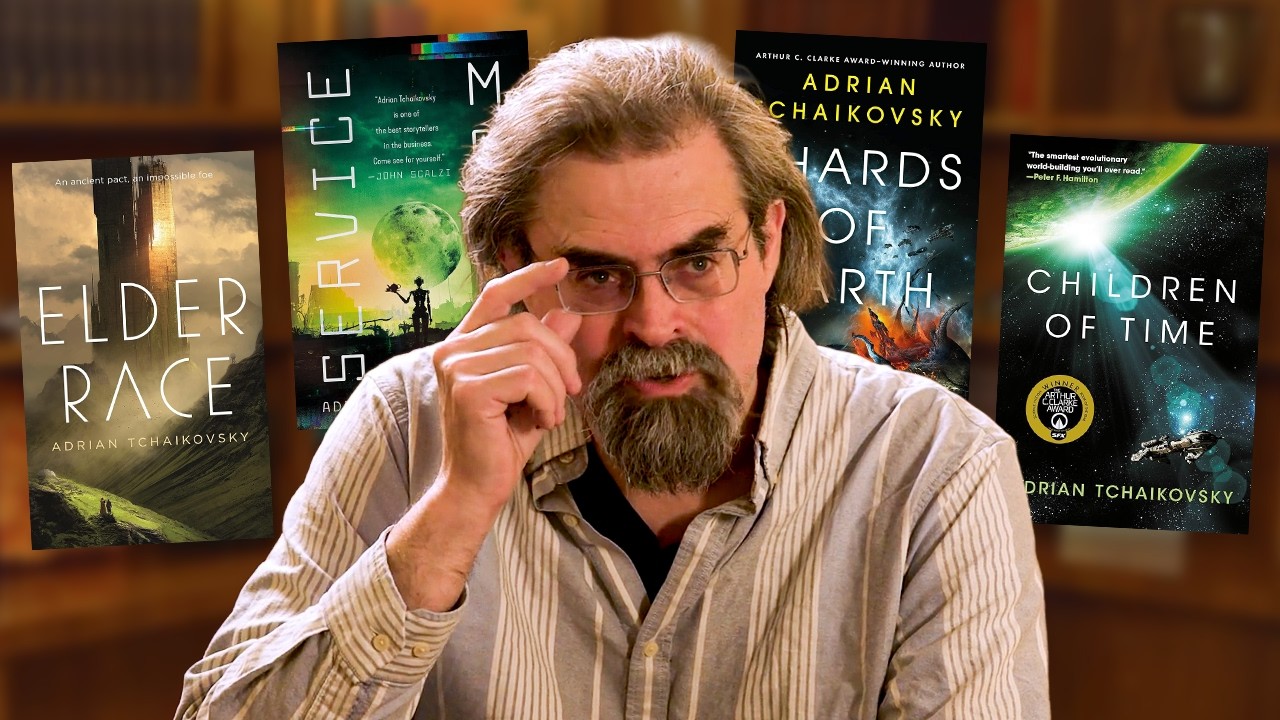
Adrian Tchaikovsky is a prolific science fiction and fantasy author (over 60 books, Arthur C. Clarke Award winner for Children of Time) who discusses his approach to writing imaginative fiction, covering worldbuilding, character creation, fight scenes, and the craft of storytelling.
Planning and worldbuilding
Tchaikovsky plans his novels in advance, a habit drawn from running tabletop role-playing games, where worlds must be robust enough that players cannot break them.
This translates directly into fiction: he builds worlds that feel immersive and complete, extending well beyond the boundaries of any single story.
He typically produces a detailed chapter-by-chapter Word document outlining what happens in each chapter and even which pieces of information must be exchanged between characters and when, because getting information to the right place at the right time is roughly 90% of planning.
He works linearly through the outline, though he allows himself to deviate during writing when better ideas emerge or when logic breaks down.
He once reached three-quarters of the way through a book and realized the entire plot had been rendered pointless by the ending, requiring a major rewrite.
He deliberately does not plan his endings, letting the momentum and trajectory of the book determine how it concludes, which gives the ending an organic inevitability he could not impose artificially.
Worldbuilding as the foundation
His process starts with a “what if” question, which he treats like a stone dropped into a pool: the ripples spreading outward represent chains of logical consequences that build the entire world.
A good “what if” must be original enough that he can find his own unique spin; he avoids crowded idea spaces (like dragons) unless he has a genuinely fresh take.
He often has many “half-book ideas” that only become complete novels when two or more click together, such as uplifted octopuses plus an alien creature that interfaces with human neurology forming Children of Ruin.
He builds worlds from the ground up so that by the time he begins plotting, the world has a solidity and robustness that prevents narrative collapse.
The world itself generates the story: its inherent flash points, pressures, and fractures dictate the plot and give rise to characters organically.
He distinguishes between hard science fiction (bound by the “left wall” of what science says is possible) and fantasy (where the author builds the logic by hand), with a continuum between them.
Moving toward harder science means accepting constraints (no time travel, no faster-than-light travel without justification); moving toward fantasy means more narrative freedom but requires internally consistent rules.
Magic in fantasy almost always demands a price because costless magic eliminates narrative tension and makes every problem trivially solvable.
Characters
Characters grow out of the world rather than being imposed on it; by the time a character emerges, they already have strings connecting them to every other part of the setting.
Characters surprise him as they develop, revealing depths, relationships, and motivations not present in the outline, often filling gaps in ways his subconscious recognizes before his conscious mind does.
He resists the idea that science fiction has a special problem with flat characters, noting that criticism of the genre is harsher than for other genres where similar weaknesses exist.
He inhabits characters by putting on a kind of “mask” or filter, seeing the world through their perspective, a technique drawn from tabletop role-playing games.
Cities versus travel narratives
He favors city-based settings over the travelogue structure common in fantasy because residents cannot walk away from the consequences of their actions.
This creates a more complex, interwoven narrative where characters have pre-existing relationships with each other and with factions, producing a web of associations that drives the plot.
It requires more preparation (knowing who hates whom, who is allied with whom) but is commensurably more rewarding.
Research and scientific plausibility
For science fiction, he consults subject-matter experts to work out the implications of his premises, such as a submarine designer to understand the physics of water-filled spaceships in Children of Ruin, or entomologists at the Natural History Museum to determine plausible spider sizes and behaviors.
Scientific plausibility matters because it gives the story weight and gravity: readers come away feeling “this could really happen,” which is the effect he seeks.
Children of Time was inspired by real research on Portia labiata, a jumping spider species of remarkable intelligence, and the book’s spiders are kept within real physics limits.
He relies on the “one big lie” principle: the story gets one major conceit (in Children of Time, the nanovirus accelerates evolution from hundreds of millions of years to tens of thousands), but everything else must be as true as possible to support that lie.
Fight scenes
His approach to fight scenes is informed by years of stage combat, live-action role-playing, and historical broadsword training.
A good fight scene requires understanding perspective and flow: the chaos and panic of being in a fight, not just the technical details of swordplay.
He uses different techniques for different scales: large battles seen through a narrow, disorienting viewpoint (as in Joe Abercrombie’s The Heroes), skirmishes requiring logistical planning (he once mapped one out using his son’s toy insects), and duels where precise technique and character expression matter most.
The most important rule: learn everything about how fights actually work, then put as little of that knowledge on the page as possible, letting it inform subtle details rather than turning the scene into a fencing manual.
Fight scenes should advance character and narrative, not just describe action; a skilled fighter choosing not to kill someone, and dying as a result, is character development expressed through combat.
Post-tech societies and information asymmetry
He is drawn to post-tech settings, where characters live in the wreckage of a forgotten past, because they carry a sense of tragedy and grandeur.
These settings create a three-sided knowledge structure: what the author knows, what the character knows, and what the reader knows, and playing with the gaps between them generates tension and emotional impact.
In City of Lost Chances, multiple characters may possess a missing item, but none admit to having it, and the reader must deduce who does (Tchaikovsky himself did not decide until late in the writing process).
In his Expert Systems novellas, readers understand the colonial origins of a planet’s inhabitants long before the characters do.
In Dogs of War, the narrator is a bioengineered dog who cheerfully describes committing war crimes without understanding what he is doing, creating agonizing tension between the reader’s knowledge and the character’s innocence.
Improving as a writer
He improves by setting specific craft goals for each project, such as writing a mosaic narrative with interweaving character threads (City of Lost Chances) or attempting to evoke a sense of the numinous inspired by Robert Holdstock’s Mythago Wood and Susanna Clarke’s Piranesi.
He finds it more useful to read contemporary peers than canonical classics, since current writers are already building on the same foundation of past work and are pushing into new territory.
He works to connect readers with characters’ emotions by inhabiting each character’s perspective fully, treating even minor characters as real people with wants and fears, which allows readers to feel along with them.
Endings
The ending is the most important part of the book because it is what readers are left with.
A good ending must feel both surprising and inevitable: the logical result of everything that came before, yet not obviously foreseeable during the reading.
He achieves this by refusing to plan endings in advance, letting the accumulated motion of the story carry him to the only ending the book can have at that point.