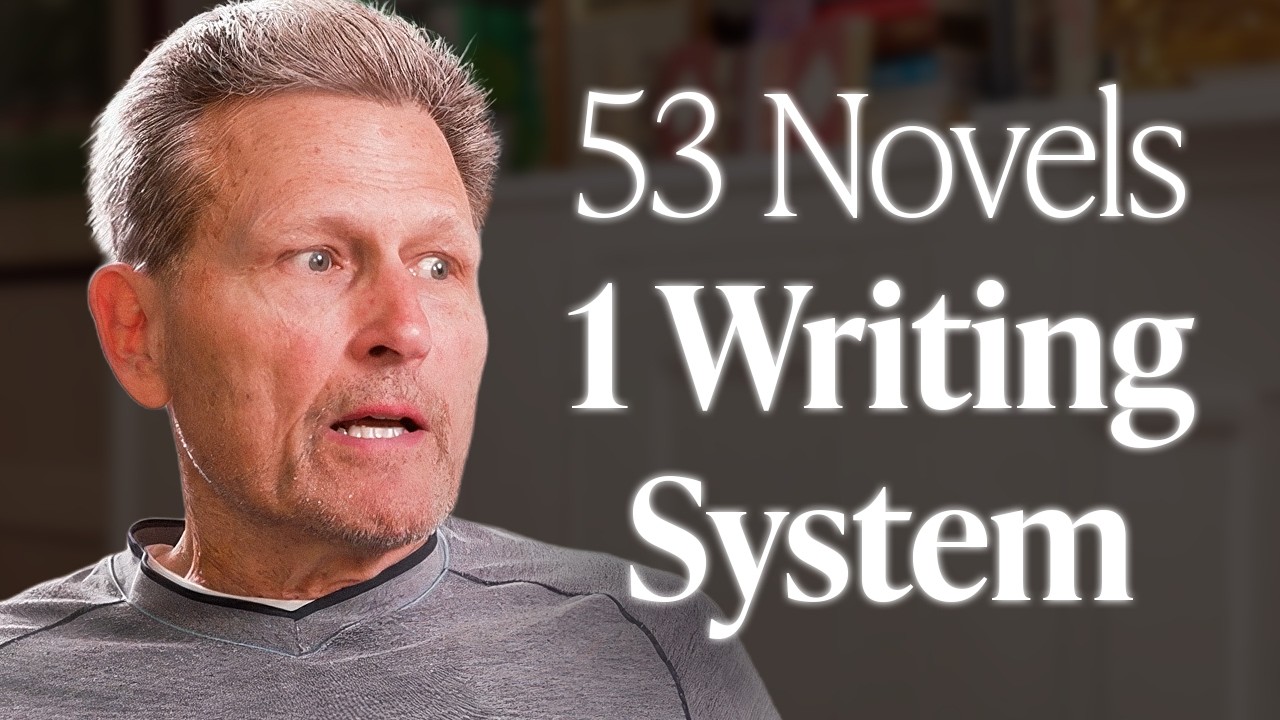
- David Baldacci — 53 novels, seven children’s books, 200M+ copies sold, former lawyer — shares his integrated approach to writing craft and publishing business, revealing how he builds tension, develops characters, structures novels without outlines, and negotiates partnership deals that changed author economics.
The “Big Pop”: Seizing Narrative Control from Page One
- Baldacci opens scenes with deliberate ambiguity, inviting readers to form assumptions, then subverts them with the least likely outcome — e.g., two bodies in a house assumed connected turn out to be unrelated murders with different killers.
- This “big pop” breaks the reader’s predictive confidence: “You’re not going to figure any of this out. Sit back, relax, don’t second guess me anymore.”
- Readers of mysteries/thrillers pattern-match from genre familiarity; the big pop exploits that by going three layers deep where the reader only went one.
- Making readers wrong early earns their full, undivided attention for the rest of the book.
Writing Process: Linear, Outline-Free, Edit-Heavy
- No outlines, no jumping around — writes page one to the end linearly: “I take my first step and keep going.”
- Outlines feel like practice (Tom Brady in drills); real writing is game day — decisions matter in the moment, no kicking cans down the road.
- First drafts are overwritten; the heavy lifting is editing: moving scenes, cutting, adding, usually deleting.
- No universal template — the best process is whatever works for that story in that moment.
Character: Baggage, Arcs, and the Two-Layer Engine
- Every series character carries plot-irrelevant baggage: Sean King & Michelle Maxwell (failed Secret Service careers), Amos Decker (brain trauma, hyperthymesia, lost family), Atlee Pine (twin sister kidnapped at age six).
- Two-layer engine: external plot unwinds and character evolves across books — readers want to see suffering, redemption, fighting back toward normalcy.
- Characters aren’t robots serving plot; they grow during the plot. Arc means change.
- Primary, secondary, peripheral characters all get deepened — even NPCs. Minor players with texture make the whole novel feel more forceful.
- Flexibility: Camel Club members shift between primary/secondary roles across scenes.
Dialogue as Precision Tool, Not Filler
- Hates lengthy dialogue — “lazy writing.” Dialogue must advance action, reveal character, or deliver necessary information.
- Amos Decker: man of few words, each carefully chosen. “When he speaks, it matters.”
- Gettysburg Address principle: 277 words, every word earned its place. Two-hour predecessor forgotten.
- Film adaptation example: cut nine lines to one for an Oscar-winning actress — let performance carry the rest. In prose, a precisely built character lets one line do the work of ten.
- Current goal: if it used to take 100 words, write it in 10. “The hundred is just lazy writing.”
Stakes: Matching Motivation to Magnitude
- Grand stakes (meteor, 24-hour clock) are readymade; subtle stakes require deeper architecture.
- Walter Nash series: businessman achieves American dream, then FBI reveals his company is criminal — cooperate and lose everything, or refuse and lose everything. Thematic resonance: doing everything right and still getting knocked down.
- Rule: magnitude of action requires matching motivation. If a character does something incredible, the why must be equally powerful, or readers reject it.
- Family as universal stakes engine: “You don’t pick your family. All families are dysfunctional.” Early imprints define us; sibling dynamics replay instinctively for readers.
Scenes: Multi-Purpose Building Blocks with Micro-Timing
- Screenplay discipline: every scene needs at least two purposes (advance plot, flesh character, deliver info). Gratuitous scenes cut.
- Research: leave 99% out. “Otherwise you’re writing a textbook.”
- Scene order rearranged in editing — micro-timing: releasing information a few beats later can transform impact.
- “Pen ending” technique: near deadline, submit a placeholder ending with 4–5 plausible scenarios, then step away. Subconscious solves it (often in the shower).
Research: Hardware and Software, Done Personally
- Hardware: parachute towers, Army functional fitness, police walk-alongs in high-crime areas.
- Software: talking to people away from the job — e.g., 18-year-old volunteering for Iraq combat. “Why?” builds fuller, honest characters.
- No research assistants — body language, perspective, what draws your eye can’t be delegated.
- Noticing: conscious + subconscious. Walks with notebook per project — jots feelings about observations, not just observations. “I wake up every day and walk out the door.”
Business of Publishing: Partnership Over Royalties
- Core mantra: “No one should make more off the book than the person who wrote it.”
- After building fanbase and leverage, switched from 15% royalty (effectively 30% of publisher’s net) to profit-sharing partnership: publisher gets 30% return on investment, author gets the rest.
- Standard deal math: $30 hardcover → publisher sells to wholesaler for ~$15 → author gets 15% of $30 = 30% of publisher’s take. Publisher keeps 70% minus print/distribute costs.
- Under royalty model, publisher could make $30M on a book while author never earns out advance. Baldacci left “nine figures on the table” before switching.
- Negotiation vectors: multi-book deals (6 books/3 years at 2/year), genre-specific terms (historical detective vs thriller), advance vs backend, timing (Christmas vs spring/summer), marketing commitments.
- Two hats: content creator and business person. Ignoring business kills careers — publishers’ marketing plans stagnate, placement drops, timing misfires.
- Lawyer’s lesson: read the damn contracts. Ignorance is no excuse after signing.
Premise, Zeitgeist, and Jacket Copy
- Premise must resonate now: “I want people to feel like this matters for my life right now.” Next book tackles AI concentration risk.
- Jacket copy rewritten personally — first thing readers see in store. Cover + copy = enticement.
- Premise often emerges from unanswered journalistic questions: Pandora/Panama Papers revealed $30T dark money but not what they do with it → The 6:20 Man (buy power at every level).
- Let ideas percolate longer now — used to pull trigger too soon, write into walls. First chapters are the most fun: “everything is new.”
Short Stories as Novel Training Ground
- Short fiction has all novel elements (plot, character, dialogue, narrative) in 7 pages vs 400 — less daunting, can’t get ahead of skis.
- “Would you try an 800-lb squat on your first gym day?”
- Novel difficulty: multiplication tables → physics. Short story = shallow end (see bottom). Novel = 12 feet deep (can’t see bottom, terror of drowning).
- Solution: write novel as series of connected short stories. Firm edges first (puzzle border), work inward. Homicide investigation model: real cops go inside-out; writers go outside-in.
- Historical fiction research: one day in character’s life (Joyce’s Ulysses method). Archer 1950s series — 1958 LA via Etsy period gas map (Bible for geography); 1953 Vegas via frame-by-frame YouTube home movie of Strip drive.
Detail Calibration: Atmosphere Without Ego
-
3–4 sentences of description → page flip. Research ego makes you want to keep it all; editing cuts it.
- Sometimes write it just to get it out, knowing it’ll be cut. Or slash and move to where it fits.
- Producer/director test: “Why does this scene have to be in the film?” If you can’t answer, cut it.
Screenplay vs Novel: Economy vs Depth
- Screenplay teaches economy, cleverness — get from A to B in a paragraph or a gesture instead of a page.
- Novel allows fuller characterization (400 pages vs 100). But screenplay has actors: one line + Ellen Burstyn’s eyes = nine lines of dialogue.
- Great Gatsby: Nick’s interiority in book; Gatsby’s grandeur visual in film. Fitzgerald’s visual prose = director’s catnip.
Character Over Plot: Vulnerability as the Engine
- “I want to get as far away from perfection as I can.” Vulnerable, fragile, uncertain, self-doubting.
- Military analogy: they break you down to nothing, rebuild as war machine. Baldacci does the opposite — put characters through the wall, see what emerges.
- Best novels: egregious loss, knocked flat repeatedly. Real character shows in response — getting back up.
- “You never know the real person if you’ve only seen them in good times. Bad stuff is interesting. Good stuff is granola.”
Mystery Planting: Variable Success, Reader Feedback Loop
- Success varies book to book. Sometimes nailed it; sometimes telegraphed. Causes: mindset off, character-plot mismatch, or just whiffed.
- Post-book breakdown: game film + reader emails + friend reactions. If enough readers saw it differently, that’s the author’s problem.
Motivation: Passion Tank Must Be Full
- “If I am fascinated by what I’m writing about, everyone else will be fascinated too. If I’m not interested, nobody else will be either.”
- Waits until committed and excited. Doesn’t count pages/words. Writing fast = cylinders clicking = writing well.
- Knowledge pots: learns something new daily across huge spectrum. Originality = combining unique knowledge pots (C-164 + Cyrillic = new story).
Emotional Sequencing: The Roller Coaster’s Few Peaks
- Finite setups where you “go for it.” Can’t keep reader at top of roller coaster — must bring down, build slow, then release.
- Those moments are electrifying, giddy — “I’ve been waiting 300 pages to unleash this.”
- Post-peak crash: high then low. Every book needs at least one. Requires balls to execute + knowledge that opportunities are rare.
- Slow down execution: “I don’t do that by rushing. I do it by slowing it down.” Like life’s milestone moments — first communion, degrees — few, precious, stretched.
Children’s Books: Same Craft, Different Vocabulary
- Only difference: word choice. Kids are sophisticated — write down at your peril.
- Faster hooks: no 50-page buildup for 14-year-olds unless 50 perfect pages.
- Suspense via anticipation, not explosions. Hitchcock: never show the smash, lead imagination. Unforgiven gut-shot scene: 5 minutes watching a man die — consequences for killer and victim. “Best action is when you slow it down. When you speed it up, people miss the impact.”
Reading Masters, Not How-To Books
- Self-help writing books = “I can’t write a real book so I write a self-help book.”
- Read for pleasure, then ask: “Why was that great?” Reverse-engineer in situ — see the movie acted by great actors.
- Great books grow with you: To Kill a Mockingbird = adventure at 10, racism/justice at 20. Maturity always in book; you catch up.
- Books as armor: grew up in segregated Richmond. Mark Twain: “Travel is fatal to prejudice.” Books = travel without passport. “Books are like body armor against bigotry. They just are.”