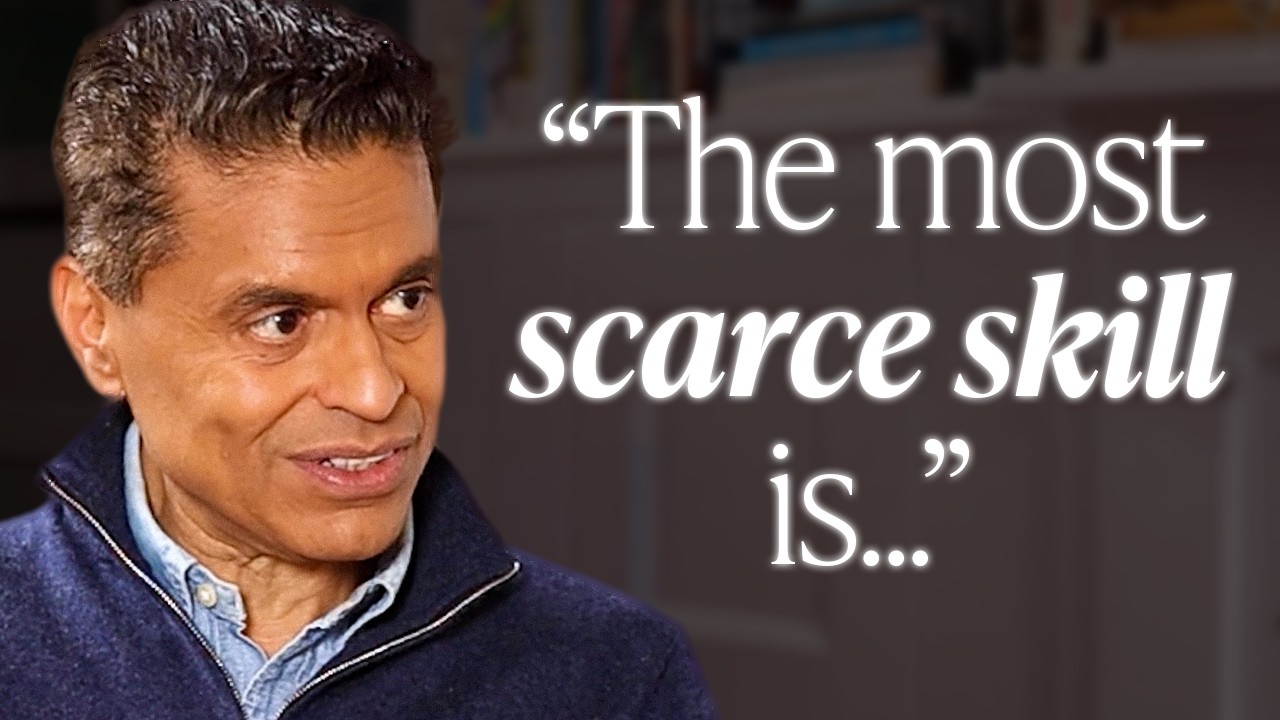
Fareed Zakaria is a journalist, author, and TV host who has spent decades writing columns, books, and hosting GPS on CNN. This episode is a deep dive into his philosophy and practice of writing: how he structures his routine, what he believes makes a good take, how he thinks about books versus articles versus television, and what skills he believes will remain uniquely human in an AI-driven world. The conversation is wide-ranging, touching on craft, mentorship, travel, reading, and the emotional dimensions of communication.
The role of books in Fareed’s life
Books are Fareed’s most important professional output after his family, because they take years of deep work and become part of his identity.
He writes books out of two motivations:
Guilt — a sense that real intellectual work requires producing books, not just columns or TV segments.
Learning — writing a book forces him to read dozens of sources on a subject and synthesize them into his own analytic framework, which he finds deeply satisfying.
He describes himself as someone who loves having written more than the act of writing itself, which he finds painful and arduous.
For his most recent book, a single chapter on the French Revolution required reading roughly 20 books plus academic articles and translated primary sources.
Building a writing routine
Fareed’s mentor at Harvard, Samuel Huntington, would wake at 6 a.m. and work in his basement study for four hours before doing anything else. Fareed realized he lacked that self-discipline and needed external structure.
Journalism gave him that structure: weekly deadlines for 25 years have trained him to produce consistently. What once took half a week now takes about two hours.
Books are harder because they fall into the “important but not urgent” category. He has learned to plan them more deliberately:
He maps out each chapter’s topic and required research in advance.
He relies heavily on research assistants to gather and organize source material, a practice he has adopted more seriously in his last two books.
Fareed’s relationship with AI
He uses AI actively, especially for tasks like interpreting medical data, where it can synthesize vast amounts of information quickly.
He sees two distinct uses of AI:
AI as writer — generating text for you — which he rejects entirely.
AI as super-powered research assistant — which he finds useful but limited.
Key limitations of AI for deep work:
It lacks access to most books and paywalled sources, so it often relies on reviews or excerpts, producing work that can feel like a sophomore bullshitting.
Thinking is partly a process of reading, talking to people, and ingesting ideas — AI can’t replicate that journey because the destination isn’t known until you arrive.
AI can’t provide the intellectual courage to make an argument and put your reputation behind it.
The skill AI cannot replicate is judgment: knowing which of several defensible positions is the right one to advocate for at a given moment, and having the credibility and courage to stand behind it.
What makes a good take
The most important principle is value added: the audience is smart and informed, so you must tell them something they don’t know, give them a new analytic framework, or provide unfamiliar history or context.
A good take is structured as an exclamation point, not a period:
It must organize around one clear idea, not two or three.
It should be assertive and unsettling — grabbing the reader by the lapels.
This applies to columns and short-form writing in the 500–800 word range; longer essays (like those in the New Yorker or Atlantic) are a different category.
Writing for TV versus print
The core principles are similar for Fareed because his columns are already analytic, argumentative, and narrative-driven.
Key mechanical differences:
Subordinate clauses don’t work on TV — you must lead with the main clause.
Lists and certain written rhetorical devices don’t translate to the spoken word.
Longer spoken formats (like a 90-minute lecture to 3,000 people) are much harder and require constructing a chronological narrative with anecdotes and detours, more like a literary essay.
The case for TV as a medium:
It reaches people at scale and creates an emotional, personal connection that print cannot.
Regular viewers feel they know and trust the host, making the host a guide rather than just an analyst.
Fareed compares TV to Japanese haiku: few words, but arranged correctly they have powerful effect.
Politicians seek TV because people vote from the gut, not the brain — if you’re in the business of public education, you need to reach people emotionally as well as intellectually.
Tools for reaching the gut:
Fareed prioritizes authenticity over polish — he speaks conversationally, not in the clipped anchor voice.
He avoids putting on a persona and instead shares what he’s thinking as part of a conversation, which builds trust more than brilliant one-liners.
Fareed’s daily routine and learning process
There is no average day — his life is chaotic with travel, family, and multiple commitments.
The central activity is consuming knowledge: reading books, calling experts, and trying to understand issues from the ground up.
He delegates most of the TV production work (guest selection, segment editing) to his team and focuses his own time on thinking, reading, and writing.
He schedules blank time specifically for reading and research, protecting it from meetings and calls.
He works backwards from the present: he looks at what’s happening in the world, asks what the roots are, and then goes back to read historians or call experts as needed.
How he reads efficiently:
For most non-fiction books, he extracts the central argument by reading the introduction, conclusion, and key chapters — he can realistically crack a 600-page book in about two hours.
He rereads the books he considers truly great multiple times, which gives him an x-ray understanding of how the argument is constructed.
Books he has reread multiple times include Samuel Huntington’s Political Order in Changing Societies, Kenneth Waltz’s Man, the State and War and Theory of International Relations, and Steven Pinker’s 1688 (on the Glorious Revolution).
Deep reading also teaches him about the craft of writing itself — on second and third readings, he begins to see the underlying structure and mechanics of how an argument is built.
Lessons from reading fiction
Fareed came to America from India for college at Yale, where he encountered American literature — Hemingway, Fitzgerald — for the first time.
The Great Great Gatsby became a formative book for him: he read it as a story about the American dream, about aspiration, reinvention, and leaving the past behind — an immigrant’s journey.
His love of America, shaped partly by reading its literature, informs his work and his generally positive view of American power compared to other great powers in history.
He acknowledges that this view draws criticism from the left, but his analytic answer is that compared to the Kaiser’s Germany, Hitler’s Germany, the Soviet Union, Mao’s China, and the British and French empires, the United States has been the best superpower in modern history.
He felt genuine sadness when USAID was dismantled, seeing it as a point of pride that the richest country in history was also the most generous, saving millions of lives from AIDS and TB at very low cost.
Journalists and intellectuals Fareed admires
Walter Lippmann — the greatest American journalist of the 20th century, who co-founded The New Republic, wrote Wilson’s Fourteen Points, and was the most influential columnist in America through the 1960s.
Lippmann showed Fareed that a journalist could also be an intellectual, addressing daily issues while also thinking in broader, longer-term terms.
His book Preface to Morals, written in the 1920s, explored the modern loss of certainty in faith, tradition, and community — a dilemma that still resonates today.
George Will — admired for being both a journalist and an intellectual, with extraordinary clarity, polish, and economy of language that comes from thinking through writing.
Bernard Levin — a British columnist who wrote in a deeply personal style about his enthusiasms (operas, walking in the countryside), making everything interesting through authentic passion.
Building a unique point of view through direct experience
Fareed emphasizes the importance of going places and talking to people on the ground.
He recounts a conversation with the deputy managing director of the IMF, who said that within 24 hours of visiting a country, he realized his previous assumptions were wrong — something about being fully present and interacting with people for whom the stakes are real reveals what data cannot.
Fareed still travels extensively and uses trips to meet large numbers of people — breakfasts with six, coffee with two — building a network of contacts he can call when something happens.
Two anecdotes from London that revealed a ground-level truth about British pessimism:
A bouncer at his hotel, an Algerian immigrant of 25 years, said when he arrived people seemed generally happy to be in London; now people seem generally unhappy.
In a pub, when someone shouted that Britain’s second-largest city had gone bankrupt and said “at least in America they have jobs,” the entire bar fell silent in agreement.
He acknowledges the plural of anecdote is not data, but argues that data can also hide important things — like the geographic and demographic discontent that preceded Trump’s election.
He cites Ed Luce (FT columnist) and Chris Arnade (who walked forgotten American cities and interviewed people at McDonald’s) as examples of journalists who picked up on something the intelligentsia missed by going to places and talking to ordinary people.
The underlying principle is the map-territory distinction: all maps (models, data, frameworks) are simplifications, and you must constantly oscillate between the map and the territory to generate real knowledge.
Fareed’s study
After The Post-American World became a bestseller in several foreign countries, Fareed used the unexpected foreign royalties to build a custom study in his townhouse.
He worked with a Brooklyn woodworker to design it with English pine, featuring a rolling ladder (inspired by My Fair Lady) and a hidden desk behind mirrored pocket doors — because he is a messy writer who needs his papers out but wants the room to look beautiful when closed.
The experience reinforced for him how profoundly shaped environments affect us emotionally and creatively.
Kushwan Singh: Fareed’s childhood mentor
Kushwan Singh was India’s most prominent journalist and novelist (author of Train to Pakistan, the best novel about India’s partition). He worked with Fareed’s mother and became a mentor to young Fareed.
He taught Fareed the love of words and language, reciting poetry on nature walks and making Fareed memorize works like Wordsworth’s “Daffodils” and Byron’s “She Walks in Beauty” — poems Fareed can still recite decades later.
He also taught Fareed tennis and swimming, and modeled a rich, balanced life — professionally accomplished but also making time for nature, sport, and beauty.
Fareed contrasts Singh’s rounded life with his father’s driven, single-minded political career, and says he has always tried to maintain that balance.
Rapid fire: core lessons from different mediums
Books teach depth of understanding — great books reveal that complex phenomena have layers and layers of causation, and no simple answer is usually the full answer. You still need to be able to provide a simple construct, but you should know how complicated reality really is.
Articles are exclamation points — they must make one assertive, unsettling point that grabs the reader and tells them something they didn’t know. If you’re not doing that, you’re failing.
TV is about connection — quoting Maya Angelou: “Nobody will ever remember what you said, but they will remember how you made them feel.” The most important thing is the emotional bond with the viewer.
Watching himself on TV
For the first three years of his TV career, Fareed could not watch himself — it was awkward and undermined his confidence.
He eventually realized he would only improve by watching himself critically, so he began reviewing every show with purpose:
Noticing physical habits (like slumping) and verbal tics (ums and ahs).
Identifying the follow-up questions he should have asked.
He compares this to purposeful practice in tennis — you don’t improve by just playing; you isolate weaknesses and drill them deliberately.
How Fareed would teach a writing seminar
He would assign a great deal of excellent writing for students to absorb, rather than focusing on rules.
Key texts he recommends:
George Orwell’s “Politics and the English Language” — both for its lessons and as a model of beautiful writing about writing.
William Zinsser’s On Writing.
He believes writing is learned primarily through trial and error — doing it, making mistakes, and improving through repetition. This process cannot be short-circuited.
Closing reflection
The host shares a personal story: as a college student, he met Fareed briefly at a conference and was struck by the intensity of Fareed’s attention — 90 seconds of complete, focused presence that left a lasting impression.
Fareed responds that every person is interesting and has something to teach you — whether a peasant in rural India or a taxi driver. The skill is bringing that out of them, because everyone is an expert on something through their lived experience.