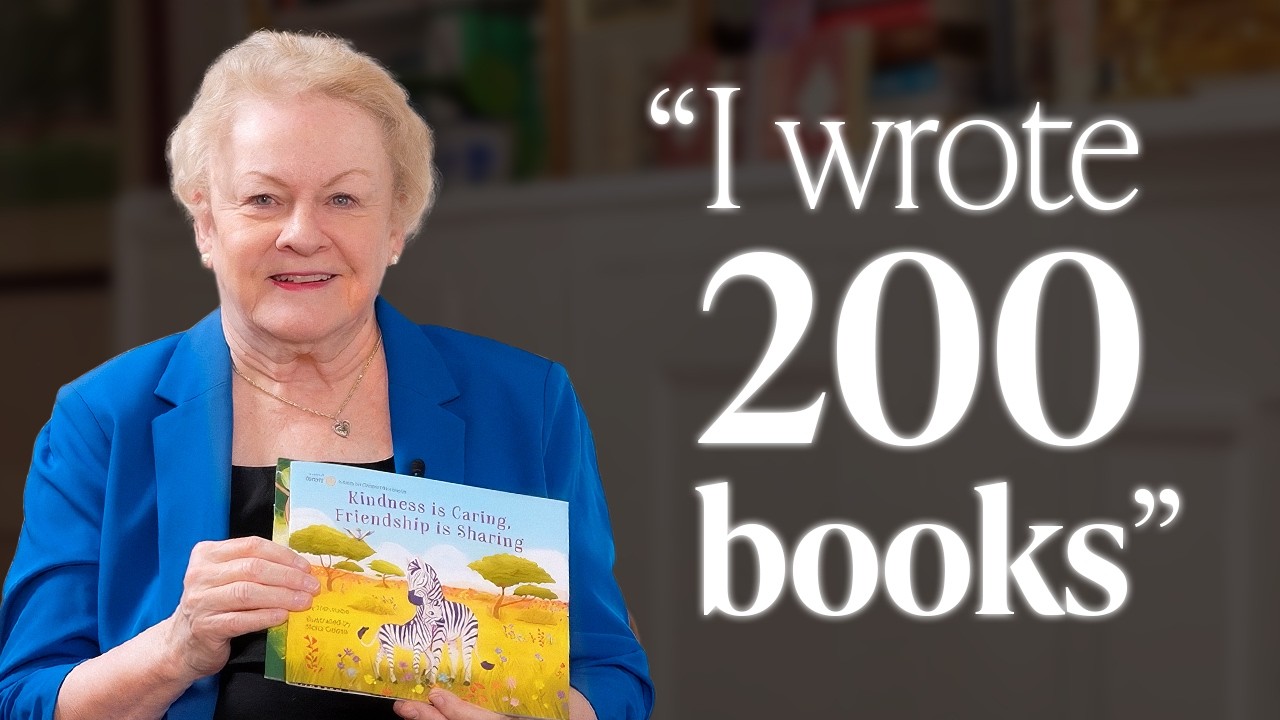
Tish Rabe has written over 200 children’s books across a 40-year career, including work for Sesame Street, Disney, and 53 books in the Dr. Seuss universe after his death in 1991. She started as a music production assistant on Sesame Street, where she sang with the Muppets and wrote her first book in 1986. In 2020 she founded her own company, Tish Rabe Books, taking control of the full production process from words to illustrations to printing and distribution.
Writing the ending first
Tish learned from the Sesame Street writers’ room to write the ending before anything else, because knowing the destination lets you work backward into the story and ensures every page is driving toward a meaningful conclusion.
For Kindness is Caring, Friendship is Sharing, written with the Trumbull Rotary Club, she wrote the final page first: the friends watching a butterfly fly by, reflecting that “kindness and caring, friendship and sharing are the best ways to start.”
The ending carries lasting weight in a children’s book because it’s the last thing a child hears before closing the book, going to sleep, or heading out to play.
Structure: beginning, middle, end
Tish thinks of every book in three parts: beginning, middle, end.
Beginning: Establish the setting and character. For the Rotary book she chose the African plains to reflect the organization’s international scope, and named the zebra protagonist Amani, which means “peace” in Swahili.
Middle: Introduce conflict. In that book, a hungry lion threatens the animals, who must cooperate to survive.
End: Resolve with emotional resonance. The zebras huddle together so their stripes blend, confusing the lion, and the story closes on a message of cooperation and kindness.
She urges writers to figure out character names early, because naming forces you to know who your characters are.
Hooking young readers
The most important thing is creating characters kids will like and want to follow.
Know your target age group. Tish distinguishes between zero to four (very few words, slow pacing, bedtime routines) and four to seven (more words, more complex stories).
Make characters slightly older than your audience. Kids look up to older children and want to be like them.
For the zero-to-four range, she wrote Sweet Dreams Ahead, Time for Bed, which includes a lullaby she composed: “Night is here, today’s done. It’s time to sleep, my little one.”
The power of the page turn
A page turn in a children’s book carries enormous weight compared to a novel, because there are so few pages and each one controls pacing and suspense.
In Sometimes Apart, Always in My Heart, a book for military families, she uses the page turn to build suspense around whether Daddy Bear is coming home. The child hears something outside, turns the page, and there he is.
She designs covers so characters face into the book, pulling the reader’s eye toward the first page turn.
Why animals?
Tish uses animal characters because they avoid the problem of real children not seeing themselves represented in a 24-page book.
Drawing real people is also much harder than drawing animals.
Animals let her tell universal stories without excluding anyone.
Working with illustrators
In traditional publishing, authors and illustrators rarely communicate directly. Editors manage the relationship to maintain creative control, especially on established brands like Dr. Seuss.
Tish has never met or emailed the illustrator of her Dr. Seuss books.
Since starting her own company, she now works directly with illustrators. She submits text with art direction notes (e.g., “Daddy Bear getting ready to go to work”) and the illustrator brings their own creative ideas.
A great illustrator’s most important quality is expression: the faces on characters should tell their own story. She points to a rooster hidden in a barnyard scene that children love discovering.
She starts with black-and-white sketches before committing to full color, which allows for adjustments before the illustrator invests hours in painting.
Editing and revision
Tish rewrites extensively before anyone else sees a manuscript. By the time an editor reads it, it has gone through many versions.
She has a professional editor, a Sesame Street veteran, who reads everything she writes.
Key tip: Have someone who has never seen the work read it aloud to you. You will catch mistakes, unclear passages, and rhythm problems you can’t see yourself because you’re too close to the material.
When her children were young, she had them read her Dr. Seuss books aloud. If they stumbled on any word, she changed it.
Writing from the child’s perspective
Tish writes from the child’s point of view so young readers can see themselves in the story.
In the military book, the final image is from the child’s perspective, being held by the returning parent.
She interviewed military families extensively and included their real coping strategies in the book, such as a father tracing his hand on paper so the child can give him a “high five” every time they walk past it.
A recurring theme across her work is the moon as a connection between separated loved ones: “Every time you see the moon with its glowing light, know I am safe and you are safe and everything’s all right.”
Rhyme and rhythm
Dr. Seuss used pure rhymes (cool/pool). Tish sometimes uses slant rhymes (go/home) when the word she needs has no perfect rhyme.
She wrote a marching cadence for the military book inspired by the rhythm of An Officer and a Gentleman: “I know we’re not together, but I’m here to stay. I’m always thinking of you each and every day.”
She sometimes invents words to solve rhyme problems. For a book about pets, she set the story in the town of “Gerplets” so she could rhyme with “pets.”
She used to rely on a computer program called A Million Gazillion Rhymes but after 40 years can generate rhymes mentally on demand.
Using public domain melodies
Tish frequently writes lyrics to well-known melodies like Twinkle Twinkle Little Star so children and parents can sing along immediately without needing to learn a new tune.
She confirmed with teachers in Uganda that Twinkle Twinkle Little Star is universally known, making it a reliable vehicle for songs in books intended for international audiences.
She wrote 15 different sets of lyrics to Twinkle Twinkle Little Star for various projects, including a Sesame Street book about Elmo’s first sleepover.
Educational content vs. story
The Dr. Seuss Learning Library books required Tish to research science topics at the library, simplify the concepts, and then render them in accurate rhyme.
When Pluto was reclassified as a dwarf planet, she had to rewrite the planetary mnemonic in There’s No Place Like Space from “Mallory, Valerie, Emily meets us just served up 999 pizzas” to “Mallory, Valerie, Emily Muckles just showed us 999 nickels,” and the illustrator had to redraw the page.
Even her story books carry educational messages. Bert and the Broken Teapot teaches that friendship matters more than things, and Oh, the Places You’ll Go for babies (Oh, Baby, the Places You’ll Go) was designed to be read in utero, based on research that newborns respond to voices they heard before birth.
The business of children’s books
Traditional publishing: Authors are paid either a flat fee (no ongoing income) or royalties. Tish receives royalties on her Dr. Seuss books, paid twice a year in February and August, with amounts that vary unpredictably.
Pricing: Children’s books average $9.99 to $12.99, much less than adult hardcovers, so volume matters.
Self-publishing lessons since starting Tish Rabe Books in 2020:
Choosing the right illustrator is critical and difficult. She works with two New York agencies and has sought artists from specific regions (e.g., an African illustrator for the Rotary book set in Africa).
She advises against self-publishing with illustrations already attached, because traditional publishers prefer to match text with their own illustrators and may reject a submission over art they don’t like.
Format decisions (square 8x8, rectangular 7.5x9, or oversized) affect what the illustrator can do with single pages versus two-page spreads.
Distribution is the hardest part. Getting on Amazon requires extensive verification. She also sells through her website, book fairs, and school visits.
She cautions against translating books into other languages unless you have confirmed distribution channels in that market, and she does not attempt to preserve rhyme in translations.
Overcoming creative blocks
Tish does experience writer’s counter to the myth that prolific writers never get stuck.
She builds buffer time into deadlines. If a book is due in June, she sets her internal deadline for May.
When truly stuck, she steps away entirely: “You cannot force it.” She recommends the “three Bs”: bed (sleep), bath (relax), and bus (go somewhere new and change your scenery).
Ideas often arrive unexpectedly. The concept for Mystic by the Sea came to her during a coffee shop meeting when she saw four seagulls fly overhead and imagined them as tour guides for the town.
Timelessness and legacy
Children’s books have an unusually long commercial life. Goodnight Moon (1947) and The Cat in the Hat (1957) still sell strongly.
Tish wrote two Teenage Mutant Ninja Turtles music videos in 1993. Decades later, a song from We Wish You a Turtles’ Christmas (“Got to Get a Gift for Splinter”) was licensed for the trailer of a new Ninja Turtles movie, generating significant income and an on-screen credit.
She tells her family that creative work you put into the world can resurface in unexpected ways, and that rights and royalties can endure for generations.