-
Ray Thompson, a leading non‑fiction storyteller, joins the host to dissect how great stories are built—from finding a compelling hook to nailing an ending—while sharing personal habits, the importance of structure, and the craft of reporting.
-
Why writing feels hard
- Bad writing is easy; the challenge is moving from “writer’s vomit” (over‑producing) to purposeful storytelling.
- Early tools and formulas help at first, but seasoned writers must unlearn them to let specific, universal truths emerge.
- A story must say something new that is both personal and resonant for the reader.
-
Finding the universal in the specific
- Extreme examples (e.g., Michael Jordan at 50) act as lenses for ordinary anxieties—identity loss, aging, the clash between public persona and private self.
- Profiles become mirrors for the writer’s own questions; the writer’s obsession with a subject fuels authenticity.
-
Writing routine & environment
- Thompson’s “good days” involve a ritual: school drop‑off, coffee/Guinness stop, then writing in a country‑side office, followed by walking around Oxford, Mississippi.
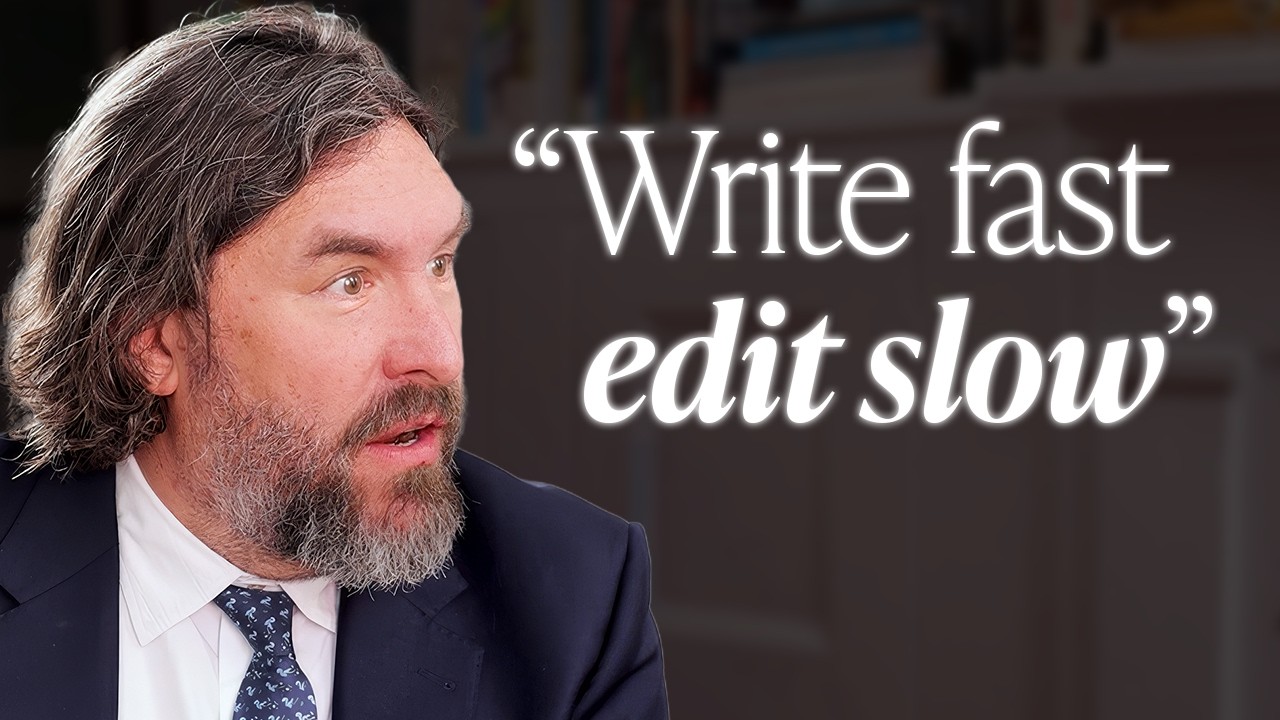
- He alternates between rapid first drafts (to capture momentum) and slow, meticulous editing (to cut excess).
-
Architecture over words
- Professional writing is fundamentally about structure—how pieces fit together—rather than individual sentences.
- He progressed through deliberate practice:
- Hundreds of 1,200‑word pieces → mastery of that length.
- Then 2,500‑word, 3,600‑word, 7,200‑8,500‑word magazine stories.
- Eventually 12,000‑15,000‑word magazine pieces and full‑length books.
- Repetition (“reps”) is the core training method; there is no mystery, only disciplined iteration.
-
Choosing a story idea
- Early career: chase “white whales” that impress editors.
- Later: pursue topics you are obsessed with—personal fascination outweighs external validation.
- No right or wrong method for outlining; outlines are a scaffold that eventually become unnecessary once intuition takes over.
-
Building interiority
- A profile’s core is the central complication of a person’s life and how they solve it daily, most of which happens internally.
- Effective detail work makes external actions carry the weight of that interior life without explicit exposition (e.g., Michael Jordan’s love of westerns revealing his father‑loss).
-
Crafting vivid characters
- Minimal, precise description can convey complex personalities (e.g., Tiger Woods’s yachts named “Privacy” and “Solitude” hint at his introverted celebrity).
- Secondary characters are presented as fractal reflections, offering multiple angles on the protagonist.
-
The “hammer” ending
- Thompson always knows the ending first; the rest of the piece is engineered to make that climax land powerfully.
- Good endings are elliptical: they resolve the narrative while leaving a lingering, open‑ended question—like a door that remains ajar.
-
Scene‑by‑scene construction
- Treat a long‑form piece like a screenplay: each scene must hit a distinct note and advance the thematic question.
- Magazine stories have a “second section” that functions as a verb, propelling the narrative forward.
- Transitioning to books requires new techniques; books cannot simply be elongated magazine stories because they lack the “depressurizing” moments that keep a magazine piece lively.
-
Place as character
- Thompson views geography as a conduit to understand his own sense of home; the Mississippi Delta becomes a metaphorical “soil” that stores generational memory.
- Southern writing excels at externalizing interior conflict—land mirrors the human heart.
-
Dialogue vs. quotation
- Long stretches of dialogue are preferred; they move the story faster than quoted speech.
- Over‑adorned prose (“purple prose”) often signals a reporting gap rather than stylistic flair.
-
Reporting as the foundation
- Good non‑fiction is fundamentally reporting: interviews, archives, timelines, and fact‑checking.
- The joy of assembling a timeline from disparate documents is likened to a treasure hunt; a single, well‑crafted page can feel like a major victory.
-
Secondary characters & fractal truth
- Multiple perspectives on a subject create a “fractal image” of the person; truth lives at the intersection of self‑story and others’ stories.
-
Driving questions
- Each piece begins with a core question that guides research and keeps the reader engaged, even if the question is never stated outright (e.g., “What will Steve Kerr do after basketball?”).
-
Attitude toward metrics
- Thompson cares more about the story’s integrity and his editors’ satisfaction than raw traffic numbers; he believes audience preferences are unknowable.
-
Phases of a writer
- Writers move through identifiable phases (e.g., the Michael Jordan phase, the “Barn” book phase); reinvention keeps the work fresh.
- Over‑repetition can trap a writer; recognizing patterns helps avoid stagnation.
-
Critique of brainstorming
- Formal brainstorming sessions feel artificial and hinder personal, organic idea generation.
- Spontaneous, informal exchanges (texts, hallway chats) produce more authentic, useful material.
-
Medium‑specific lessons
- TV/Documentary: “Tell, don’t show” because the camera shows; minimal voice‑over, use “skinny tracks” to connect ideas lightly.
- Magazine article: Capture a single moment like a dispatch—a letter from a specific time and place.
- Book: Construct an entire universe; the narrative must sustain its own internal logic and breadth.
- Profile: Identify the subject’s central life complication and illustrate daily problem‑solving.
-
Four writer’s values (inspired by Steve Kerr’s office wall)
- Joy: Find pleasure in discovery, even in tough topics.
- Empathy: Respect the humanity of subjects and readers.
- Competitiveness: Strive for excellence and rigor.
- Mindfulness: Stay present in the moment of writing.
-
Final thoughts on endings
- A satisfying ending offers resolution and an elliptical hint of the unknown, avoiding a tidy “bow” while preventing a messy, directionless conclusion.