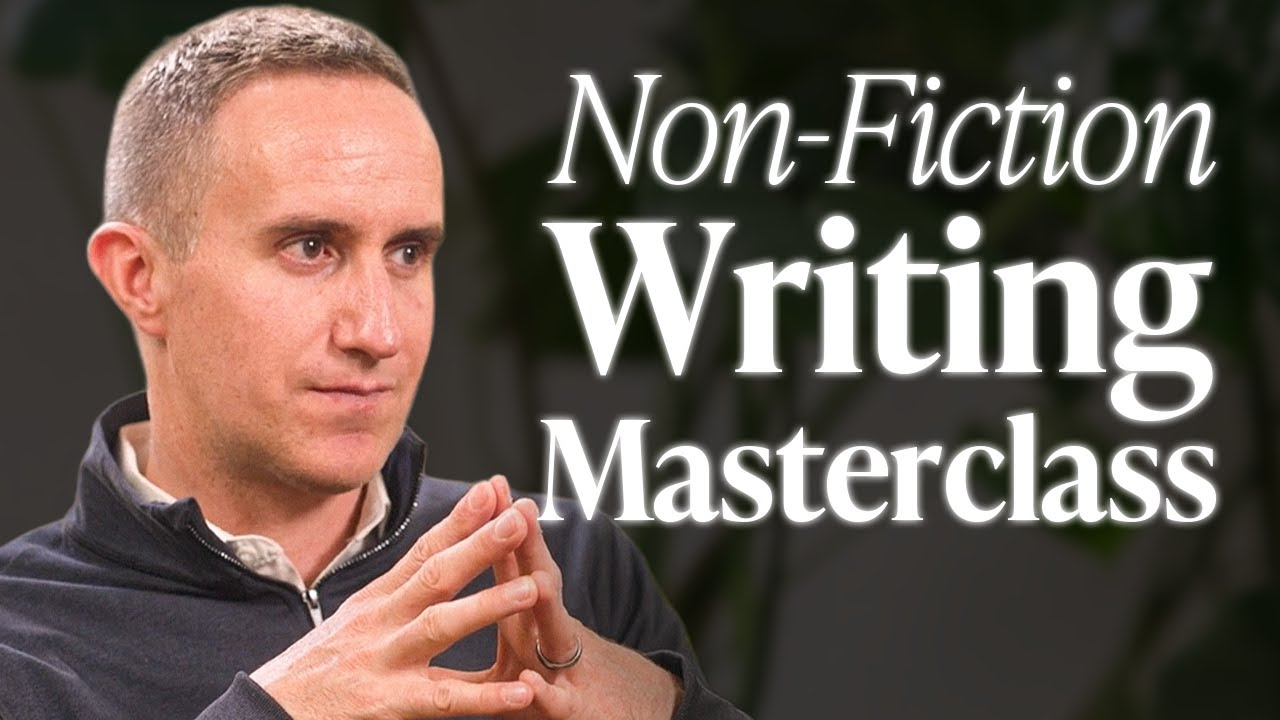
Morgan Housel is a bestselling author and storyteller who has sold over 8 million copies of The Psychology of Money. He honed his craft by writing more than 4,000 blog posts before publishing books. This episode focuses on his philosophy of storytelling, writing process, and how he collects and distills ideas.
The Core Principle: Get to the Point
Housel believes the most important rule in writing is to get to the point quickly and clearly.
There is no reward for difficulty in writing. If a reader has to reread a paragraph multiple times, that is the author’s failure, not the reader’s.
He cites Erik Larson as a master example: Larson can tell in one and a half pages what other historians need 46 pages to communicate, without losing any substance.
The stakes for being boring are higher today than ever. Fifty years ago, a reader had nothing else to compete with. Now, a phone is always in your pocket. If the writing drags, the reader is gone.
Mark Twain used to read aloud to his family and watch their facial expressions. When they leaned forward, he knew he was onto something. When they got bored, he cut it.
Storytelling Over Data
For non-fiction, especially about money or business, storytelling is not optional. It is a survival technique.
If you write about the stock market by saying “Here’s what the Dow Jones did this morning,” you are dead as an author.
Stories let readers empathize and contextualize their own lives in a way that data dumps cannot. A good story from a thousand years ago can feel more immediate than a spreadsheet.
The best stories are often very short. Housel’s new book, The Art of Spending Money, contains roughly 140 stories in 210 pages. Some of the most powerful stories are only three lines long.
How to Hook a Reader
The difference between a weak hook and a strong one is specificity.
Weak: “A lot of wealthy families end up going broke.”
Strong: “The Vanderbilts had the equivalent of $300 billion, and within 60 years, almost all of it was gone.”
The Vanderbilt story illustrates a deeper truth: money gave them financial independence but destroyed every other form of independence. Their personalities, marriages, and life choices were completely controlled by wealth.
Anderson Cooper, a Vanderbilt heir who inherited nothing, is arguably the most successful and happiest Vanderbilt in 150 years. His grandfather Reggie Vanderbilt died a drunk who gambled away the fortune.
Housel draws a parallel to TMZ: it gets more page views than many serious news outlets not just because of gossip, but because it is extremely good at hooking attention. There is a moral and an immoral way to do this.
Collecting Stories
Housel sees himself as a collector of stories. He reads, watches, listens, and observes constantly, then stores stories for later use.
He has published blog posts titled variations of “Several Short Stories” that are essentially collections of anecdotes he couldn’t fit anywhere else.
The best story wins, and the person who says the most in the fewest words wins.
How Morgan Uses ChatGPT
Housel uses ChatGPT frequently as a research tool, essentially as “Google on steroids,” but refuses to use it for writing.
He believes the process of writing is what makes you think. If an LLM writes your structure or sentences for you, you strip out the cognitive benefit.
He has experimented with uploading manuscripts for feedback. It can be decent at high-level observations (e.g., “your intro was rambling”) but poor at catching typos and grammar.
As a research accelerator, it is transformative. Tasks that used to take an afternoon of sifting through PDFs now take seconds, though he warns it still hallucinates and cannot be used as a crutch.
Teaching vs. Preaching in Writing
Housel deliberately avoids positioning himself as the smartest person on the page. He quotes other people extensively.
Deferring wisdom to others gives you more authority, not less. A 22-year-old who says “I did research and here are the best things I found from people with more experience” is far more compelling than one who claims to understand the world.
People magazine was once the most widely read magazine in the world. Most of its stories are fundamentally about a single person, which is why readers connect with them.
This connects to the Stalin quote: “One death is a tragedy; one million is a statistic.” Individual stories create empathy. Group stories create distance.
The Wide Funnel, Tight Filter Framework
Housel borrows this idea from Patrick O’Shaughnessy for how to read books.
Wide funnel: Start reading any book that looks even 1% interesting. Use free Kindle samples (10% of any book) to lower the barrier.
Tight filter: Be merciless. If the writing style doesn’t work for you, slam it shut and move on. Housel finishes a single-digit percentage of the books he starts.
He believes most people who say they don’t like reading actually just force themselves to finish bad books (bad for them, not objectively bad) because they feel a moral obligation or think boredom is their own character flaw.
How His Writing Style Emerged
Housel wrote 4,000 blog posts over many years, often multiple pieces per day. His style emerged largely from repetition and feedback.
Blog comment sections were vicious, but they were also constant feedback. He learned what worked and what didn’t through thousands of iterations.
Over time, he transitioned into what he calls “selfish writing.” He realized he could not please everyone, so he decided to please himself. He writes what he finds interesting, funny, or moving, and trusts that this authenticity resonates.
He compares this to painters, musicians, and sculptors, who do not have editors. They do their best work when they are doing it for themselves.
He notes that prominent creators in other fields, like a major YouTuber, eventually stop looking at data and develop an intuitive sense of what will work. Housel believes he can now read three pages of a book and estimate how well it sold.
Why Write Books in an Online World
Housel views social media as spring training, blog posts as regular season games, and books as the Super Bowl.
A bad tweet is forgotten immediately. A bad blog post can be corrected next week. A bad book is a permanent scar on your career.
But a great book can stick with you for life and change your circumstances in a way that even a viral article cannot.
Books carry a cultural significance that free online content does not, similar to the difference between a Tarantino movie and a YouTube video.
Readers give books more patience than tweets. In a tweet, you have three seconds. In an article, maybe a line or two. In a book, readers might give you eight pages. This allows for deeper, more nuanced storytelling.
How Writing Books Has Changed How He Reads
Housel now has deep admiration for beautiful prose, even when the underlying ideas are flawed.
He will recommend books to friends and they will say the author got everything wrong, but he will still say the writing was beautiful.
He cites Gibbon’s Decline and Fall of the Roman Empire as a book that gets a lot of historical details wrong but is still admired because the prose is extraordinary.
A sentence he remembers from a D-Day book: “All of the men were willing to give their life that day. All of the men gave their life that day.” That kind of punch and rhythm is extraordinarily difficult to achieve, and he has deep respect for it whenever he encounters it.
He now believes that saying something well matters more than saying something new. The Psychology of Money contained no original ideas, but it worked because they were expressed in a fresh, enjoyable way.
The Writing Process: Observation and Unstructured Time
Housel cannot schedule creativity. His two best titles, The Psychology of Money and The Art of Spending Money, both came to him during unstructured moments, once while walking down a street and once while on a treadmill.
Good ideas come in the shower, while walking the dog, at 2 a.m. They never come when he is trying to force them.
He deliberately structures unstructured time into his day. He works in sweatpants on the couch and resists filling his schedule with tasks.
He believes most great writers are wanderers who need independence and unstructured time. It is rare to find a great writer who thrives in a corporate environment where an editor tells them to “be creative” on command.
He references Jerry Seinfeld ending his show in 1998 because fame made it impossible to observe ordinary people in public, and observation was the engine of the show’s creativity.
Becoming More Observant
A friend told him to practice “I spy” as an exercise in observation. Go to a place and identify 20 specific things you notice.
This simple practice makes you see things you would otherwise overlook. When you describe those observations to others, they think you are remarkably perceptive.
Housel constantly takes notes on things people say and interrupts conversations to write things down. Over years, this accumulates into a rich library of insights and anecdotes.
Lessons from Ken Burns
Housel considers Ken Burns one of the greatest content creators in any medium.
Burns takes topics people already know (the Civil War, World War II) and tells stories about them that no one has heard before. He adds enormous value without adding new information.
His documentaries are masterclasses in storytelling craft: the music, the narrator’s voice, the transitions. Burns literally edits his script so that a beat in the music lands on a powerful word.
This reinforces Housel’s core belief: you do not need new ideas. You just need to tell existing stories better.
The John Grisham Technique
Housel admires John Grisham’s pacing: a slow, grinding build-up followed by a sudden shock.
Grisham’s chapters are often slow and tedious, which makes the sudden plot twist far more powerful. The boredom is a deliberate tool.
This works well in fiction and film (e.g., Parasite), where the audience is there for the story itself. In nonfiction, stories are in service of teaching something, so the technique is harder to apply, though the underlying principle of pacing and tension still matters.
The Kevin Costner Story
Housel shares a story told by Kevin Costner about a homeless friend who lived in his basement in the 1980s and kept asking Costner to read his manuscript.
Costner repeatedly refused. Eventually, he relented and read it. The manuscript was Dances with Wolves, which became Costner’s biggest film.
The lesson: you never know where talent will come from. Everyone deserves a chance. The system is relatively meritocratic today, but art is subjective, and there is no reliable formula for identifying talent in advance.
Housel’s own book, The Psychology of Money, was rejected by every US publisher. It was finally published by Harriman House, a British publisher, and went on to sell over 8 million copies. He holds no grudge because he recognizes how subjective the process is.