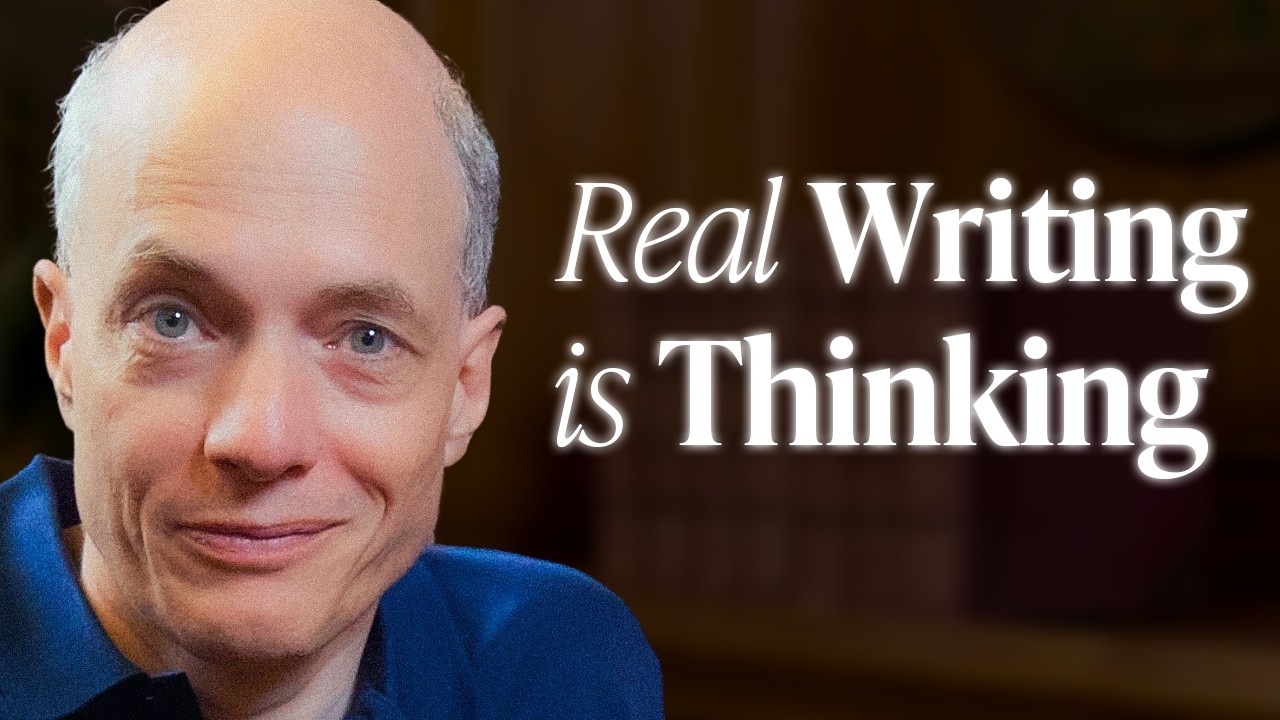
Alain de Botton is a writer and philosopher whose work—spanning books like Essays in Love and The Architecture of Happiness, and founding The School of Life—centers on making inner emotional life legible through language. For him, writing is not about craft or form first, but about processing pain and preserving beauty: turning fleeting, overwhelming feelings into concrete ideas that bring relief, clarity, and connection. He sees writing as a therapeutic act, a way to control experience by naming it, and believes the best writing emerges from honest self-observation rather than academic authority.
Writing Begins with Fragments, Not Books
Great writing starts not with a grand plan but with fragments: a half-scene, an image, a passing thought. De Botton compares writing to archaeology—finding broken pieces of a pot and slowly assembling them into a coherent whole.
He often begins with something small: a man leaving a dentist’s office in London, a happy couple in a restaurant, a line from a notebook. These become “magnets” that draw in other observations over time.
He rejects the idea that a book is a natural unit of thought. Instead, he sees it as an artificial construct imposed by publishing. Real thinking happens in sentences, images, and aphorisms.
Early in his career, he was drawn to maxims—short, witty psychological insights—like those of 17th-century French writer La Rochefoucauld. This form felt truer to how minds actually work than the traditional novel.
The Role of Pain and Suffering in Creativity
De Botton is drawn to two forces: pain and pleasure. He writes to master what feels uncontrollable—especially emotional pain—and to hold onto beauty before it fades.
He describes writing as “revenge”: a way for the silenced or misunderstood to finally have their say. Many writers are meek in person but fierce on the page.
Suffering strips away social niceties and forces raw honesty. In moments of grief, anger, or despair, people access truths they normally suppress. Great art often emerges from this tension.
He cites Van Gogh’s Irises as an example: the painting isn’t just about flowers—it’s a life raft painted by someone in agony. The beauty is inseparable from the pain behind it.
But he cautions against seeking out suffering. It comes naturally to everyone. “Life’s cooking,” he says. “Just sit still.”
Living Like a Writer Means Paying Attention
Most of writing happens away from the desk—in showers, walks, travel, or sleepless nights. The key is not discipline in the traditional sense, but attentiveness to one’s own sensations and thoughts.
He compares writing to sailing: you must be on the water with your sail up, but you still need the wind. You can’t force inspiration, but you must be ready to receive it.
Constant distraction (like scrolling) kills inner attention. True presence—like a child noticing moss on a wall—is where insight begins.
He practices daily “downloading”: sitting quietly and jotting down whatever arises. This reveals layers of thought invisible during busy hours.
Good writers triage differently: they notice what others ignore, guided not by logic but by emotional resonance.
Why the News and Politics Hinder Authentic Thinking
De Botton argues that modern news functions like a new religion, dictating what we should care about and how we should feel. This industrializes the mind and crowds out personal reflection.
News focuses on surface novelty, while wisdom lies in recognizing timeless patterns—archetypes like betrayal, ambition, or love—that repeat across history.
Political thinking simplifies human complexity into left vs. right, us vs. vs. them. But real people are messy: Napoleon wrote tender love letters; politicians we dislike may still attract us.
He encourages stepping back from media cycles. Not knowing the latest scandal or celebrity is a sign of mental freedom, not ignorance.
Art, Enchantment, and the Limits of Reason
De Botton values enchantment—the sense of mystery and wonder—in a disenchanted age dominated by logic and data.
He admires religions not for their truth claims, but for their sophisticated use of art, ritual, architecture, and story to transform inner life. Art tries to do this too, but lacks institutional power.
Objects and places “beam out” visions of how to live. Beauty, as Stendhal said, is “the promise of happiness.” When we find something beautiful, we’re responding to a way of being.
He’s inspired by painters like Cy Twombly, Agnes Martin, and Rothko—not just for their aesthetics, but for how they visualize inner states like melancholy, order, or chaos.
Writing for Yourself First, Then the Reader
De Botton writes primarily for himself—to honor his own feelings—but always with an imagined reader in mind.
He pictures two audiences: his erudite, academic father and his uneducated, nature-loving nanny. His goal is to speak clearly and deeply to both.
He also traces his voice to childhood: he invented a teddy bear and comforted it nightly, translating his own pain into soothing words. The School of Life, he says, is a continuation of that act.
A good writer asks: “Where could this go inside the reader’s mind?” But the starting point must be personal truth, not performance.
On AI, Teaching, and the Future of Writing
De Botton uses AI as a therapist and research tool, but not for writing itself. AI can summarize existing thought, but it can’t access his unique emotional landscape or intuition.
He believes AI pushes writers to go deeper into their own experience—to be more honest, more original, more faithful to their “neglected thoughts.”
If he taught writing, he’d focus not on grammar or structure, but on helping students distinguish between what they’re supposed to feel and what they actually feel. The curriculum would center on introspection, authenticity, and recovering inner voice.
He’d start by asking: Why do you want to write? And are you trying to write the kind of book you think you should, or the one you truly need to?