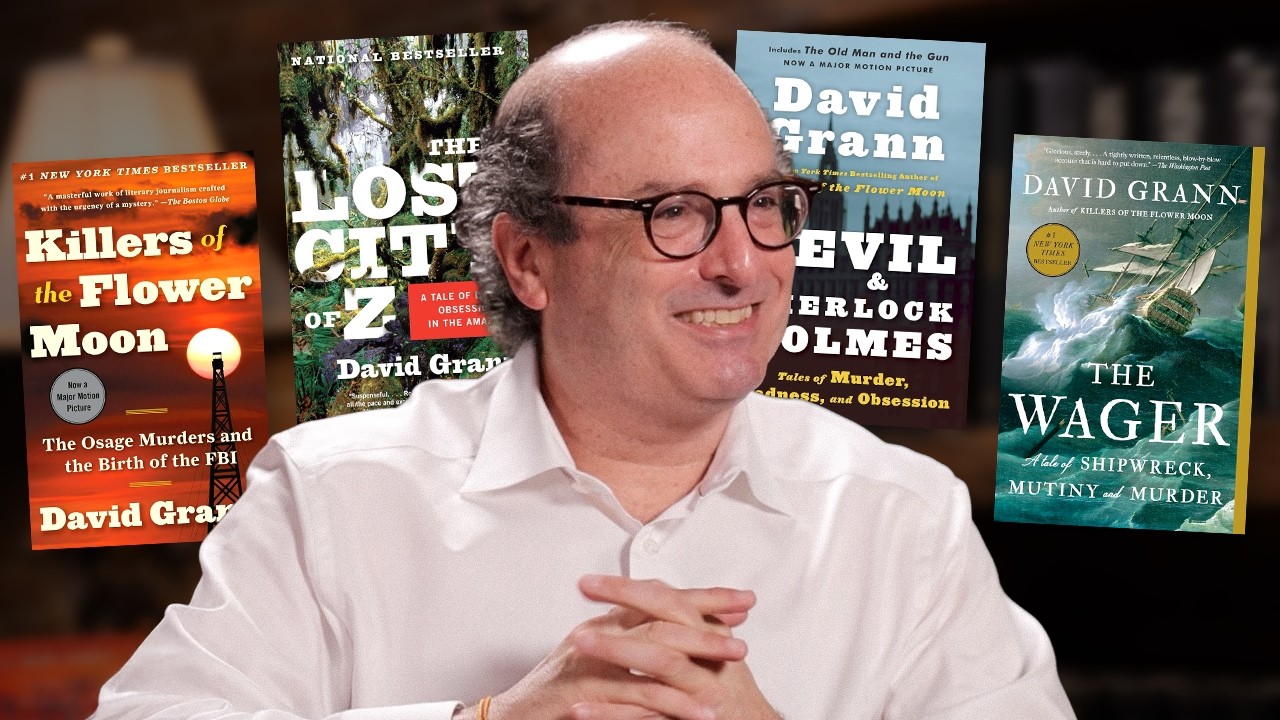
David Grann is a master of narrative non-fiction whose books—Killers of the Flower Moon, The Wager, and The Lost City of Z—are celebrated for their vivid prose, deep research, and gripping storytelling. This episode explores how he finds, researches, and writes stories that feel both epic and intimately human, revealing the methods behind his ability to turn historical events into page-turning narratives.
How David Grann finds and develops stories
Stories begin with curiosity, not inspiration: Grann doesn’t wait for divine ideas—he actively seeks them out by calling experts, reading widely, and following footnotes. For The Wager, he stumbled upon an 18th-century midshipman’s journal while researching mutinies, which sparked his interest.
Three criteria for choosing a project:
Does the story spark deep curiosity?
Is there enough archival material to reconstruct it faithfully?
Does it speak to deeper themes—truth, power, survival, justice—that resonate beyond its time?
Themes emerge from research, not the other way around: He doesn’t start with a message. Instead, meaning reveals itself as he uncovers evidence. For example, Killers of the Flower Moon shifted from a “who did it” mystery to a “who didn’t do it” exposé of systemic corruption and a culture of killing.
The role of deep, patient research
Research is foundational: Grann insists that great nonfiction cannot exist without exhaustive archival work. He spends years in archives, reading diaries, letters, logbooks, and legal records to reconstruct scenes with emotional and factual precision.
Breakthroughs come through serendipity and tedium: Important discoveries—like secret grand jury testimony hidden in an unmarked folder—often appear after weeks of dull scanning. Patience and persistence are essential.
Outlines can be massive: A single 3,000-word chapter may be supported by a 200-page outline containing every biographical detail, physical description, quote, and environmental note needed to build a vivid scene.
Immersive reporting: going to the place
Visiting locations transforms understanding: Though he initially researched The Wager entirely from documents, Grann later traveled to Wager Island in Patagonia. There, he realized the castaways must have suffered from hypothermia—a fact he’d missed despite two years of study—because of the relentless wind and rain.
Sensory experience informs emotional truth: Standing on the island, he grasped why one officer wrote, “the soul of man dies in him.” The trip didn’t make it into the book directly, but it deepened his empathy and accuracy.
Physical danger mirrors historical peril: His harrowing boat journey—listening to Moby Dick while bracing on a tossing deck—gave him a fraction of the terror the sailors faced, reinforcing the story’s emotional stakes.
Crafting vivid, three-dimensional characters
Characters are built from fragments: Grann gathers every scrap—letters, speech patterns, class background, mannerisms—to reconstruct people as fully as possible. He avoids romanticizing or excusing them, aiming instead for honest, nuanced portrayals.
Diction reveals character: The gunner on The Wager wrote in a direct, Hemingway-like style—unusual for the ornate 18th century—revealing his working-class roots and no-nonsense personality.
Selective detail creates realism: Like J.K. Rowling’s description of Hagrid, Grann uses a few precise, evocative details (e.g., “eyes glinting like black beetles”) rather than exhaustive description.
Writing techniques that create suspense and beauty
Tell stories chronologically: Grann follows the timeline as the people lived it, preserving their uncertainty. This creates natural suspense—even when the reader knows the outcome.
Use small moments to reveal big truths: A handshake between enemies on Wager Island—a tiny, quiet act—speaks volumes about shared humanity amid conflict.
Choose language for its poetic resonance: In Killers of the Flower Moon, he uses Osage moon names like “flower killing moon” and plant names like “spiderwort” not just for accuracy, but for their evocative, musical quality.
Cut ruthlessly: Early drafts often include 10,000+ words on topics he loves (e.g., shipbuilding). His wife and editor help him distill these to the most revealing details—like the fact that 4,000 trees were needed to build one ship.
The function of prologues and structure
Prologues must hook and frame: They answer: Why should you care? What’s at stake? Grann often places himself in danger (e.g., lost in the Amazon in Lost City of Z) to create immediate tension while weaving in deeper themes.
Structure serves the story, not the author: He inserts himself only when it advances the narrative (as in Lost City of Z) and removes himself when it doesn’t (as in The Wager, despite his dramatic trip).
The best opening sentences come late: The first line of The Wager—“The only impartial witness was the sun”—came after finishing the entire manuscript. It captures the book’s core theme: competing versions of truth.
The emotional core of storytelling
Joy comes from discovery and connection: Grann has cried during interviews when sources share powerful personal stories. That emotional resonance is what he hopes to pass to readers.
Terror comes from the act of writing: The real fear isn’t research—it’s whether he can do justice to the story on the page.
Small stories can carry huge meaning: Whether it’s a handshake on a deserted island or a janitor in the Twin Towers, intimate human moments often reveal more than grand events.
Writing as sense-making: Grann writes to impose order on a chaotic world—to cut through lies, confusion, and noise and find clarity through facts and narrative.
Lessons from film and legacy
Film and books are different mediums: Film shows; writing must evoke through words. But both benefit from strong scenes, visual detail, and character depth.
Stories deserve to be known: Grann is drawn to overlooked histories. When Scorsese adapted Killers of the Flower Moon, it brought a suppressed chapter of American history to millions—fulfilling Grann’s goal of making the unknown unforgettable.