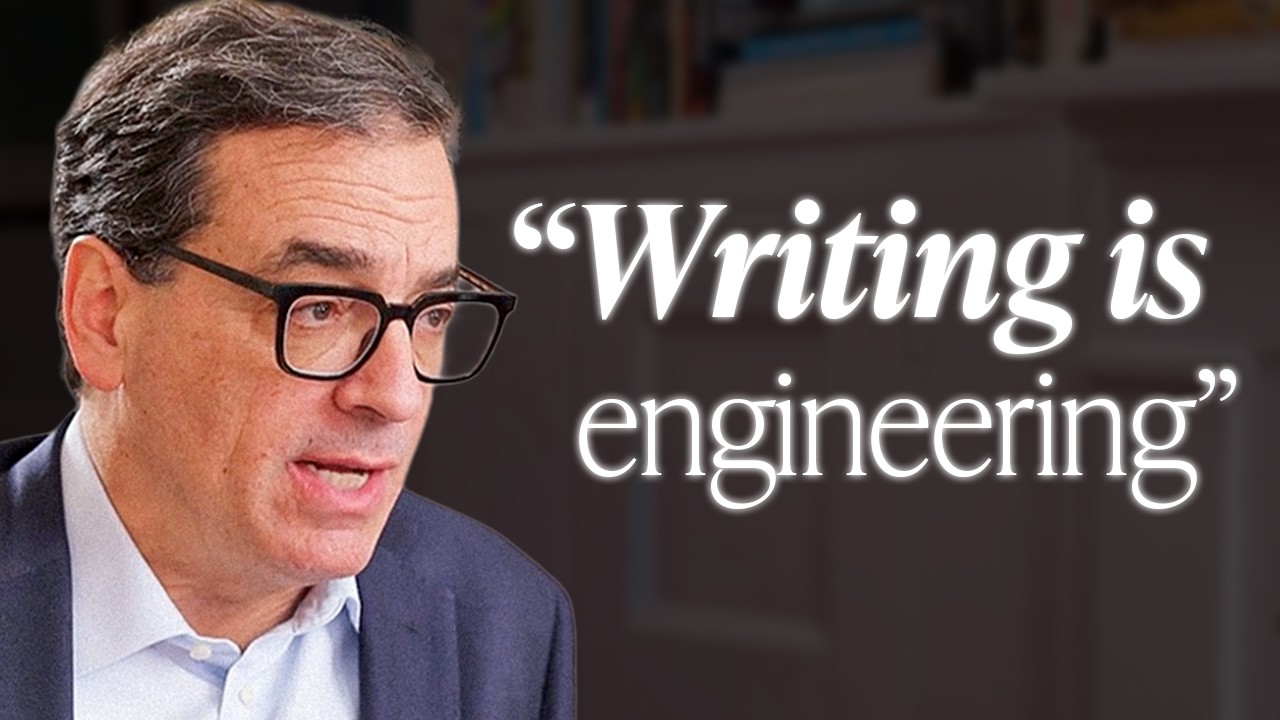
Daniel Pink is a bestselling non-fiction author (Drive, The Power of Regret, To Sell Is Human, When) who treats writing as a disciplined, engineering-like process rather than a purely artistic one. He emphasizes routine, structure, and usefulness, and is now branching into playwriting as a new creative challenge.
Writing routine and process
Pink writes in a converted garage behind his house, 22 steps from his back door, with no phone or email access.
He sets a modest daily word count — typically 500 to 800 words — and does not stop until he hits it, then moves on to other tasks.
He works on one chapter at a time, spending several weeks drafting and another week editing and rewriting before moving on.
He describes writing as still “really, really hard” even after decades, and sees the rigid routine as liberating rather than constraining.
He is a slow writer and reader, identifying as a tortoise rather than a hare, and values consistency over intensity.
The centrality of structure
Pink cannot begin writing a book until he can see its skeleton — the structure — even if it changes later.
He spends months doing research and reporting before finding the right organizing principle, often using whiteboards or large Post-it notes arranged behind his swivel chair so he can stare at them while thinking.
For When: The Scientific Secrets of Perfect Timing, he initially tried organizing by time scales (day, week, month, year) and then by domains (school, work, health, leadership) before arriving at a conceptual framework built around beginnings, midpoints, and endings.
Once he has a structure, he stress-tests it while writing — for example, a planned section on breaks in the When book grew into a full chapter once he realized how much material he had.
Socializing ideas and feedback
Pink actively talks about works-in-progress to see how people react — whether their eyes glaze over, whether they ask questions, whether they disagree — treating real-time feedback as a structuring tool.
He also studies audience reactions when giving speeches, tracking laugh density and pacing, a technique inspired by the filmmakers behind Airplane! and Naked Gun, who tested screenings and revised any stretch longer than 25–30 seconds without laughter.
He applies the same analysis to his own plays, mapping where laughs occur and adjusting scenes where the audience might disengage.
Book proposals as idea tests
Pink writes 30–40 page book proposals before committing to a project, both to test whether the idea can sustain a book-length treatment and to test whether he enjoys working on it.
A strong proposal must articulate: what the idea is, why it is both fresh and familiar, why no one else has written it, why he is the only person who could write it, who the audience is (never “everyone”), why the book meets this particular moment, and the story of how the idea came to him.
He has abandoned proposals mid-writing — notably one called The Invisible Present about unseen forces shaping the world — when he realized the idea wouldn’t sustain a book, preferring to discover that after 10 days rather than after signing a contract.
Research discipline
Pink reads research until he starts feeling he’s “heard this before,” which signals he’s reached saturation.
He triangulates findings across disciplines — for example, combining chronobiology, judgment-and-decision-making research, and sports psychology — and is skeptical of single-study claims from obscure journals.
He is ruthless about cutting material that was time-consuming to research but doesn’t serve the reader; in The Power of Regret, weeks of research on how regret develops in children was reduced to a single paragraph.
On breaks and performance
Pink argues that breaks should be treated as part of performance, not a deviation from it, the way athletes think about recovery.
Effective breaks are: in motion rather than sedentary, outside rather than inside, social rather than solitary (even for introverts), and fully detached from screens and phones.
He cites a study where people walking on a treadmill generated three times as many creative ideas on the “alternative uses” test as people sitting in a chair.
Why interdisciplinary material appeals to him
Pink sees himself as a translator and generalist, drawn to cases where different academic fields are asking similar questions in isolation without talking to each other.
He finds value in surfacing the harmony across disciplines — for example, what chronobiologists, decision scientists, and sports psychologists all independently discover about timing — and bringing that synthesis to a general audience.
How he became a writer
Pink never set out to be a writer. He went to law school, worked in politics, and wrote articles on the side — for free, at midnight, for publications like George magazine — while holding demanding day jobs.
He realized the side activity was the main event: the signal of what he was “constituted to do.” Writing gave him autonomy and the ability to work for himself on his own ideas.
He also studied linguistics and cognitive science in college and wrote short stories as a hobby, treating writing the way some people play golf.
Playwriting as a new challenge
Pink has started writing plays, initially thinking they were dramas until a table read with actors revealed they were comedies.
He sees playwriting as fundamentally different from book-writing: a book is like building a house (rooms can be rearranged and it still stands), while a play is like building a watch (if the gears don’t mesh perfectly, it simply doesn’t work).
Plays are also collaborative — actors elevate the material and reveal problems the writer couldn’t see — whereas books are a direct transmission from writer to reader.
He values theater as one of the last phone-free, screen-free shared human experiences, which he finds urgent in the current moment.
Developing taste and craft
Pink believes young writers should read widely and write frequently to “get their reps,” and should develop taste by studying what they love and what they loathe — forcing conscious discernment rather than passive appreciation.
He keeps a running collection of good paragraphs, introductions, and sentences in a simple document, which he reads when his own writing feels dull, using it as a menu of voices and styles to pattern-match against.
He also recommends keeping a commonplace book — he has kept one for eight years — noting striking sentences, phrases, and unfamiliar words, which changes how you pay attention to the world.
Writing to figure things out
A formative lesson from a college essay-writing class with professor Charlie Yarnoff: “Sometimes you have to write to figure it out.” This contradicted the standard school model of thesis → outline → write.
Pink often discovers what he actually thinks only through the act of writing, a principle he considers one of the great joys of the craft.
He also endorses the exercise of writing the most compelling argument for something you vehemently disagree with, a practice he discussed with Tyler Cowen and that echoes the law school skill of arguing both sides.
The most important question before starting a project
Before taking on any new writing project, Pink asks himself one question: What is the promise I’m making to the reader?
He frames reading as a significant investment — $25 and roughly nine hours — and feels obligated to pay it off by making the work entertaining, diverting, useful, and capable of changing how readers see their world and what they do.
For non-fiction, he believes usefulness is paramount: the win is not just that people think differently but that they actually do different things.