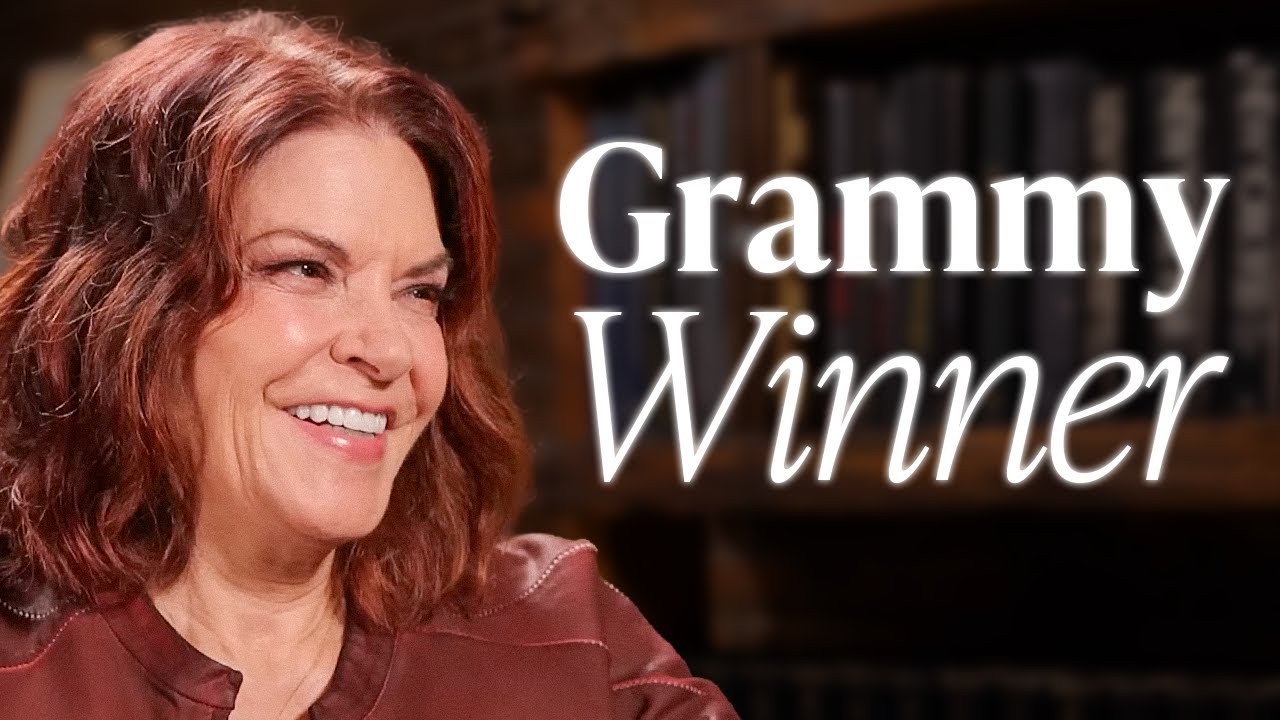
Rosanne Cash is a four-time Grammy-winning songwriter with over 40 years of experience, and this conversation explores her creative process, the role of language and rhythm in songwriting, how emotions like anger and grief fuel art, and the discipline required to sustain a lifelong writing practice.
Language and Rhythm as Foundational Instincts
Cash’s love of language began in early childhood, fascinated by signs, word meanings, and the rhythms of sentences, which she describes as “hardwired” into her.
She started writing poetry as a pre-teen and won a poetry contest at age nine, establishing an identity as a writer that has remained unchanged for half a century.
The rhythms of language drew her toward songwriting naturally, since both involve internal cadence, melody, and rhyme.
Her memoir was written with a songwriter’s sensibility, using repeating rhythms and returning themes rather than strict chronology, a structure she also brings to prose essays.
Songwriting Process and Structure
Cash describes songwriting as entering a room without knowing what it looks like, exploring its corners, hitting a wall, slogging through self-criticism and editing, then finding a way through to the end.
Songs vary wildly in how long they take to write; some come easily with light editing, others are “like pulling teeth,” but there is always an editing process.
In editing, she sometimes puts ambiguity back in, valuing intrigue and mystery over clarity, while maintaining a clarity of intent behind the ambiguous language.
She used to avoid feedback entirely during the writing process but now co-writes with her spouse John Leventhal, who gives unsolicited feedback that she has learned to accept and argue through productively.
She relies on internal red flags during editing, such as overusing nature metaphors, overusing certain adjectives, or using words that are too literal, too specific, or too expected.
Surprising herself while writing is the most fun part of the process, and she often discovers things about herself she didn’t know she knew.
Deconstructing the Craft Through Study
As a young songwriter, Cash deconstructed songs by Bob Dylan, Guy Clark, Appalachian ballads, Beatles songs, Elton John, and Joni Mitchell, analyzing how they worked and what made them specific to each artist’s voice and life experience.
Deconstructing meant writing down lyrics and studying how a songwriter moved from one idea to another, how far they stepped from the expected, and how they brought the song back around.
Studying Joni Mitchell was a revelation because it showed Cash that a woman’s inner life was valuable and worthy of public expression, countering the message she had absorbed from the world that men were the poets and women should keep their feelings private.
She emphasizes mastering fundamentals first, comparing it to Picasso’s representational skill before cubism: young songwriters should learn to construct and follow rhyme schemes before breaking them.
The Role of Emotions in Writing
Anger is a powerful creative fuel because it strips a writer out of their head, which is where writer’s block lives; Cash wrote “Roses in the Fire” from real rage, tossing her husband’s roses into the fireplace, and the energy of that emotion drove the lyrics.
Grief is equally or more clarifying than anger because you cannot talk your way out of it; it contains anger, exhilaration, and storm-like movement, and Cash sees it as rich material for art.
She wrote “The World Unseen” from deep grief after her father’s death, beginning with a line from the Psalms he requested in his final months: “I’m the sparrow on the roof,” followed by “I’m the list of everyone I have to lose.”
Cash references Rainer Maria Rilke’s letters on grief compiled in Letters to a Young Poet (referred to as The Dark Interval), which offer not solace but invitations to let grief move through you and to follow it as a path into deeper life.
She sees grief and anger as invitations for discovery, and notes that people often run from these emotions despite their creative fertility.
Truth, Pretense, and Identity
Cash has a deep aversion to pretense, rooted in childhood observations of her famous father’s world, where she questioned whether the connections fame created were real.
She learned from her father a respect for the art of songwriting, his vast knowledge of songs, his work ethic, and his sensitivity to the suffering of others.
Her mother’s discipline and sense of routine have been useful to her, while her mother’s focus on appearances has been something she works to resist.
She is not self-destructive, unlike her father, and recognizes that living up to parental expectations is now entirely in her head since they are no longer alive.
When asked what she does best in the world, she says writing, but also names being a good friend, mother, and wife, and suggests her curiosity may be her greatest strength.
Voice, Evolution, and the Physical Instrument
Cash’s singing voice has improved over 40 years because she has worked at it and learned its contours, just as her writing voice has developed through decades of practice.
She describes the voice of self-criticism as asking “Why can’t you do it?” and comparing herself unfavorably to others, but she has learned to recognize it as part of the process rather than believing it.
Her voice has changed with age, losing some top notes but gaining depth, and she connects this to Joni Mitchell’s “Both Sides Now,” which Mitchell recorded early in life and again decades later, the later version carrying the weight of lived experience.
Ray Charles said you are a better singer at 50 than at 20 because your life shows up in your voice, and Cash agrees completely.
Songwriting Traditions and Modern Pop
Cash loves the full range of American songwriting traditions: Appalachian ballads connected to Celtic music and oral history, dark songs about death and permanent separation, Delta blues documenting suffering and violence, and the Carter Family through Elton John.
She contrasts these traditions with much modern pop music, which she sees as driven by track and beat rather than lyrics, with lyrics serving as a tertiary adjunct; she cites Ed Sheeran’s “Shape of You” as an example where the lyrics are barely noticed.
She prefers lyric-driven songs but notes they do not have to be complex, pointing to Lenny Ann Lewis’s “Why” as a perfect distillation of pure longing.
Visual Thinking and the Mystery of Creation
Most of Cash’s songs begin visually; she describes seeing headlights on a Texas road at the piano and the entire first verse of a song emerging from that image, with the song’s meaning revealing itself only after the words were on the page.
She values not fully understanding what she has written, seeing this mystery as central to songwriting and poetry in a way that is less common in prose.
She wrote “The Killing Fields” about lynchings in Arkansas, inspired by visiting the lynching memorial in Montgomery, Alabama and the summer of George Floyd’s murder, and deliberately structured it as an Appalachian narrative ballad with no choruses, moving from present to past and back to present.
Music, Memory, and the Brain
Music survives in the brain when other memories fade, as seen in Alzheimer’s patients who remember songs but not their children’s names.
Cash’s grandfather, knowing he was about to die, asked for a specific Mozart piece, needing that particular song to accompany his final moments.
She notes that people use specific songs to usher themselves through major life transitions, such as divorce, listening to the same pieces over and over.
Love Songs and the Dream About Art
For Cash, a great love song must be multifaceted, not too sweet, and free of pretension or misplaced earnestness; she cites Nick Cave’s “Into My Arms,” which begins with “I don’t believe in an interventionist God,” as a killer love song.
She had a pivotal dream in the 1980s in which she attended a party where Linda Ronstadt was talking to an old man she knew was named Art; when Cash tried to join the conversation, he looked at her coldly and said, “We don’t respect dilettantes.”
The dream shook her and led to a commitment to go deeper in her writing rather than dabble, a turning point in her artistic life.