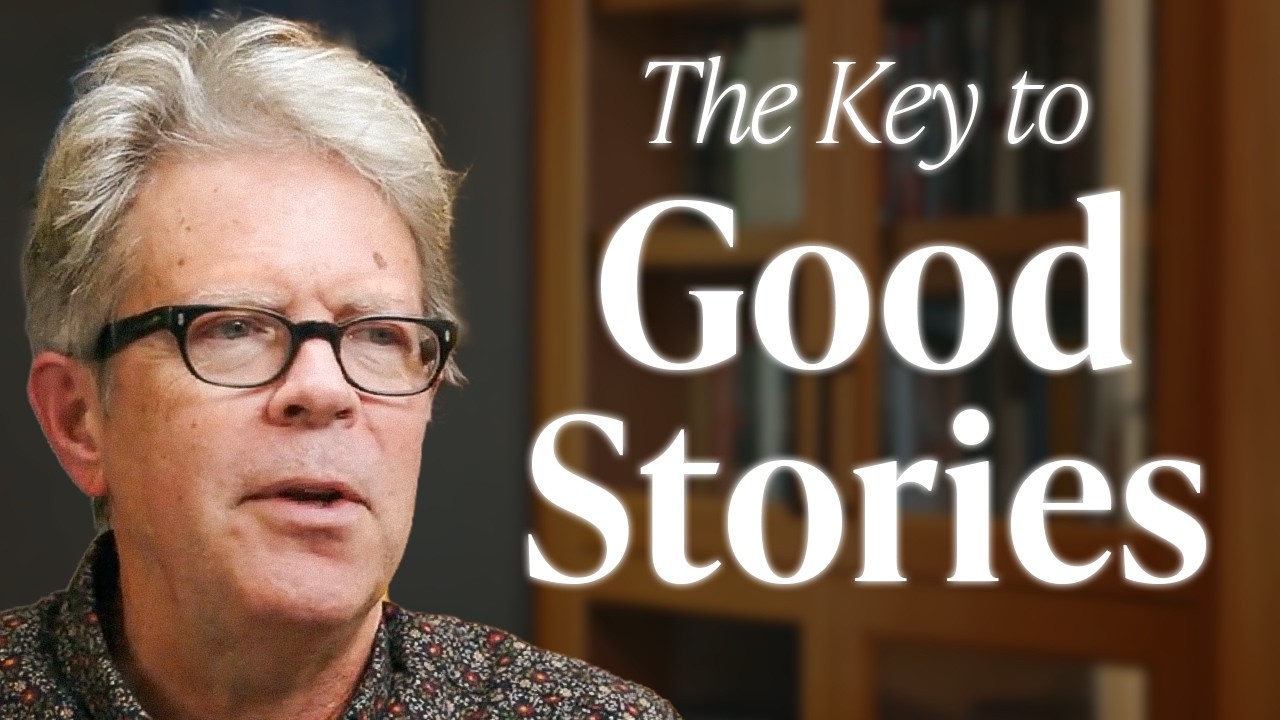
Jonathan Franzen on writing, character, and the comic novel — Franzen discusses his approach to fiction, emphasizing that his primary goal is to create pleasure and fun for the reader, that character-building starts with identifying a small, comic problem a character wants to solve, that self-examination is essential for writers to overcome shame and write honestly, and that he sees himself as a comic novelist working within the tradition of middle-class realism, drawing on influences like Viennese satirist Karl Kraus to critique the dehumanizing effects of technology, media, and consumer capitalism.
Creating rich characters
Franzen is fundamentally a novelist of character, and his main characters receive far more attention than secondary ones.
Secondary characters are easier because their dramatic function is limited and defined; you only need a couple of traits to make them work.
Main characters require finding what Franzen calls a “comic problem” — a single sentence describing something the character wants, ideally one that makes you smile when you read it.
The problem doesn’t have to be large or high-stakes; in fact, the smaller and more trivial the problem, the funnier it can be, because the gap between the character’s intense desire and the insignificance of the object is inherently comic.
Once you have something a character wants, you create obstacles and put characters in scenes where they want different things — that’s the basic engine of drama.
Franzen is not interested in biographical backstory, physical description, or a character’s history; he goes straight for the story essence of who the character is, and fills in the rest as he writes.
Why novels must be funny
Franzen identifies as a comic novelist and pushes back against the prejudice that seriousness and humor are incompatible.
He points out that the vast majority of great novelists and playwrights throughout history have been funny at least some of the time.
Humor is an indicator of distance — if the author can laugh at the protagonist, the reader trusts that they won’t be asked to sign on to a simplistic victim narrative.
He distrusts writers who present themselves as morally serious victims, because that stance usually signals a lack of perspective and limits the book’s appeal to people who share that same sense of grievance.
The kind of novels he likes to read and write work from the premise that no one is all good and no one is all bad, and that a more nuanced view of human nature is both more truthful and more entertaining.
The role of self-examination in writing
Franzen argues that deep self-investigation is essential for writers, even when writing fiction that is not autobiographically about them.
His goal is to create characters who are completely not him so that he can pour all of himself into them — this is easier with female characters because the gender difference creates immediate psychological distance.
Self-investigation becomes critical when a writer encounters high levels of shame — when the story wants to go in a certain direction but the writer feels ashamed to go there.
The warning sign is that the pages lose their humor and become depressed, ugly, and self-interested; the writer starts piling on depravity as a way of objectifying the shame they feel.
There is no technical solution to this; the writer must go into the shame and figure out why they feel it.
One option is to decide this isn’t the book to explore that material; another, which Franzen used while writing The Corrections, is to do a deep self-analysis and eventually find a way to make what seemed shameful into something ridiculous — which restores comic distance.
Comic distance means the author is no longer personally implicated in the character; you can see what’s wrong with them, feel for them, and be amused by them simultaneously.
Franzen’s distinction from trauma dumping
Franzen distinguishes his approach from trauma dumping, which he sees as focused on the self, flavored by complaint, and implying injustice.
What he wants instead is a bond with the reader where loyalties are shared between author and reader, with characters as the common ground.
He praises Holly Hall’s novel Banal Nightmare as an example — it features eight characters, each convinced of the unique terribleness of their situation, and the effect is comic rather than tragic because the reader can see the pattern and laugh rather than feeling asked to absorb one person’s suffering.
Fun and pleasure as justification for writing
Franzen has evolved through three phases of justifying novel-writing: first as a political act to expose injustice, then as a way to combat existential loneliness by connecting one consciousness to another, and finally to the view that writing for pleasure and providing pleasure is justification enough.
He defines fun broadly — it includes using unusual words, crafting sentences with unfamiliar structures, and exploiting the flexibility of English (like placing an adjective after the noun it modifies).
He acknowledges that writing is grueling but compares it to birdwatching or pursuing a difficult goal: the suffering is subsumed into the larger pleasure of the pursuit and the eventual capture.
When something isn’t working, his two diagnostic questions are: “I don’t see the humor in it” and “This isn’t fun enough.”
Writing process and craft
Franzen does not outline his novels in detail because a fully planned book reads as sterile and planned; if you can outline it, there’s no point in writing it.
Instead, he knows roughly where he needs to go but has no idea how to get there — the adventure is making an unlikely sequence of events seem inevitable.
He pushes himself to make things more extreme and original, following Flannery O’Connor’s idea that the writer does whatever he can get away with — though he acknowledges that four out of five times the extreme choice won’t work.
He works with obsessive revision: on a typical writing day he spends four hours rewriting 200 words from the day before, then writes one new page in the last 20 minutes.
He used to write five to eight pages a day; now he is lucky to get one, but that page is polished to a publishable standard.
He builds the novel like an iron bridge — each section is solid before he extends it, and he can see the direction the bridge is pointing even if the full path ahead is foggy.
Tone is the most important element — he searches for the right tone for the book and for each character, which might take six months to find for a single sentence.
On clichés and creating experience
Franzens considers clichés a serious flaw because they signal an inattentive writer and break the reader’s immersion.
He allows himself at most one cliche per book; when reading others’ work, he stops at the second cliche.
Clichés aren’t just borrowed phrases like “white as a sheet” — they can also be borrowed feelings, borrowed ideas, and borrowed situations that the reader has encountered too many times before.
His goal is to create a vivid dream-like experience for the reader, which is disrupted by anything that reminds them they’re reading a constructed text — including experimental fiction that breaks the fourth wall.
He trusts that readers are very good at filling in gaps from minimal information, so a writer doesn’t need as much detail as they might think — even minor characters can be established in two sentences.
Observing the world and writing about families
Franzen is not the type of writer who walks around with a notebook observing strangers; instead, he has always been good at reading people and noticing what’s happening between them.
He comes home from social events and discusses with his partner Kathy (also a writer) what they noticed about people — what someone didn’t want to talk about, for example — and tries to work out what might have been going on.
He believes laughter is the sound of comprehension — when people laugh at an observation, it means the writer has hit on something true.
He is drawn to writing about families because, even in a digitally mediated world, family relationships force real-time, high-stakes interaction that people cannot avoid.
He is not interested in writing about people whose entire lives are spent online because he sees that as a limited subject; his job is to put characters in the kind of situations they have dedicated their lives to avoiding.
Early critique of technology
Franzen was writing about the dangers of digital technology in the 1990s, well before most cultural critics.
He was well-positioned to see the problems because he was politically engaged and deeply distrustful of consumer capitalism and large corporate interests, and because the publishing world was already threatened by the prospect of the “third screen” (computers and smartphones).
He was influenced by Viennese satirist Karl Kraus, who identified an evil triad of media, money, and technology, and who ruthlessly exposed the phony language used to promote war interests in Vienna — Franzen sees the same dynamics at play in Facebook and Big Tech.
What bothered him most was not the corporations themselves but the lies — the claim that the internet would usher in an era of prosperity, equality, and democracy.
He contrasts this with more honest talk about the internet being good for the economy and for buying things, which he actually doesn’t object to — he likes eBay and Wikipedia.
He credits the TV show Silicon Valley with helping to make the “making the world a better place” narrative laughable, and notes that figures like Zuckerberg and Musk no longer even pretend to be good guys.
On the writing life
Franzen sides with Flaubert’s principle that you must be regular and orderly in your life so you can be violent and original in your work, rather than the romantic trope of the writer whose chaotic life fuels great art.
He acknowledges that some writers like Hemingway needed to go out and have experiences, but he believes more good work has been done by people who stayed home.
He writes in a quiet, normally dark office, wearing earplugs for most of his waking hours (and while sleeping), and has experimented with various methods of sensory reduction including noise-canceling headphones and even a blindfold during a period of nicotine withdrawal.
Why he loves birds
Birds have become a real fascination for Franzen, and he sees in them a model for the kind of beauty he values in writing.
His favorite bird is the California towhee, which many birders consider one of the ugliest birds in America — drab, gray-brown, and unremarkable — but which Franzen finds the most beautiful bird in the world.
They mate for life and stay close to each other, calling back and forth all day: “You there?” “I’m here.”
They sing duets when breeding, and have a distinctive shape he can recognize at a quarter mile.
He contrasts the towhee with a scarlet macaw, which is visually stunning but has a horrible, shrieking call — he prefers subtle beauty over obvious, showy beauty.
He believes that merely describing nature’s beauty is tedious; what makes birds interesting is their behavior, and the fact that they are there every day outside your window saying, “Hey, we’re still here.”