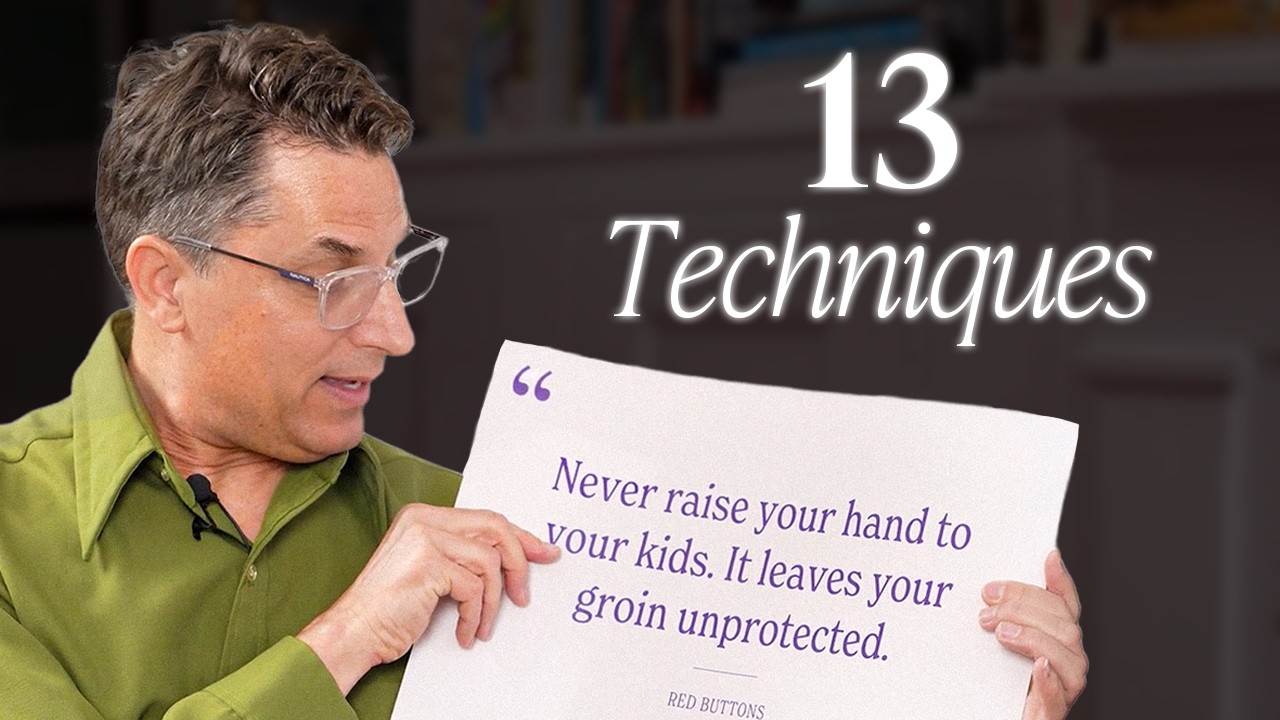
Comedian and comedy teacher Robert Mack joins the show to break down 13 jokes from legends like Mitch Hedberg, Steven Wright, Seinfeld, Louis C.K., and others, using each one to illustrate the core principles of what makes comedy work — and why dissecting jokes, while famously unfunny, reveals the hidden machinery of laughter.
The #1 rule of comedy: a skewed point of view
Mitch Hedberg — “I used to do drugs. I still do, but I used to, too.”
The fundamental rule of comedy is showing reality from a skewed or unexpected perspective.
This joke uses misplaced focus across time: the listener expects “I used to do drugs” to be followed by “but I quit,” so “I still do” creates a surprise.
It’s self-contained — no backstory needed — which is a hallmark of great one-liners.
The humor comes from the brain holding two contradictory thoughts simultaneously and resolving the conundrum.
Incongruity: when things don’t fit
Steven Wright — “Oh man, I lost a buttonhole.”
An incongruity is something that doesn’t quite make sense — you can lose a button, but not a buttonhole.
The brain recognizes the mismatch, figures it out (he’s conflating buttons and buttonholes), and that resolution triggers laughter.
Evolutionarily, laughter may have originated as a signal that things are okay — the brain detects a threat (fighting), then recognizes incongruity (it’s just play-fighting), and the body releases tension with a laugh.
This is why laughing at something gives you a sense of control over it.
Changing scale and misplaced focus
Steven Wright — “Everywhere is within walking distance, if you have the time.”
He changes the scale of the problem: distance isn’t the issue, time is.
“It’s a small planet after all, but I wouldn’t want to paint it.” — same technique, absurdly reframing a mundane idea (painting a house) at planetary scale.
Wordplay and competing ideas
Steven Wright — “I went to a general store, but they wouldn’t let me buy anything specific.”
Puts two opposing concepts (general vs. specific) together for ironic effect.
“I’m a big fan of science. I follow it religiously.” — another pairing of ideas that don’t typically go together.
Self-contradicting statements are funny because they force two opposing thoughts into the brain at once.
There’s almost always a kernel of truth in a good joke — comedy starts with truth, then zooms out, exaggerates, or looks at it from another angle.
Vividness makes jokes stick
“My mother-in-law weighs a thousand pounds” vs. “My mother-in-law looks like the Michelin Man.”
The second is funnier because it’s vivid — you can picture it.
A metaphor’s power comes as much from being vivid as from being true.
Hyperbole works when it paints a clear picture in the listener’s mind.
Pattern recognition: the secret engine of comedy
Red Buttons — “Never raise your hands to your kids. It leaves your groin unprotected.”
The first half sets up a pattern the brain expects: something wholesome about child-rearing.
The punchline is a left turn — completely different from where the pattern was heading.
Our brains are wired to recognize patterns (Romeo → Juliet, peanut butter → jelly), and skilled joke writers exploit this by setting up expectations and then breaking them.
This is why knowing your audience matters: you need to know what patterns their brains will follow.
Know your audience
Robert once performed for Indian-American businessmen and used a Road Runner cartoon reference that always gets laughs — but got zero response because the audience didn’t grow up with that show.
A joke that works 100% of the time with one crowd can completely miss with another if the cultural reference isn’t shared.
Older references (Eartha Kitt, Ella Fitzgerald) may not land with younger audiences; you have to update them (Beyoncé).
Connection is half the battle — once you’re connected with an audience, you can take them anywhere.
Why winning isn’t funny
Charles Schulz quote: “Winning isn’t funny.” — Charlie Brown is lovable because he always loses; perpetual winners have no conflict or drama.
Carol Burnett: “Comedy is tragedy plus time.”
Comedians who connect instantly often have an underdog quality — they’re a little overweight, have a weird voice, a lame walk — and they acknowledge it immediately on stage, creating instant rapport.
If the setup is already visible (someone is 7 feet tall), the comedian can skip straight to the punchline because the audience already has the context.
Misdirection and the bait and switch
Steve Hofstetter — “I read an article that said the Bible was the most bought and sold book last year. Harry Potter was number two. That means a book where a boy magician defeats the evil lord of the underworld sold better than Harry Potter.”
The joke creates tension by mentioning the Bible (audience tenses up), then engages them with Harry Potter as number two.
The description “a book where a boy magician defeats the evil lord of the underworld” clearly describes Harry Potter — but the audience has been led to think it’s about the Bible.
The final line (“sold better than Harry Potter”) forces the switch: wait, we were talking about the Bible the whole time?
This is a bait and switch — you imply you’re talking about one thing, leave clues pointing that direction, but you’re actually talking about something else.
The surprise triggers a dopamine release, and laughter is contagious.
If you rewrote it to reveal the subject too early (“Harry Potter was number two. The Bible is a book where…”), the surprise would vanish and the joke would die.
Tension and release
“My favorite thing in the bedroom is when she puts on her nurse outfit and leaves for work without waking me up.”
The setup (“bedroom,” “nurse outfit”) leads the audience to expect a risqué joke — tension builds.
The punchline reveals it’s innocent: his wife is literally a nurse going to work.
The laugh comes from the release of built-up tension — a principle Freud identified.
Word choice is critical: “outfit” implies both role-playing and a work uniform. “Costume” would signal Halloween; “uniform” would be too serious. Only “outfit” bridges both meanings.
The written sentence is perfectly innocent — it’s the performer’s delivery and pauses that lead the audience down the wrong path, giving the performer plausible deniability.
The rule of three
“P. Diddy, Harvey Weinstein, and Bill Cosby walk into a bar. Do not go to that bar.”
Things in threes are funny — one isn’t a pattern, two might be, three definitely is.
The third item often breaks the pattern set by the first two (e.g., running a marathon, climbing Mount Everest, getting under your desk to plug in a USB cable).
This joke also works as a meta-joke — it steps outside the standard “walks into a bar” format to comment on the joke itself (“Don’t even go to that bar”).
It creates tension by naming three figures associated with sexual misconduct, then releases it with the punchline.
It’s endlessly updateable as new names enter the news.
Seinfeld’s technique: name the universal annoyance
Seinfeld — “a bit of a close talker”
Larry David and Seinfeld’s signature move: take a small, universal annoyance that everyone has experienced but never articulated, name it, and exaggerate it.
Other examples: “the low talker,” “the close talker,” “no tuck in the hotel bedroom.”
The laugh of recognition is a powerful trigger — when someone names something you’ve experienced but never put into words, you laugh because you feel seen.
Good comedy finds the specific and makes it universal.
Seinfeld has described his process as being “constantly irritable” — noticing what drives you insane, then playing with that sensitivity.
The process: observe something → write it down → exaggerate it → present it entertainingly.
Misplaced focus and historical knowledge
“Other than that, Mrs. Lincoln, how was the play?”
Uses misplaced focus: Lincoln has just been assassinated, but the speaker wants to know about the play.
Requires cultural/historical knowledge to land — it wouldn’t work for someone unfamiliar with the Lincoln assassination.
The name matters: “Mrs. Lincoln” has instant recognition; “Mrs. Smith” wouldn’t work. “Mrs. Kennedy” would work for the same reason.
There’s a line of cruelty that can feel mean-spirited depending on timing and community — jokes about Lincoln and Kennedy feel benign enough, but a Princess Diana version felt too recent or too “not my people” to Robert.
Short stories and character
Louis C.K. — taxi driver story (24 seconds)
A Muslim taxi driver honks at a woman who flips him off. He says: “In my country, if a woman show you this finger, I could get out, beat her to death, and if I drive by here a week later, she’d still just be laying there.”
Stories have a beginning, middle, and end — the arc keeps people invested even if a single punchline might not land.
By putting the dark material in a character’s voice (the driver, not himself), Louis C.K. avoids being the bad guy — like a ventriloquist whose puppet says the nasty things.
The setup is minimal and efficient: New York, taxi, different culture. No unnecessary details about clothing, destination, or day of the week.
The art of storytelling: details vs. the important things
A good story includes only the important things that keep the plot going — not everything that happened.
Bad storytellers get caught up on the wrong details (what year was it? what was he wearing?) and lose the audience.
Robert’s screenwriting professor at UCLA: “A story isn’t everything that happened. The story is only the important things that happen.”
Mitch Albom observed that his aunts would get stuck on details (“Was it 1945 or 1946?”) while his uncles told stories with only the essential beats: “We were coming over the hill. We heard shots. I turned to the guy next to me and said, ‘They’re shooting at us.’”
However, some details matter — they paint a picture. A joke that starts nebulous often needs a very specific punchline to land.
Wordplay and cultural knowledge
Dan Gabriel — “In Japanese, the word problem is the same as opportunity. Which I think is great because I’d much rather say, ‘I have a drinking opportunity.’”
Wordplay that reframes a negative (problem) as a positive (opportunity), applied to something universally relatable (drinking).
Mark Christopher — “The Notorious B.I.G. once wrote a song where he predicted his own death. Do you understand what that means? Biggie Smalls was also a medium.”
Requires knowing Notorious B.I.G. is also called Biggie Smalls, and that a medium is a foreteller of the future.
If the audience lacks that knowledge, the joke won’t land — one of the inherent risks of comedy.
A comedian can “plant the seed” earlier in the set by mentioning the nickname, so the later joke pays off.
What it feels like to bomb
Bombing is brutal — it’s giving your best material and getting nothing back.
At one show in an MGM resort suite, Robert was bombing so badly he couldn’t make eye contact with the audience and found himself looking out the window wondering if it opened.
The last show you do is the one you remember — the only way to get rid of a bad performance is to do another one.
Is it the comedian’s fault or the audience’s? It’s complicated:
If your proven material isn’t working, it might be the audience (wrong crowd, distractions, TV on in the background, they didn’t know there was a comedy show).
But the comedian’s job is always to connect — if you don’t know the audience, you have to find a way.
Robert’s friend’s rule: “It’s always your fault. If you’re not getting laughs, you’re not doing your job.”
Robert’s writing process
It starts with observation: seeing something odd or interesting (a dog wearing a prettier sweater than its owner) and dictating it into his phone.
During dedicated writing time, he free-writes around the idea — exploring connections, seeing what bounces off what, like making a collage with words.
Example: his mouse died, he had to use the scroll wheel with his thumb, thought “dogs don’t have thumbs,” which led to “what if there was an internet just for dogs?” — an unfinished premise he’ll flesh out later.
He keeps a notebook of raw ideas and develops them when he has time.
What comedy can’t be taught — and what can
Robert teaches the evolution of laughter and the triggers that cause it.
He teaches comedy filters/techniques (hyperbole, misdirection, misplaced focus, taboo, irony, etc.) — Scott Dikkers of The Onion identifies 11 such filters.
He teaches the process: observe → process → write down → rebuild with truth + an interesting/exciting angle.
The goal: take something universal and make it specific enough to paint a picture in someone’s mind.
What can’t be taught: timing — that has to be learned through practice.
His advice: watch and read a lot of comedy, write down what strikes you as funny, explore why it works, and get another set of eyes on your material because everyone has blind spots.