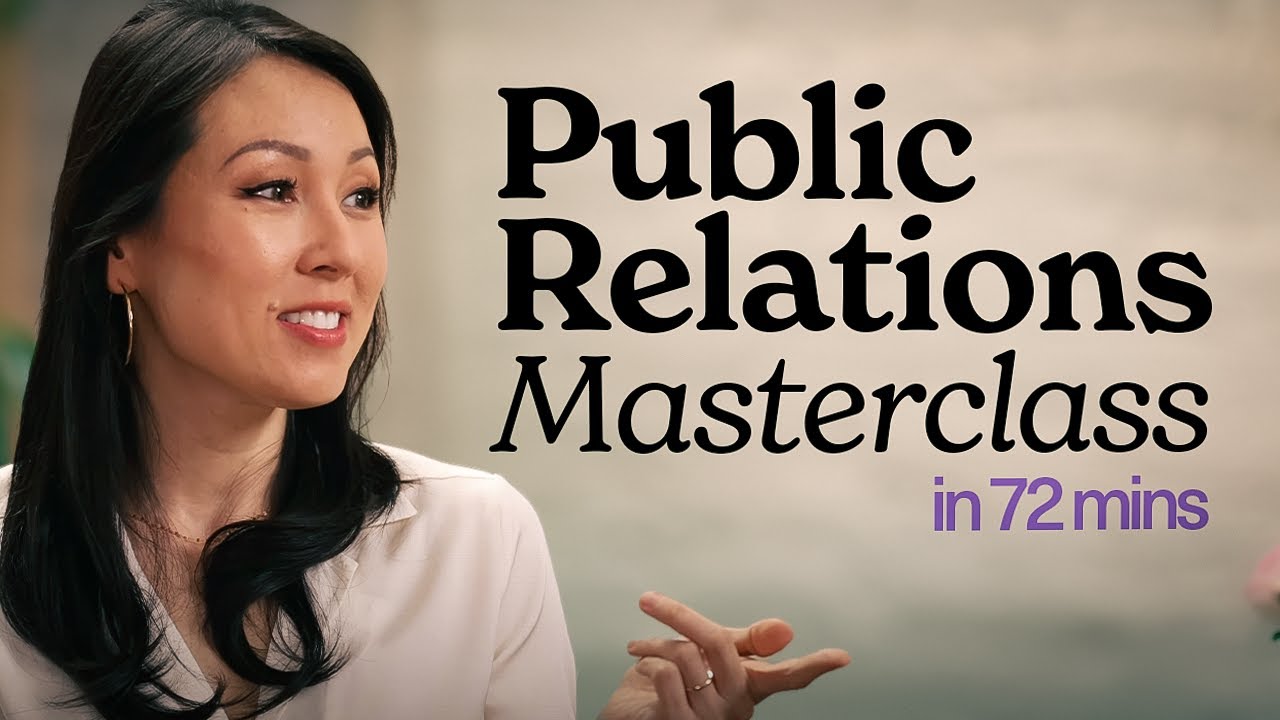
Lulu Cheng Meservey is a communications expert who has worked with companies like Substack and is known for rejecting bland, risk-averse corporate speak in favor of writing with personality, clarity, and emotional resonance. She draws on an unusual range of influences—counterinsurgency theory, behavioral psychology, game theory, K-Pop fandoms, and ancient Greek debate—to explain how messages spread, how trust is built, and how companies can communicate in ways that actually move people.
Why corporate speak exists and how to avoid it
Corporate communications persist primarily as a form of risk minimization: if you say nothing distinctive or spiky, it’s hard to get in trouble—but the tradeoff is that you also miss opportunities to connect.
It’s also a collective force of habit: people entering corporate roles unconsciously mimic the style of those who came before, cosplaying as “corporate ancestors.”
Lulu avoids corporate speak by reading everything out loud—if you’d never say it to a family member or friend, your body will resist saying it, and that cringe feeling is a reliable signal.
Reading aloud also improves cadence and rhythm, making writing better overall.
Writing under pressure
On high-stress days—crises, major announcements—the key is preparation: establish the “weight-bearing pillars” of any statement in advance (audience, priorities, what you care about vs. what they care about).
When the day arrives, filling in details becomes like mad libs: you’re just plugging in a few nouns and verbs into a structure that’s already built.
Establish clear authority and approval chains in advance so you don’t waste time deciding who needs to sign off during a fast-moving situation.
Minimize the number of people in the approval loop; for high-stakes items, pre-identify exactly who needs to review so the process is “boom, boom, boom.”
Conveying emotion without being emotional
When writing, aim for one dominant emotion or feeling the reader should walk away with, plus one clear call to action—three is the absolute maximum.
The art of good writing is being in a sober, low-emotional state yourself while still creating feeling on the page. Bottle up emotion, step back, then mix it into something appropriate for public consumption rather than letting it gush out raw.
Companies should feel like an extension of their customers: hire from the community you serve, and make the company’s personality culturally familiar to the people you’re trying to reach.
Companies, souls, and personality
Companies don’t have souls in a spiritual sense, but they can function as if they have one: an ineffable atmosphere where people intuitively understand what the company would or wouldn’t do, even if it’s not written down.
Much of that gets communicated through writing—which is why soulless, robotic corporate speak is so damaging.
Lulu deliberately exposes her own personality in professional communications because people don’t trust corporations or institutions, but they will trust a person. Vulnerability and honesty are the only real path to building trust.
Game theory and strategic retaliation
Lulu follows a strategy she calls “tit for two tats” (not tit for tat): she often turns the other cheek, but when someone repeatedly crosses a line—being cruel, dishonest, or unfair—she addresses it publicly and decisively.
This is drawn from repeated game theory: if you’re playing a game over and over, your optimal strategy is to shape others’ future incentives by responding to patterns, not individual slights.
The advantage of waiting is that you respond from a place of calm, dispassionate analysis rather than reactive emotion, which makes your response more credible and effective.
Why media attacks startups, and the counterinsurgency lens
As Substack grew, it faced accelerating attacks from incumbent media who felt threatened—a pattern Lulu recognized from her graduate study of counterinsurgency.
Counterinsurgency and startup communications share the same physics: if you’re coming from behind and challenging incumbents, you can’t rely on existing power structures to carry your message.
Instead, you find centers of gravity in communities (influencers, trusted voices), get them to buy in, and let them spread the message outward.
You build your own distribution networks and speak directly to your audience in ways they understand, through people they trust, with clear actions to take.
Christianity as the ultimate messaging case study
Christianity is one of the most successful message-spreading operations in human history, and it offers two lessons:
The story arc: Things were supposed to be a certain way → something went horribly wrong → there’s a solution → the solution requires action → the solution restores the ideal. This arc is deeply embedded in human psychology—people have “receptors” shaped exactly like this story.
The distribution method: Find centers of influence, don’t rely on existing power structures, speak directly to people through trusted carriers, and give them clear actions. Every company needs its equivalent of 12 disciples.
Distribution: quantity vs. depth
There’s a fundamental tradeoff between quantity (how many people you reach) and depth (how deeply you resonate with them).
At one extreme: a message that appeals to everyone but means almost nothing (“breathing air is good”). At the other: a message that’s incredibly meaningful to one person but reaches no one else.
Companies must consciously choose where on this spectrum they need to be, based on what they need people to do and how many people need to do it.
If the ask is small and simple, go mass market. If the ask is big (invest a million dollars, make a major commitment), go deep—call three people personally and invest months in each relationship.
Many of the most effective distribution channels are illegible or underestimated by mainstream media (e.g., Joe Rogan’s podcast).
Slogans, rhymes, and tribal identity
Effective slogans work like religious shibboleths: they get repeated until they take on outsized, almost sacred meaning, and knowing them marks you as a member of a tribe.
Rhyming and ABBA structure (“Ask not what your country can do for you, but what you can do for your country”) create a cognitive pleasure that makes people feel truth is encoded in the phrasing.
Amazon’s “focus on the customer” and “Day One” are examples: simple slogans repeated consistently across shareholder letters, speeches, and even building names, accumulating meaning over time.
Behavioral psychology and framing
Lulu worked in a behavioral psychology lab and brings those insights to communications: the goal is to interact with human psychology in a benign way.
The ultimatum game demonstrates the power of framing: the same factual offer (splitting $100 as 60/40) produces completely different reactions depending on whether you frame it as “I’m giving you $60” vs. “I’m keeping $40” vs. “we found this pot of gold” vs. “you earned this.”
Framing influences not just whether someone accepts an offer, but how they feel about you—which is directly applicable to marketing, sales, and any communication where you’re asking for someone’s time or money.
Cultural erogenous zones and the API metaphor
People have “cultural erogenous zones”—pre-existing shapes in their minds that certain ideas fit into. You can’t change what these are; you have to mold your message to fit them.
If your idea doesn’t naturally fit, you need to build an API (bridge) between where your audience is and where you are—a gateway drug or transition that lets them receive and make space for your new idea.
Example: Kamala Harris, running for Senate, wanted people to care about K-12 education. Many cared about national defense but not education. Her bridge: you can’t join the army unless you can read at a 10th-grade level, so if you want a future pipeline for the military, you need to educate 10th graders. She connected the thing they cared about to the thing she wanted them to care about.
This doesn’t mean only saying what people already believe—Lulu strongly advocates for bold, new, even controversial ideas—but you still have to attach them to existing receptors for them to stick.
Lulu’s writing process
She writes late at night, half-asleep, when her brain is looser and more willing to wander. She jots ideas on her phone in airplane mode, then evaluates them in the “harsh light of day.”
This mirrors the ancient Greek practice of debating ideas twice—once drunk, once sober. If an idea makes sense in both states, it’s probably good.
She writes on her phone because she does a lot of cutting, pasting, and reordering: she cares deeply about the arc of every story, and changing the order of elements can completely change what kind of story it is.
She keeps a “scrap heap” at the bottom of her documents for sentences she falls in love with but that don’t serve the piece. Rather than deleting them (too painful), she moves them out of the way. After a few days of distance, she can see they’re not as irreplaceable as she thought.
She combats the illusion of transparency (assuming readers know what you know) by letting time pass and returning with fresh eyes, or by having her husband—a policy paper writer—edit for logical gaps and tell her to “stop throat clearing” and just say the thing.
Writer brain vs. friend brain
Writer brain is the performative mode where you’re trying to sound impressive for a discerning audience. Friend brain is when you’re relaxed and talking naturally.
To break out of writer brain, Lulu reads drafts to people who know her as a person (her husband, her five-year-old daughter)—they’ll call her out when she doesn’t sound like herself.
She also recommends hiring people from outside communications (designers, programmers, veterans) who don’t know the templates and are therefore freer to be creative. Experience can be a shackle.
Twitter as a medium and growth tactic
Lulu uses Twitter strategically: having a public presence changes the incentives and behavior of reporters, who take you more seriously and think twice before publishing something unfair if they know you’ll rebut it publicly.
It’s easier to defend others than yourself—defending yourself looks defensive, but someone else defending you is more convincing to bystanders.
Twitter’s 280-character limit is a forcing mechanism against bloat and bloviation. Lulu sometimes drafts in the Twitter compose window even when she has no intention of tweeting, just to force herself to be crisp.
Growth tactic: tweet frequently and regularly. Momentum builds—one hit tweet makes the next more likely to land.
But she cautions against chasing numbers for their own sake: after a meetup where she realized the attendees weren’t her people, she shifted focus to quality of audience over size. A small group of deeply passionate true believers who will spend money, time, and social capital on your behalf is more valuable than a large passive list.
Lessons from Substack
At Substack, Lulu learned that consistency and a clear proposition are the basic hygiene of newsletter growth.
For email newsletters especially, niche beats broad: it’s better to have a small list of people who deeply want what you’re offering than a large list where nobody opens your emails. In fact, having people on your list who never read is worse than not having them—some writers actively prune their lists.
The writers who succeed have at least one of: a unique beat, a unique perspective, or a unique style. Ryan Broderick’s Garbage Day covers internet culture (a crowded beat) but his distinctive, entertaining style makes it irreplaceable.
The point is to be read, not just to have a big number.
Learning English as a non-native speaker
Lulu grew up moving around; from ages 8 to 12 she lived in Norway, where TV is in English (not subtitled) and Norwegians speak excellent English. This gave her an immersive foundation.
Being a non-native speaker is actually an advantage: she’s hyperaware of how words and phrases might be misinterpreted by someone without native cultural context, and she avoids idioms and jargon that only a native speaker would understand—treating them as a different kind of insider language.
What she reads to improve her craft
She reads as far from communications as possible to liberate herself intellectually and find inspiration from heterogeneous sources: historical fiction, classics, and the Marine Commandant’s reading list (curated by career level, mixing fiction, leadership, and political books).
A standout: Gates of Fire by Stephen Pressfield, about the Battle of Thermopylae—visceral, beautifully written, with leadership lessons embedded in story (e.g., Leonidas silently picks up a rock and starts building a wall; his men stop bickering and join him).
She’s also studying screenwriting to understand how to build compelling characters, create stakes, and generate momentum—skills she wants to bring to her writing.
Different lenses for writing
Lulu’s own lens comes from her Washington, D.C. background in geopolitics and risk management: she instinctively thinks about all the ways something could be misunderstood, misinterpreted, or fail to translate across cultural and language barriers.
Other valid lenses include engineering, design, poetry, or literature. The key is having some additional frame beyond communications itself.
She wishes she had a more literary storytelling lens—the ability to naturally create stakes, rooting interest, and momentum.
Stories vs. statistics
A recurring theme: stories beat statistics in communications. An accusation is usually a story (“David, a father of seven, lost his job to outsourcing and is now depressed”), while a defense is usually a statistic (“productivity went up by 4%”).
As the saying goes: “One death is a tragedy; a thousand deaths is a statistic.” If you’re fighting a story with a statistic, you’re always losing.
The accuser chooses the frame, just like in international negotiations: whoever writes the first draft of the treaty holds enormous power. If you’re reacting to someone else’s frame, you’re already in a losing position.
Lessons from Bitcoin, K-Pop, and evangelism
Bitcoin succeeds in part because it has no central comms department—its messaging is decentralized. People evangelize because identifying as a Bitcoin believer is part of their identity; the reward is the social and psychological payoff of publicizing that identity, not a paycheck.
K-Pop fandoms show that being a fan is fun on a meta level: you become more of a fan because you enjoy being part of the community, and the community rewards deeper devotion. Identity and community reinforce each other.
People who like a thing can make you like it more or less: if the evangelists for your brand are annoying, cool, or scammy, that perception transfers to the brand itself. Choose your evangelists carefully—they should be aspirational for the next circle of people you want to reach.
Cautionary tale from crypto: many projects focused on the technology (“we’re built on the blockchain!”) rather than the benefit to the user. Nobody cares what it’s hosted on—they care what it does for them. The same applies to AI and any new technology: lead with the user benefit, not the technical novelty.
Why writing compels her
Writing takes prosaic building blocks (words, sentences) and lets you build structures that can become palaces—artifacts that live on forever.
It’s compelling because it combines multiple disciplines: strategy, business, finance, human psychology. It feels like solving a puzzle or a math equation.
And there are real stakes: if you solve it, you can spark something magical; if you mess up, it can go wrong. That tension is part of the thrill.