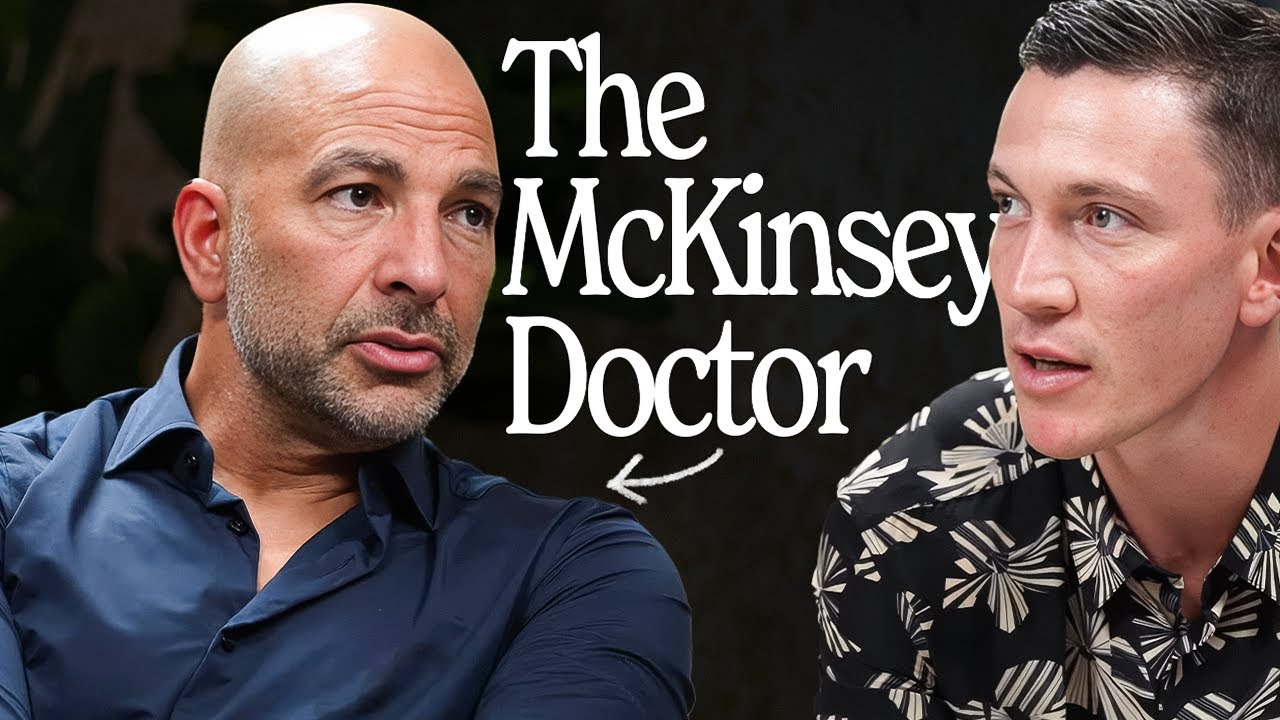
Peter Attia, a Stanford-trained surgeon turned podcaster and author of the bestselling book Outlive, discusses the emotional and intellectual journey of writing a book that bridges rigorous science with practical, life-changing advice. The conversation explores how he structured the book around storytelling, developed frameworks for complex medical ideas, overcame setbacks including losing his publisher and agent, and ultimately created a work designed to remain relevant for decades by focusing on timeless principles rather than fleeting tactics.
How Peter Attia structured his book around a story
The book opens with a vivid recurring dream from Attia’s medical residency: he’s in scrubs on a dark street, trying to catch eggs dropped from a balcony, catching some but missing many.
This dream became a central metaphor for the limitations of modern medicine—what Attia calls “Medicine 2.0”—which excels at saving people in acute crises (catching falling eggs) but fails to prevent chronic disease (stopping the person throwing the eggs).
The dream sets up the book’s core thesis: the need to shift from reactive treatment to proactive prevention, which he terms “Medicine 3.0.”
Attia pairs this with a Desmond Tutu quote about going upstream to stop people from falling into the river, reinforcing the preventive mindset.
The first chapter then opens with the line, “I’ll never forget the first patient whom I ever saw die,” grounding the abstract framework in a visceral, personal story that contrasts fast death (where medicine excels) with slow death (where it fails).
Writing technical vs emotional
Attia’s prior writing was almost entirely technical—scientific papers, blog posts, and newsletters—where editorializing is discouraged and data must speak for themselves.
He had no initial instinct to write emotionally or use personal narrative; his co-author Bill Gford pushed him to embrace storytelling.
The emotional depth was not present in early drafts but emerged through collaboration and deliberate effort to make the book resonate on a human level.
Peter Attia’s 3-part framework (Strategy, Objectives, Tactics)
The book is organized around a clear hierarchy: start with objectives, then develop strategy, then define tactics—never skip steps.
This structure, inspired by Sun Tzu’s The Art of War, helps readers avoid the common mistake of jumping straight to tactics (e.g., “eat this, not that”) without understanding the underlying strategy or goal.
Each chapter also contains its own internal frameworks (e.g., nutrition, exercise, stability) to minimize confusion and overlap.
These frameworks evolved over more than a decade of patient consultations, often drawn on whiteboards during appointments, and were refined through constant iteration.
How to develop your voice and select a medium
Attia aimed for a voice accessible to a high school graduate but sophisticated enough for readers of The New York Times or The Atlantic—avoiding both dumbing down and excessive jargon.
A key tension was balancing scientific precision with readability; for example, he and his co-author debated for a month over using the term “extracorporeal” versus a simpler explanation.
The goal was to write rigorous non-fiction, not self-help, while still offering actionable advice.
Why Peter decided to lower profit with his book cover (Easter egg!)
The book cover includes a subtle Easter egg—a small archery target—referencing Attia’s love of archery metaphors.
The publisher resisted due to added cost, but Attia insisted because it was meaningful and cool, even at the expense of marginal profit.
How to successfully work with a co-author
Attia worked closely with co-author Bill Gford through Google Docs and in-person meetings, with the deepest collaboration happening early on structure and flow.
The main source of productive tension was depth: Attia always wanted to go deeper into the science; Gford pushed to keep it accessible. They met in the middle through iterative compromise.
Unlike ghostwriting, Attia was deeply involved in every word, making the process longer but resulting in a more authentic and polished book.
Why Peter didn’t want a self-help book for the New York Times list
Attia explicitly wanted the book classified as general non-fiction, not self-help, to signal its scientific rigor.
Yet he also wanted it to be practical—readers should finish with a clear sense of what to do differently.
When the book debuted on the New York Times general non-fiction list, he considered it a major validation of this dual goal.
How to provide practical, concrete tactics
Attia uses vivid, relatable analogies to make abstract numbers tangible. For example, instead of saying “lift 40 pounds,” he describes lifting a grandchild into the air for 20 seconds.
This approach comes from his medical practice, where patients define specific goals for their “centenarian decathlon”—a set of physical tasks they want to perform in their 90s or beyond.
Goals range from basic activities of daily living (picking up a grandchild) to recreational challenges (walking 18 holes of golf), each requiring different training approaches.
Setting your most important goal
Attia’s primary goal for the book was timelessness: he wanted it to remain relevant in 10 years.
Tactics (specific diets, drugs, protocols) evolve rapidly and become outdated, but objectives (extending healthspan) and strategies (delaying chronic disease, reverse-engineering from end-of-life goals) are enduring.
The scaffolding—frameworks like the Four Horsemen of chronic disease, backcasting from the centenarian decathlon—is designed to outlast any individual recommendation.
How to write painful personal stories
Chapter 17, the final chapter, was written entirely by Attia over the course of a year, separate from the rest of the book, and was deeply personal, drawing from his journals.
It was the hardest part to write—not technically, but emotionally—because it required confronting his own flaws and vulnerabilities.
His co-author helped him zoom out from blow-by-blow detail to capture the essence without overwhelming the reader.
Peter’s career (Medical school, McKinsey, Doctor, Writer)
Attia left medical school two years early to work at McKinsey & Company, where he was excited by the intellectual challenge and risk analysis, though he later questioned whether he had “wasted” a decade in medicine.
He justified the move as avoiding the sunk cost fallacy, choosing long-term fulfillment over short-term continuity.
Ultimately, he returned to medicine in a different form—focused on longevity and prevention—shaped by his non-traditional path.
How podcasts changed Peter in 2016
In 2016, when he started writing the book, Attia did not yet have a podcast. By 2022, his podcast had become a major platform for exploring ideas weekly with world experts.
He realized that if he’d known about the podcast opportunity in 2016, he might not have written the book—but he’s glad he did, because a book reaches audiences (like his parents) who don’t listen to podcasts and offers a curated, permanent resource.
Why the publisher trashed Peter’s book
The original publisher bought the book in 2016, but the acquiring editor left within three months, and the replacement editor lacked passion for the project.
Attia missed deadlines repeatedly, and by early 2020, the publisher threatened legal action if he didn’t deliver by April.
While stranded in Norway filming a Disney+ special with Chris Hemsworth, Attia decided to return the advance and walk away, effectively killing the book.
How Michael Ovitz resurrected Peter’s book
In December 2020, Attia had dinner with friend Michael Ovitz, who had written a raw, personal book of his own.
Attia mentioned his shelved manuscript; Ovitz asked to read it and later called to say it had the potential to be a great book.
Ovitz connected Attia with an editor at Penguin Random House, who loved it. Attia and Gford spent two weeks cleaning up the “dumpster fire” of a manuscript, and the book was reacquired and published.
Peter’s daily schedule to write this book
During the final 21 months of writing, Attia dedicated one full day per week (three out of four weeks) exclusively to writing—no patients, no calls, no podcast work.
He worked from his desk at home, preferring to stay close to family rather than retreat to a remote location.
The rest of the time, writing happened on nights and weekends, making the process grueling but sustainable.
What idea Peter polished the most and his focus on nutrition
Attia refined his thinking on nutrition more than any other topic, arriving at an agnostic, principle-based approach rather than advocating a single “true diet.”
He argues that nutrition has a wide downside (poor diets cause harm) but limited upside (optimal diets offer marginal gains), whereas exercise has both massive downside (sedentary lifestyle) and massive upside (transformative benefits).
He views the body as a “dampener” of nutritional signal—focused primarily on total calories and protein—making most dietary debates (keto vs. vegan, etc.) fifth- or sixth-order effects that distract from first-order principles.
How to handle perfectionism, fear, and criticism
Attia is a self-described perfectionist, which made the writing process agonizing—he couldn’t let anything go without extensive debate.
He feared public rejection and criticism, especially knowing his views would evolve and future versions of himself might disagree with the book.
He accepted this as inevitable: either he was wrong about everything (unlikely) or he would grow (desirable), and both outcomes required putting the work out anyway.
Why Peter admires writers and speakers like Sam Harris
Attia admires figures like Sam Harris for their clarity, precision, and refusal to dumb down complex ideas.
He doesn’t try to emulate them but instead focuses on capturing his own voice as faithfully as possible.
He values the “20/80”—the deep, nuanced 20% that most people skip—over the oversimplified “80/20.”
Non-linear process of writing a book
Writing a book is not linear in terms of progress: you can be 80% through in time but far from 80% in actual completion.
The hardest parts were linking chapters together and cutting material that, while excellent, wasn’t essential—what writers call “killing your babies.”
The final 10–20% of editing, where the harshest cuts are made, yields the majority of the improvement, like carving a statue by removing stone.
How to structure the framing of a book
Attia structured the book to first establish the history and limitations of Medicine 1.0 and 2.0, then introduce 3.0 as a new paradigm.
Earlier drafts included far more scientific detail and a full section on drugs, supplements, and hormones, but these were cut (reduced from a chapter to an appendix to removal) to avoid overwhelming readers.
The lesson: even experts must resist the urge to include everything they know; a co-author or editor who respects your expertise but challenges your assumptions is essential.
Editing in the final stages
Even after the manuscript was typeset and in its final proof stage (3p), Attia made edits while recording the audiobook, realizing that reading aloud reveals awkward phrasing and errors invisible on the screen.
Most of his late edits were about clarity and flow, not restoring cut content, confirming that the trimming had been beneficial.
What matters in writing a provocative conclusion
Attia believes non-fiction should end with a call to action—what should the reader do differently—not just what should they think.
His conclusion focuses on emotional health as the most important pillar of healthspan, a surprising choice for a book titled Outlive, and urges readers to prioritize quality of life, arguing that length of life follows naturally.
How to categorize your book
Attia resisted being grouped with “longevity” gurus, as the term often connotes pseudoscience, but redefined longevity as a function of both lifespan and healthspan.
He titled the book The Science and Art of Longevity (not “Art and Science”) to emphasize that the foundation is empirical science, not anecdote.
The hardest chapter to write
The chapter on stability was the most technically difficult, requiring extensive collaboration with experts like Beth Lewis.
Stability is easily confused with rigidity, so Attia used a race car analogy—stable but moving, transmitting force without energy leakage—to clarify the concept.
He fought to keep this analogy despite publisher resistance, believing it was essential to understanding.
Explaining core ideas over dinner, not an elevator pitch
Attia rejects the idea that complex topics can be explained in an elevator pitch; instead, he aims to explain anything over the course of a dinner conversation.
This allows for nuance and depth without losing the audience, acknowledging that some ideas require time and dialogue to convey.
The importance of fact checking
The publisher did not provide a fact checker for the science, so Attia hired his own team, including his head of research and an analyst unfamiliar with the book.
Fact checking involved both verifying data and ensuring correct interpretation of studies, addressing not just fraud (rare) but more common issues like flawed experimental design or statistical errors.
The book has been praised for its remarkably low error rate, a testament to this rigorous process.
How Peter found the courage to share his personal stories
Attia included his own transformation—his struggles with emotional health, self-perception, and change—because if the goal is to inspire behavioral change, showing that change is possible in oneself is the most powerful proof.
He opens the final chapter with a raw admission: “I believed I was the most horrible, incorrigible, miserable son of a bitch…” and closes with the message that if he can change, anyone can.
The courage came from recognizing that vulnerability serves the reader’s journey, not just the author’s ego.