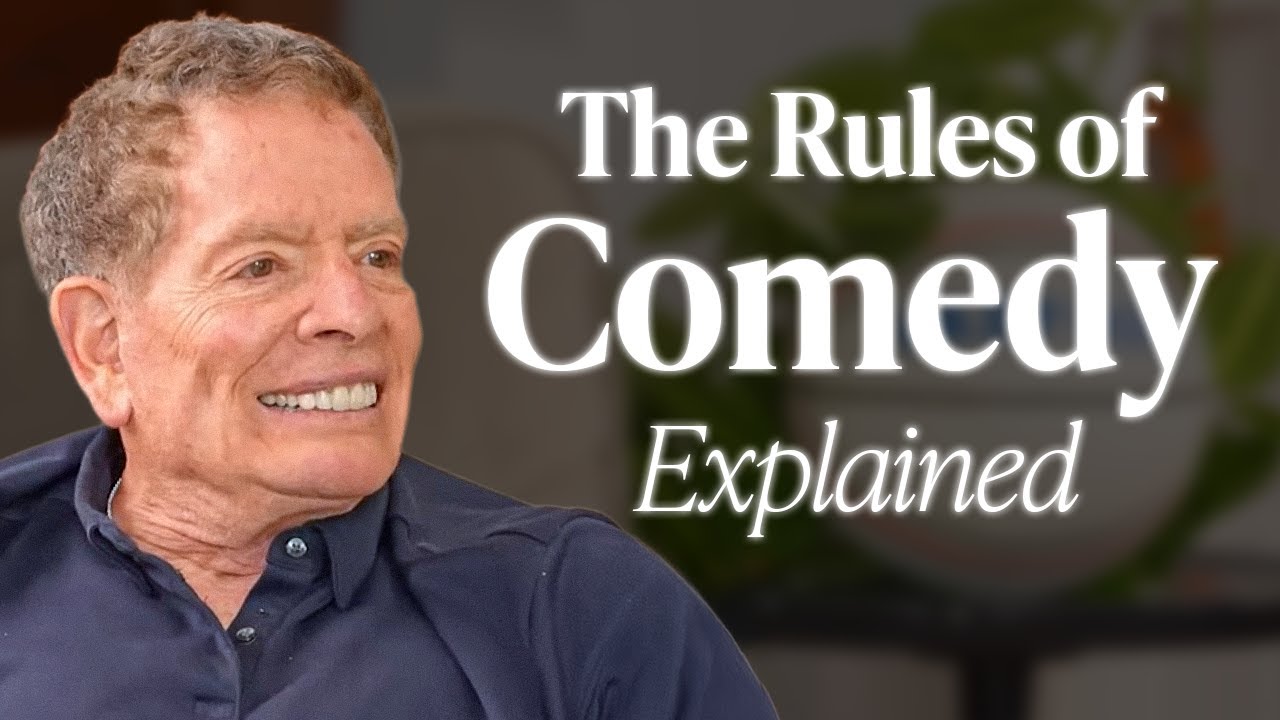
- David Zucker, director of Airplane!, The Naked Gun, and Scary Movie 3–5, explains the disciplined craft behind his seemingly chaotic comedies. His work with partners Jerry Zucker, Jim Abrahams, Pat Proft, and Mike McManus is governed by a set of self-imposed rules developed over decades, starting from their live sketch show Kentucky Fried Theater in the early 1970s. The core insight driving all of their work: comedy depends on surprise, story matters more than jokes, and discipline—not just anarchy—is what makes the humor land consistently.
The Core Principles of Their Comedy
-
Surprise is the foundation of all comedy.
- Zucker first learned this watching a Dick Van Dyke Show episode in fifth grade, where Van Dyke explained that comedy depends on reversing audience expectations.
- Their spoof method: take a serious movie (like Zero Hour for Airplane!) and flip every scene so the audience expects one thing and gets another.
- Example: two children speaking like adults, then one says, “I take my coffee black like my men.”
-
Story beats jokes every time.
- The team learned from mistakes—especially on Top Secret, which they consider their funniest film but structurally weak because it lacked a clear emotional arc.
- What audiences actually care about is the human story: in Airplane!, it’s whether Ted and Elaine get back together; in The Naked Gun, it’s whether Frank Drebin wins Priscilla Presley.
- Without a believable emotional throughline—ideally a love story—jokes become tiresome by the third act, no matter how clever they are.
- They aim for 80–90 minute runtimes, tight three-act structures, and cut ruthlessly in previews to preserve only what gets laughs.
-
Let the lines do the work—never let actors try to be funny.
- Zucker tells actors to play it straight. Priscilla Presley was told to simply be her Dallas character; he never had to direct her.
- The humor comes from the writing and situation, not from performers mugging or improvising.
The Rules They Live By
-
No joke on a joke.
- One character must be the straight man; if everyone tries to be funny, the scene collapses. This is why they cast serious actors like Peter Graves and Leslie Nielsen—their deadpan delivery makes the absurd lines funnier.
- Example: Peter Graves delivers horrifying symptoms in the foreground while Leslie Nielsen and Julie Hagerty have a mundane conversation in the background.
-
Never acknowledge the joke.
- If a character reacts to or comments on the absurdity, the laugh is cut in half. The humor lives in the audience discovering it themselves.
- Example: Leslie Nielsen looks up to the cockpit and says, “What the hell’s going on up there?”—while in the background, a woman’s legs are in stirrups and he’s holding a speculum. He never acknowledges it.
-
Related background.
- Place jokes in the background while the foreground action appears to be the focus. The audience feels rewarded for noticing.
- Inspired by Harold and Maude, where Bud Cort lights himself on fire in the background while Ruth Gordon talks to a therapist.
- Example: O.J. Simpson tumbling down the stairs in The Naked Gun while Priscilla says, “Everyone should have a friend like you.”
-
Can you live with it?
- A joke must end cleanly. You can’t let a gag linger past its punchline or carry visual consequences into the next scene.
- Example: Leslie crashes through a skylight covered in scratches—then instantly appears fine. The pistachio nut stain on their lips during the stakeout disappears the moment the scene ends.
-
Merely clever isn’t enough.
- If preview audiences say “that’s clever” without laughing, it gets cut. Laughter is the only metric that matters.
- Top Secret has their cleverest jokes, but without a strong story, it underperformed compared to Airplane! or The Naked Gun.
-
No axe grinding.
- Avoid making political or social messages the point of the movie. If the message overwhelms the comedy, the film fails—unless you’re funny enough to carry it.
- Exception: An American Carol, a political satire making fun of Michael Moore and the left, which Zucker admits is axe grinding but argues works because it’s funny and has slapstick.
-
No straw dummies.
- Don’t rely on cheap topical references (like Nixon or Trump jokes) or made-up names that only work as low-hanging targets. These date quickly and feel lazy.
- Avoid trivia references that won’t be understood in 50 years. Zucker wants his films to last.
-
No technical pizzazz.
- Big special effects, car crashes, and expensive set pieces slow down the pace and aren’t funny in comedies. The audience wants jokes, not spectacle.
- Their sets are simple (the Airplane! control tower, the police squad office), and their gags are cheap and physical—a guy thrown off a dock, a car hitting a trash can.
-
The 15th rule: There are no rules.
- When something works, they break their own rules. Mel Brooks breaks the fourth wall effectively; Zucker does it sparingly but memorably.
How They Write and Test
-
Writing is collaborative and iterative.
- They write in a room together, testing jokes on each other for instant reactions—a practice rooted in their live theater days.
- Pat Proft is considered the best joke writer they’ve ever worked with; he wrote most of Leslie Nielsen’s iconic lines.
- Scripts take up to 18 months of drafts. Zucker visualizes the page: any speech over six lines is cut.
-
They test everything with audiences.
- Starting with Kentucky Fried Movie, they preview extensively and cut to the laughs. Airplane! was previewed at 100 minutes and cut to 80.
- If a joke doesn’t get a laugh, it comes out—no exceptions.
-
Pacing comes from live performance.
- Their rule: never let silence happen on stage. It’s easier to keep an audience laughing than to restart them after they stop.
- This became the rapid-fire pacing of their movies—every line is either a setup or a joke.
Character and Structure
-
Build character in the first act.
- The protagonist needs an inner psychological problem, not just an external mission.
- Airplane!: Bob Hayes has PTSD and is afraid of flying.
- The Naked Gun: Frank Drebin’s girlfriend left him; he needs love.
- Without this, the audience has no rooting interest.
- The protagonist needs an inner psychological problem, not just an external mission.
-
Use running gags sparingly.
- Repeating a joke can work (the guy who keeps wishing the cockpit luck), but overdoing it annoys audiences.
- The Airplane! director’s cut is the only one in film history shorter than the original—they cut running gags that had been overused.
Breaking the Frame
- Acknowledge the audience—but only when it serves the joke.
- In Top Secret, Val Kilmer recites the entire plot, then Lucy Gutteridge says, “I know it sounds like a bad movie,” and they both look at the camera as if hearing the audience laugh.
- In The Naked Gun, a waiter starts to bring a Black Russian, looks at the camera, and says, “Not going to do that.”
- Groucho Marx did this regularly; Woody Allen never does. Zucker uses it rarely but effectively.
Casting and Cameos
- Sports stars and non-actors work when they can’t act.
- Kareem Abdul-Jabbar and O.J. Simpson were cast because they couldn’t act—it’s the emperor’s new clothes joke. The audience knows it, and that’s the humor.
- Kareem enjoyed it because it let him poke fun at his serious public image.
Hollywood Today
- Studios have stopped taking creative risks.
- They now only finance big stars, remakes, sequels, and franchises. Independent financing is the only path for original comedies.
- Zucker’s Naked Gun 4 script was rejected by Paramount; he’s retitled it Counter Intelligence and plans to finance it independently.
- He believes fewer people go to theaters and streaming has changed the economics, but the result is less creativity.
Legacy and Learning
-
They learned by failing and taking responsibility.
- Every flop was analyzed internally. Zucker never blamed studios or audiences—he asked, “What did I do wrong?”
- His father’s lesson: “I never learned a lesson that didn’t cost me money.”
-
Their comedy endures because it’s built on universal principles, not trivia.
- They avoid dated references so films still work 50 years later. Most of Airplane! still lands; a few jokes (like the Anita Bryant reference) are lost on modern audiences.
-
The course: mastercrash.com
- Zucker offers an informal comedy writing course focused on their rules and methods. It’s designed to be fun and accessible, not academic.