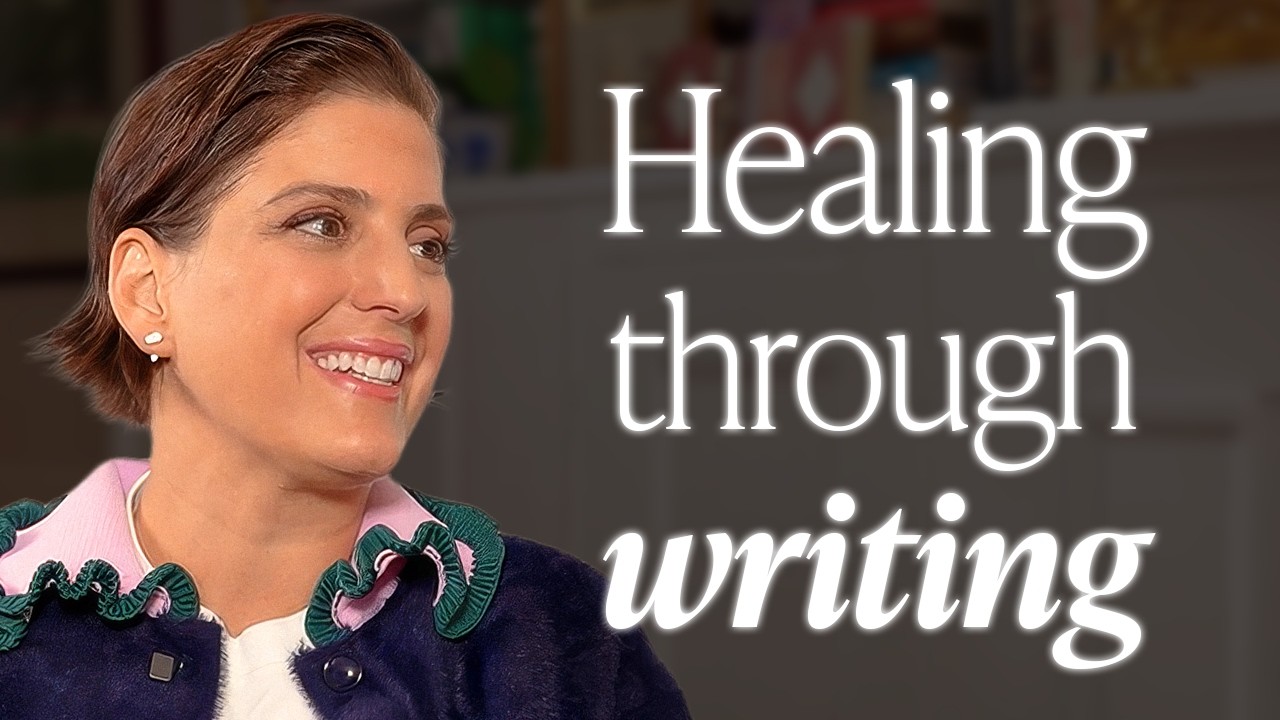
Suleika Jaouad is a New York Times–bestselling author and memoirist who began writing publicly from her hospital bed after being diagnosed with leukemia at 22. She wrote a column and video series for the New York Times, then the memoir Between Two Kingdoms, and later The Book of Alchemy, a book about creativity. This conversation explores how she accesses creative vulnerability, fights writer’s block, and uses journaling, prompts, and sensory attention to write with honesty and depth.
Her core philosophy: to write a good book, write what you don’t want others to know about you; to write a great book, write what you don’t want to know about yourself.
She grew up in a creative household—her father a professor of French literature, her mother a visual artist—but her family also valued toughness and self-reliance, making her cancer diagnosis at 22 a jarring collision between forced vulnerability and a bootstraps mentality.
Porousness as a creative stance
Jaouad describes two kinds of porousness essential to her writing:
Receptive porousness: letting the world in fully, even when it’s overwhelming—feeling the intensity of a heavy metal concert rather than shutting down.
Excavative porousness: going beneath the sediment of what you think you know about yourself, uncovering the stories and truths you’ve buried.
She learned from her mother, a painter, to lean into mistakes on the canvas: “That’s where the energy is. Don’t cover it up.”
When she first started writing for the New York Times, the pressure to write something “New York Times–worthy” killed her creative impulse. Her breakthrough was forgetting the audience and returning to the free, playful, outcome-free writing she did as a child.
She distinguishes between having a conceit or idea for a work and then forgetting it—letting the subconscious lead so she’s not writing with an agenda, but following a train of thought without knowing where it goes.
Her first drafts were often “lies”—surface-level, aspirational stories. The real story emerged only through excavation, interrogating what she thought she was writing and digging beneath it.
Writing from the hospital and the power of handwriting
In the hospital, freed from all external expectations, Jaouad returned to writing purely for herself—the way she wrote as a child. She used her journal as a reporter’s notebook, writing toward questions she couldn’t talk about out loud, from the trenches of uncertainty.
She writes all first drafts by hand in a journal to bypass the tyranny of the blinking cursor and the impulse to edit before she knows what she’s saying.
Handwriting creates a direct subconscious-to-page connection; there’s only so much crossing out you can do.
The computer demands formality and activates the inner judge too early. The judge and creator cannot operate simultaneously without shutting down access to deeper material.
She sometimes changes her handwriting mid-draft or, following poet Marie Howe’s method, writes with her non-dominant hand starting with “I don’t want to write about…” to access blocked material.
The goal is to loosen grip on both the intended outcome and the ideas themselves, writing and writing until reaching “the truth beneath the truth beneath the truth.”
Making space for writing
Jaouad is deeply introverted and creates physical and mental distance to write. While working on Between Two Kingdoms, she did self-styled writing residencies, house-sitting and dog-sitting in remote locations to escape the responsibilities of her own life.
Her daily ritual: wake up, walk the dog, leave her phone in the mailbox, write for a couple hours, then retrieve the phone on the next walk.
She uses a physical token system (a “brick” on the fridge she taps to mark focused work periods) to enforce distraction-free time.
She sees handwriting and typing as almost two different genres—the distance between them helps her see the work more clearly when she begins editing during transcription.
The unique struggle of writing memoir about trauma
Writing Between Two Kingdoms took her two years longer than expected. She spent six months unable to let go of her original book proposal outline.
She identifies two warring parts of herself: the “good student” who wants to execute the plan, and the “hellraiser” who needs to break free of it.
Writing about trauma can retraumatize: she found herself on the floor every afternoon by 3 or 4 p.m., having a trauma response to the material, even though the only threat was the blinking cursor.
Writing memoir about traumatic experience forces a confusing simultaneous dissociation (making stylistic decisions, moving paragraphs) and immediacy (reinhabitating the scene).
Her breakthrough came not from working harder but from stepping away. After a trusted writer told her 150 pages “weren’t working,” she drove to the beach with friends, and mid-conversation realized she’d been writing about illness in the past tense as if it were behind her, when she was still in the midst of reckoning with it.
Switching to present tense unlocked the writing. She opened her laptop in the car and began converting chapters, and the work came alive.
The lesson: balance rigor and discipline with strategic distance—not as a break from writing, but as something that facilitates it.
Creative cross-training and the “bed, bath, bus” framework
Jaouad’s friend offers a framework for when you’re stuck: bed (sleep), bath (relax, let the brain simmer at low heat), or bus (get on the road, change your environment).
The key distinction: knowing when you’re running from the problem versus when you’re genuinely out of juice and need to refill the tank.
She thinks of stepping away as “creative cross-training”—shifting into a different mode of expression: painting, walking in the woods, going to a museum, hearing another writer speak, playing or listening to music.
Music deeply informs her writing process. She thinks in terms of rhythm, crescendos, decrescendos, movements, and recurring motifs—she wants her books to have a symphonic structure.
She teaches an exercise called “reading the right edge”—breaking a paragraph into individual sentences on separate lines to see and shape the rhythm like an accordion of varying sentence lengths.
Beyond mechanical rhythm, there’s the rhythm of voice—something inexpressible and usually unconscious, but palpable when you’re in the flow. She recommends reading a book while simultaneously listening to the audiobook (ideally read by the author) to hear how punctuation, emphasis, and pause create music on the page.
Theme, motif, and finding the right question
Jaouad tries not to impose themes in a first draft. She lets themes announce themselves; clarification happens in revision.
She writes into questions she doesn’t know the answer to—and sometimes never arrives at an answer. Writing is where she puzzles through what she doesn’t understand.
For Between Two Kingdoms, the question was: How do I move on from this? Is it possible? She initially didn’t want to write about illness at all, until Cheryl Strayed pointed out that Strayed had said the same thing about her dead mother—and then wrote Wild, which was very much about that grief.
The question she was already asking herself in conversations with friends—Who am I on the other side of this?—turned out to be the book’s subject, even though it didn’t occur to her as a subject at the time.
She often uses the metaphor of something right in the middle of your forehead—visible to everyone else but invisible to you. The deep questions you need to write about are often so close you can’t see them. It’s not a matter of hunting for them but of shifting perspective to see what was there all the time.
The Book of Alchemy emerged from her lifelong journaling practice, which she initially dismissed as unserious—even though it was the thing she was most obsessed with and that had felt life-saving.
Novelist Jenny Miles observes that books with a juicy one-sentence cocktail-party premise rarely make good novels. The things that are hard to explain, that don’t lend themselves to a neat summary, yield richer, more complex work.
Using prompts to get unstuck
When Jaouad was stuck in recursive thought loops during her first book, she turned to the journals of writers she admires—Susan Sontag, Virginia Woolf, Audre Lorde—reading a random page or paragraph to shift her perspective, like turning a kaleidoscope so the light falls differently.
Sometimes a sentence’s structure sparked something; sometimes it was the question the writer was grappling with. This made her feel in conversation with other writers rather than trapped in her own brain.
She initially resisted formal prompts as too prescriptive (“that sounds like homework”), but during the pandemic she started a newsletter inviting writers and artists to craft mini-essays in response to prompts, and inviting readers to journal alongside her.
It gained 40,000 subscribers within 24 hours (on a platform before Substack was well known) and now has nearly 300,000 readers.
She often resists certain prompts—and finds the prompts she resists yield the most interesting work.
She uses ekphrastic prompts (writing inspired by a painting), Brian Eno ambient music prompts (writing for the duration of a song), and constraint-based prompts to break recursive loops.
Sometimes she writes an essay without knowing where it’s going, then asks herself what the prompt would be as a “part two,” and starts over from that place.
Heat mapping, intuitive editing, and getting good feedback
Her friend and mentor Melissa Febos uses “heat mapping” in first drafts: rather than judging sentences, she puts her hands over different paragraphs to feel where the energy is—where it’s warm—and keeps writing into that.
George Saunders uses an intuitive yes/no meter when editing: he looks at something and if it tips toward yes, he leaves it; if it tips toward no, he cuts or changes it.
Jaouad underlines in pink the lines that capture the essence of what she’s trying to say, then orbits the entire piece around those lines—a nonveraging way to edit that identifies the heat rather than attacking what isn’t working.
She contrasts this with the feedback she asked for on her first book (“Tell me the truth, is it as bad as I think?”) with a better approach: asking readers to tell her “where the heat is, where the electricity is.”
When requesting feedback, she asks for a trunk, branch, or leaf read:
Trunk: big-picture structural feedback on an early idea.
Branch: mid-level feedback on a section or argument.
Leaf: fine-grained line-level feedback on a near-final draft.
She prints out drafts, reads them aloud, redlines them, and sometimes cuts paragraphs apart with scissors and rearranges them as a jigsaw puzzle on her living room floor.
She uses color-coded Post-it notes for key sentences, characters, and themes, mapping them out on her walls.
For memoir specifically, she had a close friend do a “pettiness read” on her first book—looking for subconscious jabs or unfair characterizations in how she wrote about people, especially an ex-partner. She takes responsibility for becoming aware of her blind spots, which by definition require other people to point out.
The value of daily journals and techniques for capturing life
Jaouad has kept journals since she could hold a pen—hundreds of them. She tries to write every day, even if just for two minutes. She doesn’t record verbatim transcripts but captures little details and moments.
She rarely thinks “this will be a great story” while living it. She’s just living. The writing comes later, but having the source material is invaluable.
There’s a way in which committing something to ink commits it to memory—memory begets memory begets memory.
Even to-do lists are informative: what gets crossed off, what reappears endlessly, what never gets done.
She does “to-feel lists” before to-do lists.
One of her favorite prompts, from writer Ash Person Story, is Just 10 Images: writing down 10 images from the last 24 hours.
An image can be anything: a dog coiling into a ball in a spot of sunlight, a conversation, a tulip outside, seeing Bradley Cooper on the street.
The practice teaches you to see. By the time you struggle to reach number 8, you start noticing details that would have gone unnoted and unremembered—and those often turn out to be the most interesting.
She once traveled with receipt paper, filling it throughout the day with one-line images and ideas. When she sat down feeling blank, she’d find 20 lines already there.
The gift of attention: Annie Dillard and transmitting consciousness
Jaouad’s favorite writer is Annie Dillard, particularly Pilgrim at Tinker Creek—a book about a creek in a suburban Virginia neighborhood that Dillard paid attention to day after day.
Dillard takes a moment with an insect and from that tiny detail renders a whole galaxy of experience and thought. The language is beautiful, but what Jaouad finds most remarkable is “the attention she pays to the attention.”
The book demonstrates that the most interesting thing is often the thing right in front of you that you therefore don’t see.
Great writing transmits consciousness. When you read Dillard, you don’t just learn facts—you temporarily see the world through her eyes. Jaouad says she has never taken a walk the same way since reading Pilgrim at Tinker Creek.
David Foster Wallace’s essay on cruise ships gave her a vocabulary for sinks—she’s now alive to sinks in a way she never was after looking at thousands of them.
John Jeremiah Sullivan’s essay about Disney World made her fascinated by a place she had no interest in—because of the quality of his attention.
Memoir is often misunderstood as a womb-to-tomb biography, but it can be about a single moment or day. It’s less about the drama of experiences than about the attention paid to an event and how it’s rendered.
The gift to the reader is not information but a way of processing the world—teaching people how to look with that level of receptiveness.