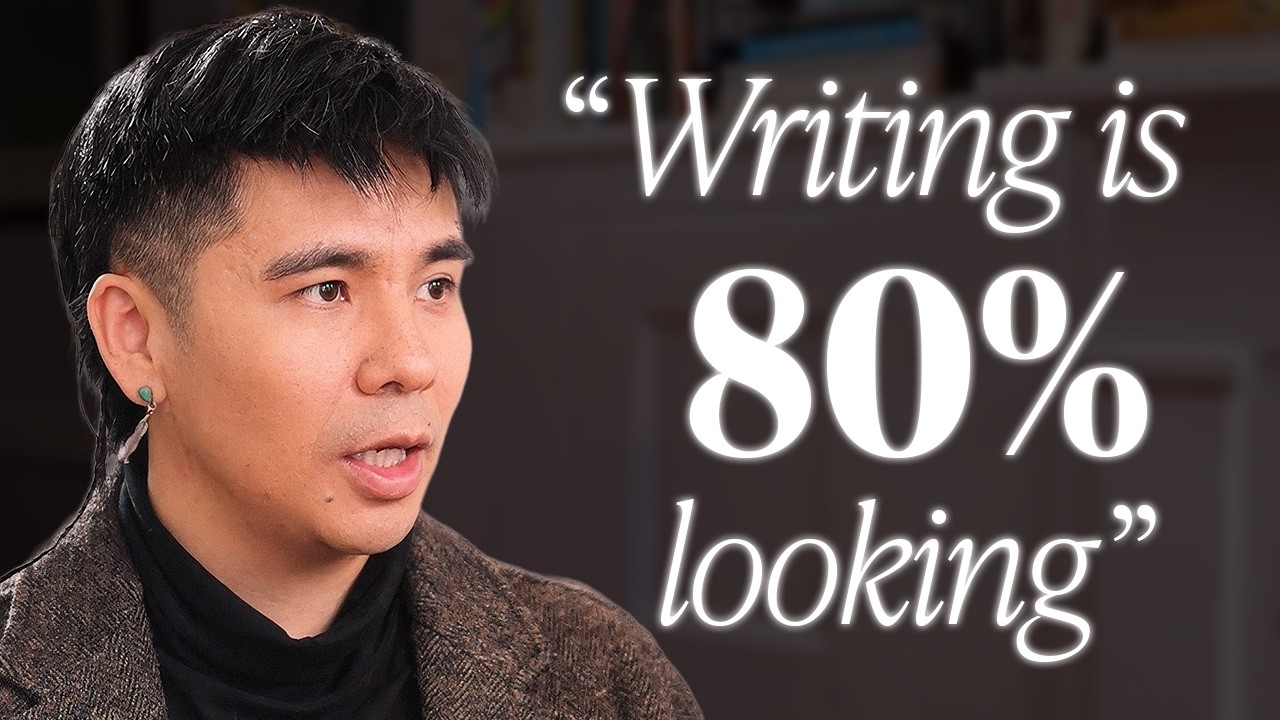
Ocean Vuong—poet, novelist, NYU professor—joins the show to talk about writing as an act of perception, wonder, and disobedience. The conversation moves through metaphor, the homogenization of the sentence, the conservatism of publishing, and the tension between language’s power and its limits. The central thread: good writing doesn’t just describe the world, it estranges it, making us see what we’ve stopped noticing.
Metaphor as observation, not decoration
Vuong tells students who ask how to write good metaphors that it comes down to observation—looking at the world until a connection forms. The rest is arrangement and syntax.
He uses Isaac Babel’s opening line from Red Cavalry as a model: the sunset described as “the low red sun rolls across the hills as if beheaded.”
A “mimetic” sentence—“a red evening sunset along the hills”—merely mimics what anyone could see. It’s useful but inert.
Babel’s version does something no other art form can: the simile of beheading embeds the violence of war into the image without stating it, and it changes the perceived speed of the sunset.
The metaphor asks the reader to bring themselves into the scene rather than passively receive information.
Vuong contrasts this with newspaper style, which prioritizes efficiency and invisibility. That style has done “incredible damage to a young writer’s imagination” because it trains the sentence to be timid.
Why Vuong’s workshop starts with recognition, not correction
In Vuong’s classes, the workshop begins not with critique but with students reading and experiencing each other’s work and naming what they notice.
The goal is recognition—identifying the tendencies, patterns, and habits in a writer’s consciousness as it’s filtered through syntax.
Every writer’s syntax is different. If you asked a room to write an ode, every poem would be different.
By week three or four, the group knows each writer’s tendencies and can give feedback geared specifically to them.
Vuong warns against the culture of productivity that fetishes output: writing a poem a day or a novel a month can produce a pile of rubble that’s harder to salvage than starting fresh.
He tells students to notice what’s new in their own work, even if they don’t understand it yet—comparing it to a Japanese botanist who searched the rainforest not for plants that looked like medicine but for anything new to him.
The analogy to relationships: you wouldn’t walk up to a stranger and offer fashion advice. You build closeness first.
How the sentence got homogenized—long before AI
Vuong argues that AI’s homogenizing effect on writing was predictable because we’ve been flattening the sentence for over a century.
A friend ran Shakespeare through Microsoft Word and got red and green squiggly lines—the software was telling him not to write like Shakespeare. With perhaps a billion users, tools like Word impose a de facto standard that is the antithesis of literary innovation.
The Victorian sentence (Melville, Whitman, Hawthorne) was rich, metaphoric, and built on oratory—long subordinate clauses that delayed the independent clause to keep a largely illiterate audience hooked. It was performative, momentous, and perfect for speeches.
The newspaper revolution after the Civil War demanded standardization. Journalism had been reckless—exclamation marks everywhere, unverified troop movements, “fake news on steroids.” After the war, papers sobered up and adopted a style optimized for clarity, brevity, and ad space.
This efficient, invisible sentence became the 20th century’s model for “good writing.” Hemingway, Crane, Orwell—all newspaper-influenced. The hallmarks of modern prose (short, clear, mimetic) are historically specific, not universal truths.
Vuong’s “bone to pick”: the culture settled on mostly one way of writing. He advocates for the Victorian sentence’s freedom to return—a style that “stranges the world.”
The right-angle-ization of culture
Vuong connects the standardization of writing to a broader cultural shift toward right angles—industrialization made it possible to produce them perfectly, and post-WWII culture embraced them everywhere.
Impressionist paintings had no right angles. Post-war abstraction (Mondrian) is all right angles.
Scientifically, straight lines don’t exist in nature—they’re an illusion. But the right angle became a metaphor for efficiency and standardization across architecture, design, and prose.
Young writers face a system—from draft one to publication—that hinders innovation. They’re taught to admire daring masters (Woolf, Melville, Baldwin, Carson) but then punished when their own work doesn’t fit the market.
Publishing is commercially conservative: “Who do you think you are? You’re not Melville.” “We need a comp title.”
Hollywood is even worse: Vuong describes pitching a documentary and being told only three unscripted formats work—true crime, music, sports. Everything else is rejected regardless of merit.
The stated preference is innovation; the actual behavior is risk aversion. Hollywood used to lead culture; now it’s the final checkpoint after you’ve already made it on Instagram and Twitter.
Rescuing the cliché through estrangement
Vuong draws on Russian formalist Viktor Shklovsky’s concept of estrangement (ostranenie): the purpose of art is to make us see things rather than merely recognize them.
Shklovsky: “Art exists in order to give back the sensation of life, in order to make us feel things, in order to make the stone stony.”
The writing workshop taboo—“this is cliché”—is misunderstood. It’s not the rose that’s cliché; it’s the idea of the rose. The writer’s job is to rescue it through arrangement.
A rose in a bride’s hair is familiar. A rose in Mike Tyson’s ear is estrangement.
Babel rescued the sunset by making it strange. The object isn’t the problem; the mode of perception is.
Vuong describes standing in front of Albert Bierstadt’s painting of the Matterhorn at the Met: he wants to see the way Bierstadt saw it, not just recognize it as “a mountain.” That’s the difference between seeing and recognizing.
Aristotle’s distinction: mimesis names what already exists (a rose, a bud). Poiesis is the process—the infinite moments between bud and rose, when the petal tears open. That threshold moment is where poetry and wonder live, but we’re taught to ignore it because it has no definition.
80% of writing is looking and thinking
Vuong estimates that 80% of writing is perception—looking, thinking, walking, observing. The remaining 20% is syntax, but that 20% is everything because it’s the “downloading mechanism” that determines whether a sentence stains the reader.
He describes video editing as a metaphor: zooming in on a timeline until you see individual frames, the way Eadweard Muybridge’s photography revealed that a galloping horse does lift all four legs. Writing is about slowing down perception to see what’s actually happening.
His teacher Ben Lerner once showed him a decent line Vuong had written, then Googled it: “300,000 people beat you to it.” The lesson: we’re here to write sentences the species has never had.
This reframed the canon for Vuong. Instead of worshipping the past as unattainable, he realized the greats were doing exactly what he was being asked to do—saying something for the first time.
Vuong is less interested in “hooking” a reader than in haunting them. He recalls Robert Browning’s “Meeting at Night,” read 20 years ago in high school, which he still thinks about every other day. That poem is “downloaded” into him.
What makes sentences memorable
Vuong returns to the question of why some writing sticks. He cites the park bench scene in Good Will Hunting where Robin Williams tells Matt Damon’s character about love—not as abstraction but as vulnerability, being leveled by someone’s eyes, feeling like God put an angel on earth just for you.
The power comes from breaking out of the mimetic mode into something that adds emotional weight.
He defends “pretentious” or self-indulgent writing: “Would you want Cormac McCarthy to be any less self-absorbed? Do you want Toni Morrison to be less indulgent in their maneuvers?”
Vuong’s first artistic culture was skateboarding and DIY punk—performance cultures that celebrated deception, beauty, and the body in motion. No one kept score. The Harlem Globetrotters, not the NBA.
He was surprised to enter a literary world with upper-middle-class decorum that demanded self-erasure—the invisible, crystalline newspaper sentence.
He notes that Gertrude Stein’s laconic style (which inspired Hemingway) came not from newspapers but from medical writing, which was also being standardized at the same time. Both paths led to the same flattened sentence.
Poetry as a laboratory for the sentence
Poetry is a “wonderless laboratory” because the writer only has to tend to language itself—no plot, no character obligations. This freedom allows the sentence to be transformed toward estrangement.
Historically, there was no rigid distinction between poet and novelist: Melville, Whitman, Dickinson, Hardy, Baldwin all worked across forms.
Vuong sees nature writing as the other space (besides poetry) where the homogenized sentence breaks down, because pure mimesis collapses—if you describe a meadow, the reader has already seen one. The power comes from the writer’s subjective filter.
He quotes J.A. Baker describing mud: “Thick ochre mud like paint. Oozing gluttonous mud that seemed to sprout on the marsh like fungus. Octopus mud that clutched and clung and squelched and sucked… Mud to the bone… Mud is another element.”
Baker’s interiority “leeches” through. The dam of mimesis breaks. You don’t need to know Baker was chronically ill to feel the obsession, but it’s embedded in the sentence.
The question for any writer: are you satisfied with what the dictionary has given you? “Red sunset” or “the low red sun rolls as if beheaded”? “Stars” or “little boats rode out too far”?
The problem with Webster’s—and the OED as a writer’s tool
Vuong uses Webster’s 1913 dictionary because its definitions are expansive, etymologically rich, and vivid—unlike modern definitions that restrict meaning.
Example: “solitude” on Google is reduced to “a kind of loneliness.” The older definition captures melancholy, internal reflection, a hint of sadness.
The Oxford English Dictionary (OED) is essential because it traces etymologies as a family tree of meaning.
“Passion” comes from the Latin for suffering (the Passion of the Christ). To be passionate is to be willing to suffer for something—not merely to be excited about it. Once you see this, you can’t unsee it.
Synchronic vs. diachronic reading—and why readers are tired
Vuong draws on theorist Yuri Lotman’s distinction between two ways of reading:
Synchronic reading: reading in a contemporary moment—a book published this season, reviewed this year, stacked alongside its peers.
Diachronic reading: reading across time—a reader who read Melville last week, Shakespeare the week before, Baldwin and Annie Dillard before that.
The publishing industry operates synchronically: books are released in spring and fall seasons, collected in year-end lists, and judged against each other within that narrow window.
Young writers are edited into the same box—their idiosyncrasies, estrangement, and wonder smoothed out. Thirty or forty similar books get published. Obligatory praise flows. Then one or two are anointed as “the book of the year.”
But readers experience books diachronically. They pick up the anointed book and think: “I read this last year. I read this in high school. Why am I reading the same book?”
This explains declining readership and reader fatigue: the system pumps out false valuation. The reader’s moment of reckoning—“I paid $32 for this, that’s my family’s meal”—comes too late for the writer who was forced to conform.
The Rotten Tomatoes divergence between critic scores and audience scores reflects the same split: critics operate within the synchronic system (Sundance, film schools, brand maintenance); audiences read diachronically.
Daringness and disobedience
When asked what he’d tell a student who wants to write and live differently, Vuong names two qualities rarely discussed in writing school: daringness and disobedience.
Daringness is the willingness to make a wager—to try something and see what happens, with the option to step back in line and be praised for conformity.
Disobedience is the refusal to accept the invisible chains—the workshop-as-factory metaphor, the “let me tighten this line” mentality, the assumption that efficiency equals quality.
Vuong credits skateboarding with teaching him that failure is not just a prerequisite to success but part of experiencing life. You throw yourself off an eight-stair, and sometimes all you get is bruises and a broken ankle. There’s no payoff, but there’s delight in doing it with friends and seeing your body move through space.
His family came from factories and nail salons. His vocation is to try things and throw them over his shoulder. “Why wouldn’t I relentlessly throw myself off an eight-stair?”
He cites poet Eduardo Corral’s simile: “Moss grows along the tree like applause.” The correspondence isn’t visual—it’s behavioral. Applause is nebulous, growing, quick. By using “applause,” Corral makes the moss move retroactively. It took Corral nine years to write that 45-page book.
The power and futility of language
Being bilingual (Vietnamese and English) taught Vuong that all words are stained by use, not definition. Wittgenstein: “The meaning of a word is its use.”
The dictionary has to catch up to speakers. Words like “Netflix and chill,” “throwing shade,” and “edging” entered the lexicon through use, not through prescriptive definition.
Innovation happens at the margins of power. Culture captures it, commercializes it, brings it to the center, and spits out homogenization—a cycle Lotman describes as concentric circles that constantly destroy and renew.
Language has made Vuong’s life—he materially supports his family through something with no weight, invisible in speech. But he holds no romantic illusion that writing saves us.
Authoritarian regimes capture newspapers and radio first. The SS officers who ran gas chambers went home to read Rilke and listen to Beethoven.
Thomas Thistlewood, an 18th-century Jamaican slaver, kept detailed diaries of his monstrous sexual violence—and also maintained one of the largest libraries of Enlightenment literature. He read Chaucer, Milton, astronomy, and wrote poetry.
Literature is a tool that can free millions (Harriet Beecher Stowe’s Uncle Tom’s Cabin, which Lincoln credited with starting the Civil War) and coexist with atrocity. Vuong works within this skepticism ceiling: he doesn’t count on literature to save anyone, but he does it anyway.