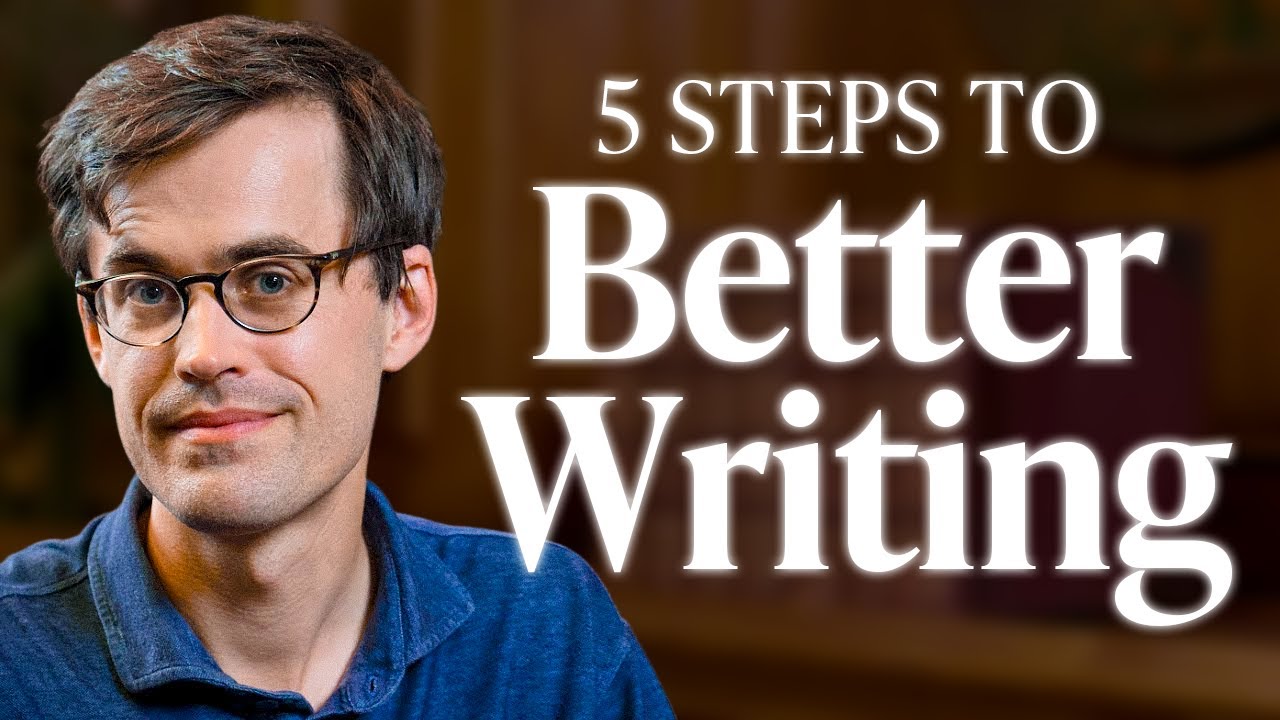
- Henrik Karlsson is a writer who developed a five-step method for producing deeply grounded, emotionally resonant essays. He writes from a place of long accumulation—ideas must live in his body for months or years before he writes them. His process emphasizes patience, reality-testing, emotional honesty, and sequencing over cleverness. He lives on a remote Danish island on a farm with his wife and two kids, and his writing life is deeply integrated with his family life. His blog, Escaping Flatland, grew from 50 readers to a thriving intellectual community once he stopped writing for mass appeal and started writing authentically for his “people.”
The Five-Step Writing Method
-
Step 1: Exploring (long accumulation)
- Writing from a deep source of knowledge and experience, not from excitement alone
- Ideas must be lived with for months or years—reading books, having conversations, journaling, revisiting and rethinking
- The goal is to move past simplistic thinking and develop an animating question: a personally urgent question that drives the writer forward because the stakes are real (e.g., “How could I become a better father?”)
- Forcing ideas before they’re ready never works; the best writing arises organically when the material and the writer are both ready
-
Step 2: Collecting thoughts (shaping under a magnetic field)
- Once the animating question emerges, it acts like a magnetic field pulling scattered notes, readings, and experiences into shape
- The writer starts to see the landscape of the piece and what material belongs
- Clusters begin to form—groups of ideas, stories, and arguments that feel like they belong together
-
Step 3: Ordering ideas (sequencing for emotional and cognitive effect)
- This is the most critical and difficult step: arranging clusters in an order that produces the right emotional and cognitive state in the reader
- Writing is not just communicating ideas—it’s about putting the reader in a certain state so that when an insight arrives, they’re ready to receive it
- Example from Ways of Seeing: a Van Gogh painting is shown, the viewer forms impressions, then learns it was the last painting before he killed himself—and suddenly sees it completely differently. Sequence transforms meaning.
- Henrik often lies on a sofa, closes his eyes, and moves ideas around almost as geometric objects, feeling for the energy between them. When the right order snaps into place, he feels a release of energy in his body.
-
Step 4: Writing the core (capturing energy, not perfection)
- Once sequencing is felt in the body, he writes fast to capture the emotional momentum
- He wants to feel excitement, laughter, tears—because if he feels it, the reader will too
- Sometimes he dictates while lying down with eyes closed, transcribing spoken drafts, repeating until the piece snaps into coherence
- The goal is a coherent whole, not a patchwork of separately written sections
-
Step 5: Editing (and writing the opening and ending last)
- He almost always writes the opening and ending after the rest of the piece is done
- Writing the opening first makes him pretentious and overworked; once the piece exists, the opening becomes obvious—sometimes it’s just a line from the middle that gets moved to the top
- Editing involves testing ideas against reality: asking his wife (who acts as editor), finding concrete examples, checking against biographies and real data, interrogating his own claims
Sucking Reality Into Writing
-
The core principle: spend more time looking at the thing you’re describing than looking at the page.
- Most writers get stuck moving words around and forget they’re trying to represent something real
- Henrik tests every piece against 3-4 concrete case studies from his own life or friends’ lives—like a painter doing a still life, constantly comparing the representation to reality
- Reality is smarter and more nuanced than any mental model; by going back and forth between observation and writing, you “suck” reality into the text
- He does exercises like staring at a plant and describing it, correcting and correcting—realizing how little he actually saw before
- This process gives the writing a humility and fidelity that purely intellectual writing lacks
-
Interrogating himself
- He interviews himself in his notebook: “What do you mean by that? Give me three examples.”
- When examples don’t match the claim, he writes about why—and that’s where the real insight lives
- He talks to his wife and friends, reads more books, and keeps testing until the piece is solid
Writing as Transformation
-
Writing makes him feel more alive by letting reality in.
- Reading a book is interesting, but unless he stops and puts his own words to it, it doesn’t become part of him
- Writing lowers the barrier between himself and life—he wants to be changed by what he encounters
- After 30 hours with an idea, he often realizes he was thinking about it completely wrong, and his opinion snaps around. His life is permanently changed.
-
The cleaning metaphor
- Like his wife’s cleaning method—pulling everything out, making it worse, then suddenly it all snaps back into order—he starts with a simple idea, gets more and more confused, brings in contradictory examples, and eventually it collapses into a new, different simplicity
- A mentor told him: ride through the confusion. You’re halfway there.
Introductions and the Art of Under-Promising
-
Two kinds of essays
- Bold promise essays (e.g., “Childhoods of Exceptional People”—claiming to catalog patterns from 40 biographies): painful to write because you must deliver on the promise; can feel strained
- Low-promise essays (starting with a small, almost silly observation): much more fun; give permission to explore freely and playfully, often ending up in surprisingly deep places
- The low-promise approach feels like over-delivering to the reader rather than struggling to meet a commitment
-
Why unpublished writing is so refreshing
- When people write in journals with no audience, there’s no force pushing them to be likable or clever
- Even when trying to be honest, knowing something will be read creates subtle incentives that sap energy
- Henrik uses “hacks” to silence this: no internet half the day, writing on paper while walking, dictating—putting himself in situations where he forgets anyone will read it
Rhythm, Grammar, and Language
-
Rhythm is felt in the body, not analyzed intellectually.
- He listens for flow, uses short sentences for snap and surprise, mixes different “chords” (intellectual passages against sensory or emotional ones)
- Juxtaposing seemingly incompatible elements creates energy
-
Danish/Swedish vs. English
- Scandinavian languages allow much freer word order; English grammar is stricter
- He misses the ability to move words around freely for rhythm
- He thinks writers should be wilder with grammar, especially in the LLM age, which is a force for standardization
- He’d love to see English absorb weird grammar from Turkish, cool words from Persian—become more eclectic and alive
LLMs and Writing
- He uses LLMs very little in his actual essays (maybe 1% of words)
- Uses them as a dictionary (“describe this word”), grammar checker, rephrasing tool (“give me 10 versions”), and to flag overused words during editing
- He’s been a power user since before ChatGPT but is somewhat underwhelmed—hasn’t seen good literature produced by LLMs yet
- He’s excited about their potential but sees them as tools for research and editing, not creation
Writing as Discovery
- He’s moved from writing-to-answer to writing-to-explore.
- The most invigorating writing to read is watching someone grapple in real time—hitting dead ends, correcting themselves, turning the car around
- This requires a different mental state: more relaxed, less afraid, willing to look stupid
- He rarely judges other writers for lack of polish—it’s often endearing. But he judges himself harshly for minor things.
- The fear of looking stupid is the force that makes writers try too hard to be smart and buttoned-up
Protecting Fragile Ideas
-
Young ideas are like little birds—easily squished by premature critique or social expectations.
- Some of his best ideas arrive as almost nothing—just a color, a feeling, a fragment
- He lets ideas live in his diary or on long walks, trusting they’ll grow
- David Lynch’s method: catch fragments of images on hooks, lower them into the subconscious, catch more pieces, trust they’ll cohere
-
Turning a net into a line
- Thoughts and memories exist as networks (nodes connected simultaneously), but writing is linear (one word after another)
- He maps ideas in Obsidian as linked notes (a web), then finds a path through the web—choosing which thread to walk so the reader feels the whole net even though they only experience one path
Mystery, Emotional Color, and Sequencing
-
Werner Herzog’s concept of “ecstatic truth”
- Sometimes you must frame, arrange, or even invent small things to convey a deeper emotional truth
- Example: Herzog staged a scene of a man opening and closing his door repeatedly to convey the profound privilege of freedom after imprisonment—it was fake, but it created a resonance that revealed a deeper truth
- Henrik doesn’t invent facts but adds emotional color and sequencing to set up the reader so an idea hits differently
-
Synesthesia in his thinking
- He experiences writing in color, sound, kinetic feeling, and energy fields
- Mathematicians (per Hadamard) think in bodily intuitions and images, not words—words come later
- He experimented with writing an essay without any words in his head, just feeling emotional currents
Strange Experiments
- He’s constantly running experiments on himself: writing by hand, walking while writing, listening to different music, writing at different times of day
- He tried dictating a piece while lying on a sofa with eyes closed, entering an almost psychotherapy-like state—this produced one of his favorite recent essays
- He’s curious about dictating while wearing noise-canceling headphones so he can’t hear himself speak—entering a pre-linguistic state where unexpected material might emerge
Courage as the Real Bottleneck
- The biggest limitation on writing well is not skill—it’s boldness and courage.
- It’s easier to tell yourself you need better metaphors or better openings, but the real bottleneck is going deeper
- Two pivotal moments deepened his writing:
- Age 15: a friend’s suicide blew him open—writing became a raw, urgent need rather than play
- Age 21-22: three weeks alone in a Bolivian mountain village with no shared language—all social roles fell away, and writing flooded through him obsessively. He came back changed, unable to fit back into his old life.
- Loneliness and stripping away social expectations are important for accessing deeper material
Porosity and Firmness
- Great writing requires being both porous and firm at the same time.
- Porous: open to reality, letting life move you, curious in a warm way, making yourself vulnerable
- Firm: having bold conviction in your values, not letting the world dictate who you are
- This paradoxical combination is embodied by figures like Jesus—deeply loving but also fierce and uncompromising
- It’s not the golden mean; it’s the pairing of opposites in tension, like a chord progression in music or the juxtaposition of chocolate and orange
Why Boring Truths Make the Best Writing
- The most alive ideas are often truisms—obvious truths that are hard to actually live by.
- “Be kind. Honor your commitments. Be a good father.” These are obvious but not easy.
- Writers skip over them because they seem boring and instead say something clever but less important
- The craft is in constructing a poetic, experiential, sequenced way to make the obvious truth pierce the reader’s heart—so they feel it, not just know it
- If the writer isn’t moved (laughing, crying, elated), the reader won’t be either
- His friend Paul Millard said he wrote his memoir by going on walks until he started crying
Writing From the Subconscious
-
Ideas are brittle when they first form—and that brittleness is useful.
- In conversation, ideas can float and morph to save face. On paper, they’re fixed and can be tested against reality.
- When an idea crumbles under scrutiny, the writer enters a state of confusion—and that’s where light comes in
- Confusion means letting go of mental models and taking in raw data from reality in higher resolution
- Military accelerated expertise training deliberately maximizes confusion to prevent “knowledge shields” (good-enough mental models that filter out disconfirming data)
-
Pre-linguistic observation
- Much of his process is about reaching a pre-linguistic state—observing reality in high resolution before compressing it into words
- He spends a year or more looking, accumulating, and letting ideas live in his body before the compression (writing) happens
- Most people speak and think in heavy compression (categories, labels, clichés). He tries to observe in an uncompressed form first.
His Life and Writing Environment
- Lives on a remote island in Denmark on a farm with his wife and two kids
- Currently living in the stable (upper floor) while the main house is being repaired for mold
- Wakes at 7, writes in what used to be the woodworking room from about 7 to 3, six days a week
- When stuck, he lies on a sofa, walks the meadow, or walks in a nature reserve
- Afternoons are for his kids (4-5 hours of present fatherhood), which grounds him and feeds the writing
- Everything is integrated: fixing a brick wall, playing with kids, and writing all feed each other
Why Write: Summoning a Culture
- Writing is a search query to find your people.
- His blog post titled “A blog post is a very long and complex search query to find fascinating people and make them route interesting stuff to your inbox” captures this
- He started with 50 readers in December 2021; as he wrote authentically, interesting strangers found him, emailed him, and became friends
- Writing became a process of summoning a culture—a community that holds and nurtures his authentic self
- He stopped writing for mass appeal (simplifying, removing weirdness) and started writing for his people. Most people found it too weird and long, but the few who loved it really loved it—and shared it. A flywheel formed.
- The deepest gift of writing: being seen in your interests, curiosities, and values, and finding a place where being your full idiosyncratic self is encouraged.