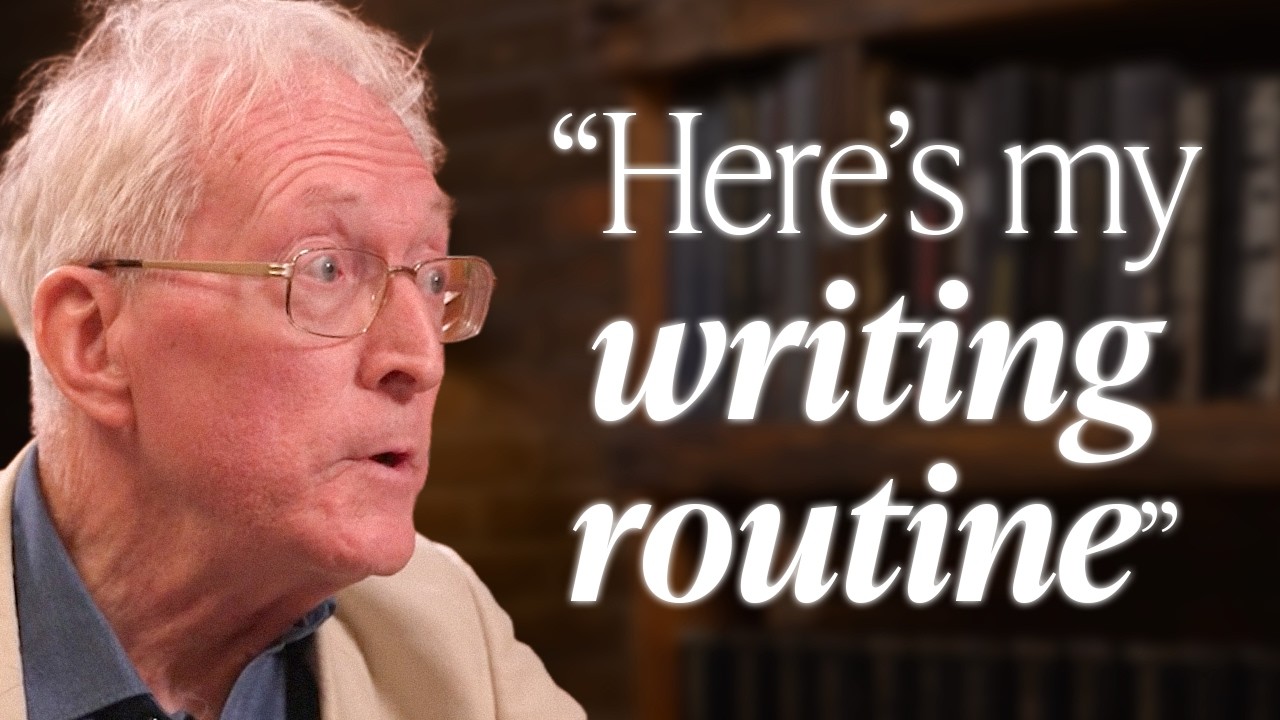
Diarmaid MacCulloch is an Oxford professor and prolific historian who has spent decades studying the Reformation and the craft of historical writing. In this conversation, he explores what it means to be a historian, how to write history that is both true and vivid, and why the discipline matters as a defense against lies and collective madness.
The historian’s role in society
MacCulloch sees the historian as a guardian of sanity — someone committed to truth in a world saturated by lies, especially from the powerful.
He inherited this commitment from his father, a Church of England rector who had “Parson’s Freehold” — a form of tenure that meant he could not be sacked for his views, giving him radical freedom to speak truthfully.
He carries that same freedom into his own work, seeing history as a tool to defend people against manipulation and to expose societies built on false narratives, such as the sanitization of museum exhibits or the demotion of national holidays that challenge dominant power structures.
He argues that STEM subjects, however valuable, do not make people moral or sane — that is the job of the humanities, principally history, philosophy, and literature, which teach empathy and the ability to listen to others.
Core principles for aspiring historians
When asked what he would tell a budding historian, MacCulloch offers two guiding principles: be skeptical, then be sympathetic.
Skepticism prevents you from being too easily seduced by any narrative, since everyone has agendas — good and bad — and it takes time to distinguish between them.
Sympathy means recognizing that historical actors are human beings, interesting in their own right, even when you disagree with them.
He emphasizes that history is always about fallible human beings operating within structures they do not fully control, and that understanding the person at the center of events is as important as understanding the events themselves.
MacCulloch’s writing process and daily routine
He is disciplined and systematic: he works from about 8:30 AM to 7:00 PM, never in the evenings, and takes a nap every day — a habit he has had since his twenties.
He divides his day into roughly two working thirds and one restful third, following advice from his doctoral supervisor, Sir Geoffrey Elton, who warned that nonstop work destroys the quality of one’s output.
His mornings are his most productive hours, and he treats lunch and the afternoon as distinct blocks of focused work.
Primary and secondary sources
For his major biographies of Thomas Cranmer and Thomas Cromwell, MacCulloch began by reading the classic secondary sources — the great 17th-century syntheses by writers like Bishop Burnet and John Strype — before returning to the primary sources.
This approach prevents “reinventing the wheel” and gives the historian a sense of how earlier generations understood the period.
Once he knows the conventional narrative and its clichés, he can go back to the original sources with a skeptical eye, looking for what the conventional story gets wrong or leaves out.
The Wolfson History Prize and what makes history beautifully written
MacCulloch is a judge for the Wolfson History Prize, which rewards books that are both excellent history and beautifully written for a popular audience.
Each year the judges review around 180 books and look for works that challenge complacent narratives — for instance, recent entries on slavery that expose the gap between the rhetoric of liberty and the reality of profit-driven human trafficking.
On what constitutes beautiful writing: he rejects purple prose and leaden, cliché-ridden prose alike. Good historical prose makes him smile or laugh while also making him think — it illuminates another human being for the reader in a way that is clever and illuminating without being showy.
He acknowledges that some beautifully written history books are factually misleading — Winston Churchill’s history of the Second World War being a prime example — and that the historian’s motto should always be “yes, but”, resisting the temptation to simplify the past into a heroic narrative.
Fiction, myth, and the limits of historical knowledge
MacCulloch draws a sharp distinction between the historian and the novelist, using his friendship with Hilary Mantel as an example.
Mantel, writing her Wolf Hall trilogy about Thomas Cromwell, was free to fill in gaps in the record with invention — she created a romance in Antwerp to account for an illegitimate child, which was technically wrong but served the story.
MacCulloch’s role was to check Mantel’s typescript for factual errors (not fictions), such as correcting “Abbot” to “Prior” of St. Bartholomew’s — details she wanted to get right even within a fictional framework.
He admires Mantel’s ability to get inside Cromwell’s head, noting that she captured two crucial truths: Cromwell’s devotion to Cardinal Wolsey and his consequent hatred of Anne Boleyn, a relationship that Protestant historiography has wrongly flattened into alliance.
Historians must signal uncertainty — saying “may have” or “it is quite likely” — whereas novelists can simply present. Both professions inform each other, but they are not the same.
The importance of sense of place
MacCulloch argues that place is central to understanding history — you must physically go to a location to grasp what it felt like.
He was inspired to become a Tudor historian by growing up in a 16th-century church in rural Suffolk, surrounded by the tombs of gentry who lived through the Reformation.
While filming a documentary in Moscow, he had 45 minutes alone inside St. Basil’s Cathedral and realized that while its floor plan is logical and symmetrical, no one ever experiences it that way — visitors are overwhelmed by its verticality, claustrophobia, and crowdedness, which he came to see as the mind of a mad czar. This insight changed his script and later his book.
He contrasts this with the Goodwill Hunting scene where Robin Williams tells Matt Damon that book knowledge cannot substitute for lived sensory experience — you cannot know what the Sistine Chapel smells like from reading about it.
At the same time, he believes a historian’s job is to tell people about a place or a person’s mind so they can access it indirectly, even if they never visit.
Is history written by the victors?
MacCulloch agrees that history is generally written by the victors, but insists this is something historians must fight against because victors’ accounts contain truth but are never the whole truth.
He points to the Venerable Bede, the great Anglo-Saxon historian, who crafted a triumphant narrative of the Roman Christian mission to England while downplaying the Christianity that already existed and the role of women.
Modern archaeology has revealed richly furnished Christian women’s graves from the period, suggesting that abbesses — women heading monasteries with both nuns and monks — were leading missions just as much as the male bishops Bede celebrated.
The historian’s task is to read victors’ accounts critically, supplement them with other evidence, and recover what has been suppressed.
Bias, honesty, and the reader
MacCulloch believes historians must declare their biases openly to the reader, as he does in his own introductions.
He compares this to Howard Zinn’s A People’s History of the United States, which openly declares its counter-narrative stance. MacCulloch suggests that multiple biased accounts, taken together in a kind of cubist composition, can approach truth more honestly than a single supposedly neutral narrative.
He sees the historian as a friend and guide to the reader, but also as a non-directive counselor — someone who helps readers look at a subject that is ultimately a look at themselves, without imposing direction.
He also values the role of entertainer: a boring book is a failure, and he delights in crafting sentences that are funny in a constructive, ironic way, especially when the subject matter — like the history of Christianity — veers into the genuinely bizarre.
Lunacy, irrationality, and the strangeness of the past
MacCulloch argues that historians underestimate the role of lunacy in history — some historical actors were simply mad, and their actions reflect that.
He points to the Rosslyn Chapel in Scotland, an extravagantly lavish but architecturally absurd building, and suggests the simplest explanation may be that its patron, the Sinclair Earl, was insane and had enough money to indulge it.
He also notes that irrationality can stem from physical suffering — Henry VIII’s bewildering behavior in his final year of life becomes more comprehensible when you factor in the chronic pain he was experiencing, which a doctor pointed out to him as an essential missing piece of the picture.
Teaching the craft of history
When asked how he would structure a semester-long course on being a historian, MacCulloch describes starting with a game he invented called “Elizabeth the First was a carrot.”
The game presents 20 statements and asks students to determine which are historical and which are not — ranging from straightforward facts (Elizabeth came to the throne in 1558) to false statements (1559) to ambiguous ones (Elizabeth was a “true daughter of her father,” which could be metaphorical or genetic) to the absurd (Elizabeth was a carrot).
The final statement — that Elizabeth was a carrot — is a fabrication he invented on the spot, and students who try to find a clever explanation for it (perhaps a Tudor idiom for redheads) learn the danger of over-theorizing and the importance of checking whether a claim has any basis in evidence.
He sees history as play — something that must be enjoyed to be worth doing — but also passionately important, because getting history right is about keeping society sane.