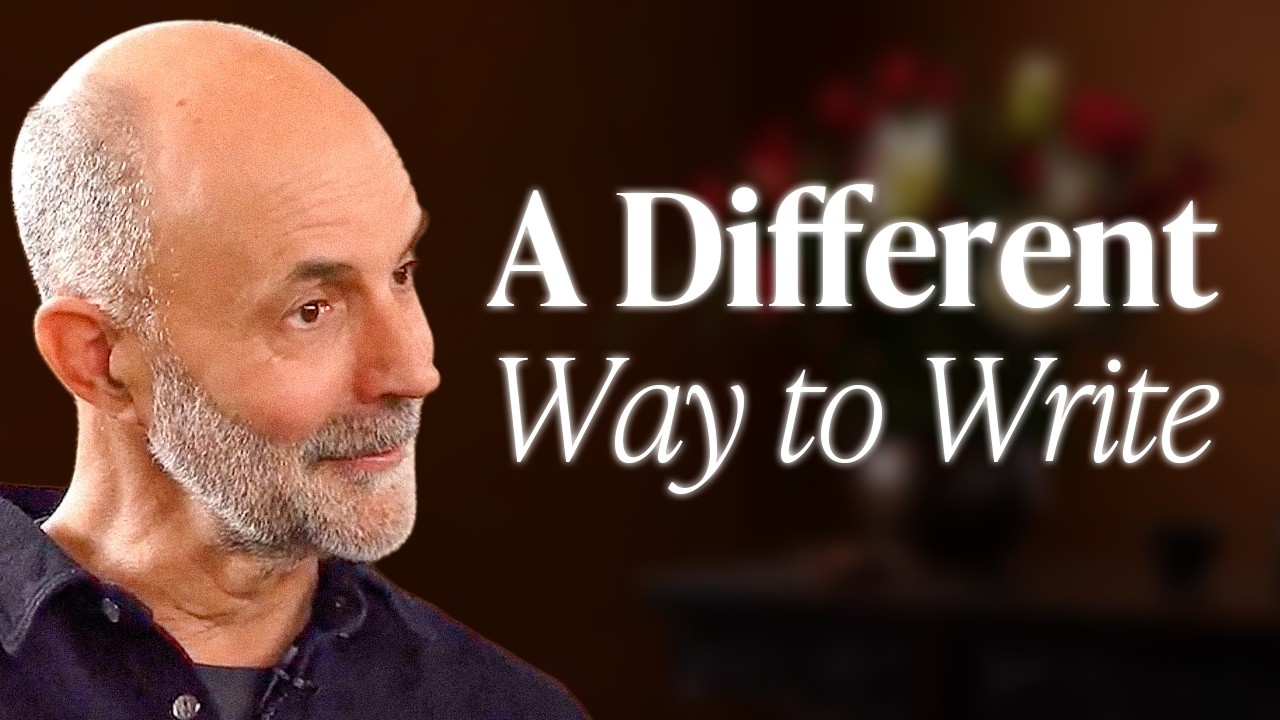
Henry Shukman is a poet, novelist, essayist, Zen master, and mindfulness teacher who has studied meditation for 35 years in the Sanbo Zen lineage. This conversation explores his writing process across poetry, fiction, memoir, and Zen koans, and how meditation, wonder, and a willingness to surrender control shape his work.
Writing, for Shukman, is not about deliberate craft or forcing expression. It is about letting something deeper than the conscious mind speak through you, a practice he first discovered as a teenager and has refined over decades.
The conversation moves through the nature of poetic vision, the role of difficult emotions, the relationship between meditation and creativity, practical lessons from different writing genres, and what it means to write from the heart.
Writing as a different way of being alive
Shukman’s entry into writing was not a choice but a recognition that another way of being alive existed.
As a teenager in England, he befriended an itinerant man named Speedy who carried a strange, vivid aliveness. After spending time with him in the Oxfordshire countryside, Shukman looked out his window one evening and felt a surge of energy. A line formed in his mind unbidden, and he wrote without planning what came next.
He finished trembling, awake in a way he had never been before. He had managed to say something about the beauty of the scene that he didn’t know he wanted to say. It was not frantic but peaceful and powerful, coming from a part of himself he had no conscious control over.
He distinguishes between writing that records information (Darwin’s journals, nonfiction) and writing that conveys lived experience — the emotional, spiritual, and philosophical impact of something the writer has gone through.
The purpose of the latter is to wake up the reader’s own capacity for deeper experience. When a writer conveys what something truly felt like, it activates the reader’s ability to be more alive, more aware of their own sensory and emotional existence.
He compares this to Monet’s impressionist paintings of Venice: Monet doesn’t capture Venice precisely, but he captures something more real — the emotional truth of being there. Writing can do the same thing.
The fear barrier and surrendering control
Shukman describes a “fear barrier” that appears when something genuine is trying to come through in writing.
When a poem is brewing, there is a moment of hesitation: Am I ready to let go? Am I ready to submit to what wants to come? The conscious mind’s job is to control and defend — evolutionarily, it is wired to scan for threats and maintain grip. But the deeper creative energy cannot speak freely if the mind is trying to manage it.
Once he crosses that barrier, the energy that comes through is far more powerful than anything he could produce deliberately. The best things he has ever written came from that release.
He does not mean there is no editing process. There is substantial tweaking, sometimes over a year. But the editing must happen in service of what the piece already is, not from a foreign vantage point that desecrates its living core.
Difficult emotions as material
Shukman wrote a poem called “Frozen Lake” after someone very close to him went through an agonizing experience.
The poem’s image: a frozen lake that most people cross without incident, but some fall through the ice into a “great dark gulf” beneath — while still walking upright in the light of the ordinary world. For those who fall, “there is no consolation, nor is any needed.”
He could not have written it in the first shock of grief. It required distance — what Wordsworth called “emotion recollected in tranquility.” Only after the system recalibrated could he inhabit the experience without being overwhelmed by it.
The poem has resonated with many people across very different circumstances, because it names a universal experience: carrying an unspeakable inner darkness while life continues on the surface.
Poetry, for Shukman, is a way of digesting one’s own life — living through experiences a second time in order to truly know them. This applies to moments of wonder and grace as much as to grief.
Meditation and writing
Meditation, practiced for 35 years, is deeply intertwined with Shukman’s writing process.
Meditation is a repeated lesson in reducing control. The controlling mind wants to make meditation conform to an idea of what “good meditation” should be. Over time, that grip softens, and you learn to simply let experience be what it is.
This practice of letting go directly serves writing: the ability to get out of the way and let something deeper come through. He sees meditation and poetry as closely related — both are about attentiveness to present-moment experience.
He was inspired by writer-meditators like Jack Kerouac, Allen Ginsberg, and Gary Snyder. Kerouac’s wild, ecstatic prose (“burn, burn, burn”) came from the same capacity that meditation cultivates: letting energy through without the mind interfering.
Natalie Goldberg told him about a friend, a quiet, prim woman who wrote detective novels full of murder and gore. The stillness of the writer’s exterior belied the violence on the page — a reminder that the deeper psyche, accessed through practice, contains far more than we consciously know.
Learning through languages and reading
Shukman had a classical Oxford education: French at 7, Latin at 8, ancient Greek at 9, Russian at 14, some German at 12. By 18 he had working knowledge of four languages besides English. His PhD in ancient Greek required reading in seven or eight languages.
This multilingual literary education formed a voice in him — a deep reservoir of rhythm, cadence, and expression that is ready to be deployed. But having the voice is not enough; you still need to know how to let it speak without getting in the way.
The editing process is where craft meets authenticity. He cites poet Robin Robertson’s advice: “You don’t want to cut live flesh.” The editor must feel which parts are truly alive and must not be amputated.
Lessons from different genres
Fiction: The primary character must have both an immediate practical problem and a deeper spiritual or philosophical one. Pierre Bezukhov in War and Peace wants to know how to live in a way that fulfills his soul — he doesn’t even know what his soul is, but he’s a seeker. Also: the third most important character in every work of fiction is the place. Place is bedrock. Homer’s Odyssey could not be set in Yorkshire; the olive trees, the wine-dark sea, and the land are intrinsic to the human story.
Memoir: You must know what the memoir is actually about — not “my life” but a precise thread. Shukman’s memoir One Blade of Grass is about his journey into Zen: why it needed to happen and how it happened. Everything else is stripped away or kept only if it serves that thread. He didn’t want to write it at all; it emerged unbidden during a period of deep silence in his practice, and he only let it become a book after friends and an editor persuaded him.
Poetry: Poetry is the closest writing comes to meditation because it is about the immediate experience of the moment — whether that moment is a perception, a memory, or a response to what is happening now. The poet is tracking what it is to be remembering, or to be seeing, right now. The poem enables a completeness of attention that cannot be achieved any other way.
Zen koans: These are enigmatic phrases from 7th–9th century Chinese Zen masters (or from the Buddha’s time). They are not puzzles to be solved logically. A famous one: “What is the sound of one hand clapping?” Another: “Does a dog have Buddha nature?” — answered with “Mu” (meaning “not”), which the student simply sits with as a sound. The koan is designed to scramble ordinary thought and carry the practitioner into the same state of openness, wonder, and boundlessness from which the master uttered it. Paradox — from the Greek para (beyond) + doxa (thinking) — is at the bedrock of every spiritual tradition because truth is not only logical (2+2=4) but also experiential and mysterious.
Writing practice and discipline
Shukman wrote professionally for over 20 years, five to six days a week. He wrote travel memoirs, fiction, and magazine pieces. He treated it as work: showing up daily, writing in diners and coffee shops, mixing first drafts with revision.
For those stuck waiting for inspiration, he recommends daily habit. Even if you can’t write what you “should” write, start with what Balzac called automatic writing — covering pages with whatever comes, just to get the engine turning over. Ed Sheeran’s analogy: turn on the tap, let the dirty water come out first, and the clean water will follow.
He points to Coleridge, who wrote over 6,000 newspaper articles plus poems and letters, and Thomas Hardy, who wrote novels until age 60 before turning to poetry. Ezra Pound, reading Hardy’s first poetry collection, said: “There is the clarity of a man who first wrote 3 million words.” The water ran clear because so much had already flowed through.
Writing from the heart
Shukman reads a final poem, “Rain at Night,” written during a long rainfall while someone dear to him was in serious trouble.
The poem asks: Who says our dark night can’t be beautiful? It holds the living and the dead together, indistinguishable in the rain’s embrace. It distorts time, evoking infinity within the present moment — what T.S. Eliot described as “the present moment shot through with rays of infinity.”
The poem came from a broken heart, a tender heart, an open heart, and a whole heart all at once. He did not intend to write it. He was simply listening to the rain.
For Shukman, writing from the heart means greater intimacy with the world — not only nature but city streets, snowfall on pavement, the sound a lamp casts on a wall. The body, made of the same stuff as the earth, is where poetry originates. The mind is a marvelous gift, but the real poet lives in the body. Great poetry feels as if it is spoken by the land itself.