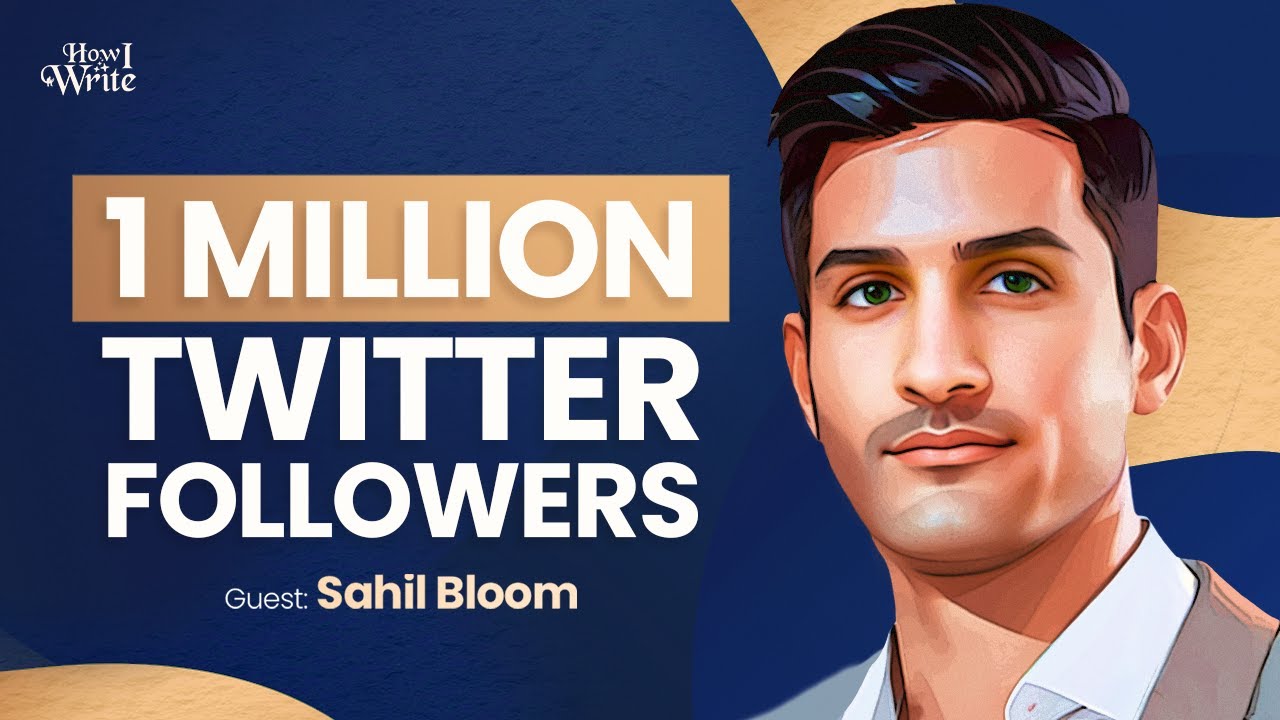
Sahil Bloom is a writer and content creator who built a large audience through Twitter and a weekly newsletter, and is now writing a book. This conversation covers his writing process, philosophy on authenticity, content distribution strategies, and the challenges of long-form creative work.
He started writing long before his public career, sending a monthly book recommendation newsletter to 10 family and friends on MailChimp starting around 2014–2015, which slowly grew to about 2,000 subscribers over five years. This was a pure passion project with no growth strategy, similar to how Warren Buffett’s shareholder letters or Howard Marks’s memos started as personal thinking exercises that eventually attracted massive audiences.
His core writing philosophy centers on distillation: forcing ideas into their shortest, clearest form. He uses Twitter’s character constraint as a tool to compress thinking, often drafting ideas there before expanding them elsewhere. He believes clarity comes from writing, not from PowerPoint slides, and that if you can’t simply explain an idea, you don’t truly understand it.
The Spectrum of Creator Authenticity
Sahil thinks about creators on a spectrum from “growth hacky” (churning out viral listicles with no soul) to “deeply soulful” (publishing rarely but with extraordinary depth and personal exposure).
The growth-hacky end offers rapid reach but no durable connection, no audience trust, and no pride in the work. The soulful end produces work that genuinely shifts thinking (like Tim Urban’s writing) but makes consistent publishing nearly impossible due to the creative drain.
Sahil’s goal is to find a middle ground: maintaining authenticity and soul while still publishing regularly enough to achieve his stated ambition of positively impacting a billion people over the next 50 years. He acknowledges this is a constant tension, not a solved problem.
Epiphanies, Excavation, and the Creative Process
For Sahil, an epiphany is a physical, gut-level rush of energy—not a purely intellectual realization. It feels like discovering a hidden path to a promised land, and it creates an urgent need to share the idea with others immediately.
He uses the metaphor of excavation to describe deep creative work: you set a compass (a true north) and dig, but you don’t know exactly what you’ll find. Surprise is inherent. This contrasts with the certainty-seeking mindset that leads to consensus thinking.
He references George Gilder’s idea that “all creativity is surprise”—value comes from bringing useful surprise into the world. To cultivate surprise, Sahil designs systems: consuming widely (books, conversations, environments), then creating space to sit and think without input (walking, journaling), which he calls the overlooked “middle layer” of creativity where ideas connect and bounce.
He surrounds himself with people who ask good questions and open new landscapes of consciousness. His “currency of life” is collecting interesting people and connecting them, likening the goal to creating a personal version of 15th-century Florence, where the Medici-funded concentration of thinkers sparked the Renaissance.
Writing from Conversation
Sahil’s primary method for developing ideas is what he calls writing from conversation: he reads or encounters something interesting, writes it down in a small notebook (he uses a dot-grid Moleskine, avoids digital tools like Notion), and within 24 hours explains it to someone—his wife, a friend, a colleague.
He watches for what lands and what confuses people. If he can distill an idea into two or three sentences and see someone’s eyes light up, it’s ready to publish. He wrote a piece called “What the Hell Is Going On” and only published it after five people in a row had that wide-eyed reaction when he explained it over dinner.
This process also serves as a memory system. Writing something down once and then discussing it cements it permanently. He thinks of memory as hiding behind context-dependent doors—environmental cues unlock associated memories.
Forced Constraints and Finding the “Shiny Dime”
Sahil believes forced constraints breed creativity. Twitter’s character limit forced him to become a much better writer. He references Dr. Seuss’s bet that he could write a bestseller using only 50 distinct words—he wrote Green Eggs and Ham with 49.
His editing process is aggressive: he always seeks the shortest possible version of an idea. He tries to strip every extra word, comma, and piece of fluff. He often writes on Twitter first to force distillation, then expands elsewhere.
He and David Perell both use the concept of the “shiny dime”—the smallest essence of what you’re trying to say. Sometimes it comes as a flash of clarity (like Sahil’s line “Never let the quest for more distract you from the beauty of enough”), but more often it’s found by throwing sludge onto the page and excavating through revision. The shiny dime is like a song’s chorus: everything else should orbit around it.
He references the centipede’s dilemma: when a centipede tries to think about which leg is fastest, it can’t walk at all. Overthinking the process kills the intuitive flow. This is why Sahil keeps his process analog—notebook, pen, printed drafts—to avoid turning writing into a overly technological, self-conscious exercise.
The Dopamine Problem of Book Writing
The hardest part of writing a book for Sahil is the dopamine cycle. Every other content he creates (tweets, newsletters) gets feedback within at most two days. A book takes roughly two years from drafting to real feedback (sales, reviews, reader responses).
He signed his book deal on September 30, 2022, with a one-year deadline. For the first nine months he wrote only about 5,000 words of a 75,000-word manuscript. Starting July 1, he committed to two non-negotiable hours of writing every morning and finished by September 30. He needed the structure and time pressure—Parkinson’s law in action.
He doesn’t consider himself an author and may never write another book. This was the one idea that consumed him (the “yellow brick road” feeling). Because it might be his only book, he has terrifyingly high expectations, which he manages by focusing on whether he genuinely loves the process and the idea, regardless of outcome.
Distribution and Newsletter Growth
Sahil’s newsletter had two major inflection points. The first was in May 2021, when David Perell encouraged him to take email seriously and build a real cadence. The second was in late 2022, when he hired a team to handle operations.
He hired Shane as a chief-of-staff figure to manage the business side: sponsor slots, collaboration swaps, lead magnets, paid ads, and tools like ConvertKit’s Spark Loop. This freed Sahil to focus on writing. Growth went from 5,000–10,000 subscribers per month to 50,000 per month.
He reinvests all newsletter ad revenue back into growth, running the newsletter at break-even. He and Shane later productized this service into a company called Paperboy, offering newsletter operations and growth as a service to other creators.
Sahil thinks about distribution as timely (platforms change constantly) while writing principles are timeless. He stays current by talking to other creators, testing paid ads, lead magnets, and referral programs, and focusing on “adjusted CPA”—the cost per subscriber weighted by engagement level, not just raw subscriber count.
Twitter (X) Evolution
Sahil started on Twitter on May 12, 2020, with 500 followers. Threads didn’t exist as a feature yet—he commented under his own posts to create them. His key insight was creating a “Twitter-native blog” by linking new ideas to previous ones, building a networked body of work. He was likely one of the first to do this systematically.
As threads became ubiquitous in 2021, the market got crowded and growth became harder. After Elon Musk’s acquisition, Sahil believes the platform improved—faster feature shipping, video focus—but it’s now harder to grow quickly as a new creator. He sees this as healthy because it shifts focus from vanity metrics to genuine connection, aligning with Kevin Kelly’s “1,000 true fans” framework.
Credibility Without Credentials
Sahil is skeptical of traditional credentialism. He points out that James Clear has no special degree in habit science—he built credibility by publishing ideas that resonated with a million people before his book sold 10 million copies.
When an older woman on Twitter told him she was “tired of his shtick” and that he had no credibility to talk about goal setting or fitness, he laughed because goal-setting and fitness are literally the two things he has the most personal proof of, with a lifetime of stats and results. He doesn’t need a degree; his lived experience and the market’s response are his credentials.
He believes the walls of credentialism are permanently cracked and that anyone can build credibility by consistently putting valuable work into the world.
Metrics, Expectations, and Creative Freedom
Sahil deliberately separates himself from metrics to protect the quality and soul of his work. He doesn’t look at post engagement for 24 hours and doesn’t check newsletter open rates for a week. He found that obsessing over likes and open rates was inversely correlated with the soul in his work.
He creates things he would want to consume himself—concise, to the point, no filler. He laments that most non-fiction books could be 15 pages but are padded to 200.
Writer’s block, in his view, comes from the fear of expectations and being imprisoned by a vision of how successful something must be. A friend helped him realize he needed to return to his original creative mode: get interested in an idea, work it out for himself, share it with others, repeat—with no regard for how successful each idea would be. That mental shift lifted a huge weight.