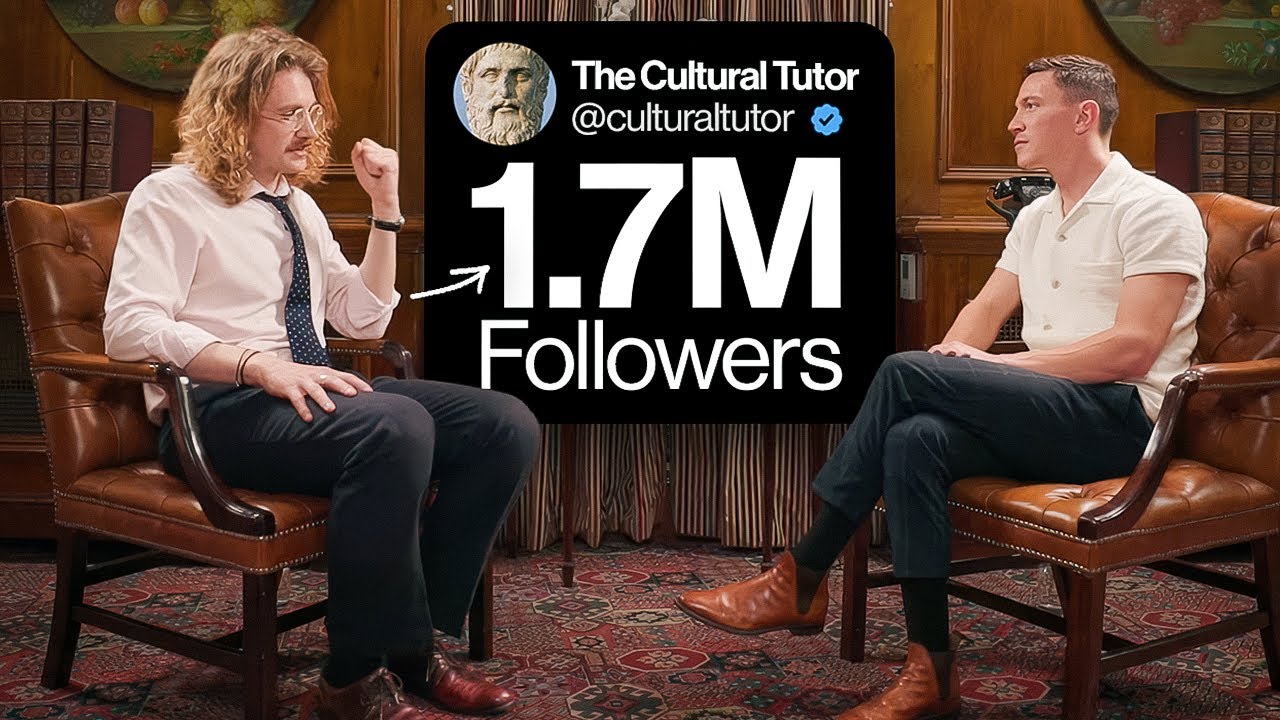
The episode explores a broad cultural shift from maximalism to minimalism in writing, design, architecture, and thought, arguing that the modern obsession with simplicity, efficiency, and convenience has sanded down the personality, texture, and grandeur of human expression. The central question is how writers can recover the best of both: the clarity and efficiency of minimalism with the personality, nuance, and vitality of maximalism.
Maximalism vs. Minimalism: definitions and caricatures
The caricature of maximalism is high Victorian prose: page-long sentences, ornate diction, and excessive verbiage; the caricature of minimalism is Hemingway: short, sharp, choppy sentences using only the simplest words.
In reality, both have virtuous and harmful sides:
Maximalism at its best captures nuance, texture, and emotion that minimalist language cannot reach; it creates an environment or “vibe” the reader inhabits rather than merely delivering information.
Maximalism at its worst is indecipherable, overwrought, and alienating (e.g., Thomas Carlyle can be nearly impenetrable on first encounter).
Minimalism at its best is clear, efficient, and accessible; it can pack enormous meaning into very few words (e.g., James Clear’s title Atomic Habits).
Minimalism at its worst is standardized, personality-free, and boring; it treats all words as interchangeable and strips away the richness of language.
The English language has roughly 750,000 words, about 150,000 in frequent use. Bad minimalism assumes the simple standard word always suffices; good maximalism exploits the full range of available words to capture precise shades of meaning.
The pendulum swings through history
Writing has oscillated between maximalism and minimalism over centuries:
14th century: Chaucer, when spelling is modernized, is “as clear as daylight.”
16th–17th century: Elizabethan prose (Thomas Elyot, Roger Ascham) and the King James Bible (1611) are remarkably simple and clear; Milton is the exception, not the rule.
19th century: The Victorians represent peak maximalism; John Ruskin is held up as perhaps the greatest prose stylist in English.
Present: We are in a firmly minimalist era across writing, architecture, graphic design, and music.
The assumption that the past was uniformly ornate is wrong; the pendulum has always swung.
What maximalism brings that minimalism cannot
Grandeur and gravity: Ruskin’s description of a wall can make a reader emotional; the Lord’s Prayer’s archaic language (“thou,” “thy,” “hallowed”) elevates and dignifies in a way modern plain language cannot.
Personality and vibe: Maximalist writing creates an atmosphere, an energy, a sense of the writer’s presence—closer to how actual conversation feels between two people.
Nuance and precision: Saying “emerald green” versus “the green of a sunlit leaf” versus “his face looked green” conveys entirely different things; collapsing all of these into “green” loses meaning.
Emotional resonance: The best maximalist prose draws on the full breadth of vocabulary and imagination to reach the reader’s emotions in ways stripped-back prose does not.
What we lose with modern minimalism
Homogenization: When everyone simplifies, everything sounds the same—ten books feel like they were written by the same person; tech logos (Burberry, Yves Saint Laurent) all became flat, indistinguishable sans-serif wordmarks.
Loss of personality and risk: Modern writing avoids experimentation, unusual punctuation, semicolons, capitalized words for emphasis, or any deviation from the standard.
Surface-level thinking: Minimalism in its malignant form doesn’t ask the writer to engage deeply with their own thoughts; it stays at the level of top-of-mind, intuitive reactions.
Boredom: The episode argues that human beings are biologically incapable of handling boredom, and variation is a law of nature—when everything looks and sounds identical, it is existentially dulling.
How technology and media drove the shift
Word processors and spell-checkers: Copying Shakespeare or Edmund Spenser into Microsoft Word produces red squiggly lines and suggested “improvements”—an invisible algorithmic hand standardizing how over a billion people write.
Grammarly and similar tools further enforce conformity.
When Thomas Carlyle capitalized unusual words for emphasis, Word would flag it as an error; the machine overrides the writer’s creative choices.
The internet and attention economy: On Twitter/X, the simpler and catchier the content, the more traction it gets; complex, gravity-laden writing loses out. Clickbait is not new—the 2nd-century writer Lucian of Samosata already complained about people being tricked into believing outrageous claims that seconds of thought would debunk.
Mass media and homogenization: Regional dialects in the U.S. and globally are flattening; mass media has done more to dilute Indian culture than foreign conquest. Writing follows the same pattern—everything converges toward a single global standard.
Typewriter to word processor: The ability to delete and rewrite endlessly made writing “too perfect,” losing the personality and style that came from the irreversibility of pen on paper.
Are we less literate than 150 years ago?
Literacy rates are higher than ever, but the depth of literacy among writers and readers has declined:
Modern writers and readers spend far less time in sustained reading and writing than 19th-century scholars like Ruskin, who had no internet, no radio, and little else to do but read and write all day.
There is a distinction between reading for information (scrolling Twitter, reading news) and the art of reading (deconstructing a text, underlining, walking with ideas, returning to them).
Similarly, there is a difference between typing (emails, texts) and the art of writing (rewriting, shaping sentences, working on precision and articulation).
Historical figures’ letters reveal a depth of introspection and articulation that is largely absent from modern communication:
Biographies of T. Erasmus, T.E. Lawrence, and others draw heavily on their letters—volumes of deep, reflective correspondence.
Modern equivalents are subway emails and brief texts: “Hey man, want to grab a bite?”—episodic, surface-level, with no elaboration or introspection.
The art of letter writing—a unique genre that forced introspection and depth—is essentially dead.
The case for minimalism
Minimalism has genuine strengths:
Engineer’s elegance: packing maximum meaning into minimum words (e.g., Atomic Habits—“atomic” simultaneously means the smallest unit, the atomic bomb’s power, and the central/core thing).
Clarity and accessibility: not everyone wants or needs ornate prose.
Overwriting has always been criticized; the Roman rhetorician Quintilian called circumlocution the worst fault in writing 2,000 years ago.
The problem is not minimalism itself but the standardization and pedantry that accompany it: the belief that there is one correct way to write, spell, and structure sentences, enforced by algorithms and social pressure.
Practical tactics for combining the best of both
Read differently and obscurely: Don’t read what everyone else is reading; go to secondhand bookshops, pick up old books, read writers from other centuries. This broadens the range of styles you draw from and opens your mind to what’s possible.
Turn off spell-checker and Grammarly: Stop worrying about perfect spelling and syntax; swim in the words and let them guide you. Language is clay, not a Lego set with fixed pieces and an instruction manual.
Learn more words—and their etymologies: Not by mechanically flipping through a thesaurus, but by understanding what words truly mean and where they come from.
Example: “Passion” comes from the Latin for suffering; the “Passion of the Christ” is literally the suffering of Christ. Knowing this transforms “find your passion” from a cheery platitude into a question about what you’re willing to suffer for.
Example: “Palimpsest”—a manuscript written, erased, and written over—can describe buildings, people, or ideas that have been layered and transformed over time. One precise word replaces a clumsy multi-word explanation.
Use the yin-yang principle for emphasis: Whatever is the minority in your writing becomes your tool for emphasis.
If your prose is 95% maximalist, a sudden short, minimalist paragraph signals the reader: focus here.
If your prose is 95% minimalist, one flowery, vibrant maximalist passage stands out and carries weight.
Write letters: Letter writing is a unique genre that forces introspection, depth, and articulation; it is one of the best exercises for any writer.
Rewrite, don’t just write: Citing Venkat Rao, the episode notes that first drafts don’t make you better—rewriting, shaping sentences, and working on precision is what develops writing skill. If volume of writing alone produced great writers, everyone who sends 100,000 emails would be Shakespeare.
Break rules boldly: Capitalize unexpected words, use semicolons, invent spellings, bend syntax—if it works and looks good, it works (“the rule of cool”). Shakespeare spelled his own name six different ways; no one cared.
Winston Churchill as a writing example
Churchill spent roughly one hour of preparation for every minute of speaking; an 8-minute speech meant 8 hours of work.
His “We shall fight on the beaches” speech (1940) illustrates maximalist technique within a minimalist frame:
Repetition as strategy: “We shall fight” repeated four times, listing five locations (beaches, landing grounds, fields, streets, hills)—the specific order and literal meaning of each location is immaterial; what matters is the drumbeat buildup.
Climax at the end: Everything builds to “We shall never surrender”—the only line that truly matters.
“Fluff” as function: A critic could compress the passage to “We shall fight everywhere and we shall never surrender” (8 words instead of 31), but the expanded version creates suspense, raises stakes, and makes the line memorable almost a century later.
This demonstrates that maximalist techniques—repetition, buildup, strategic “excess”—serve a precise rhetorical purpose that pure minimalism cannot replicate.