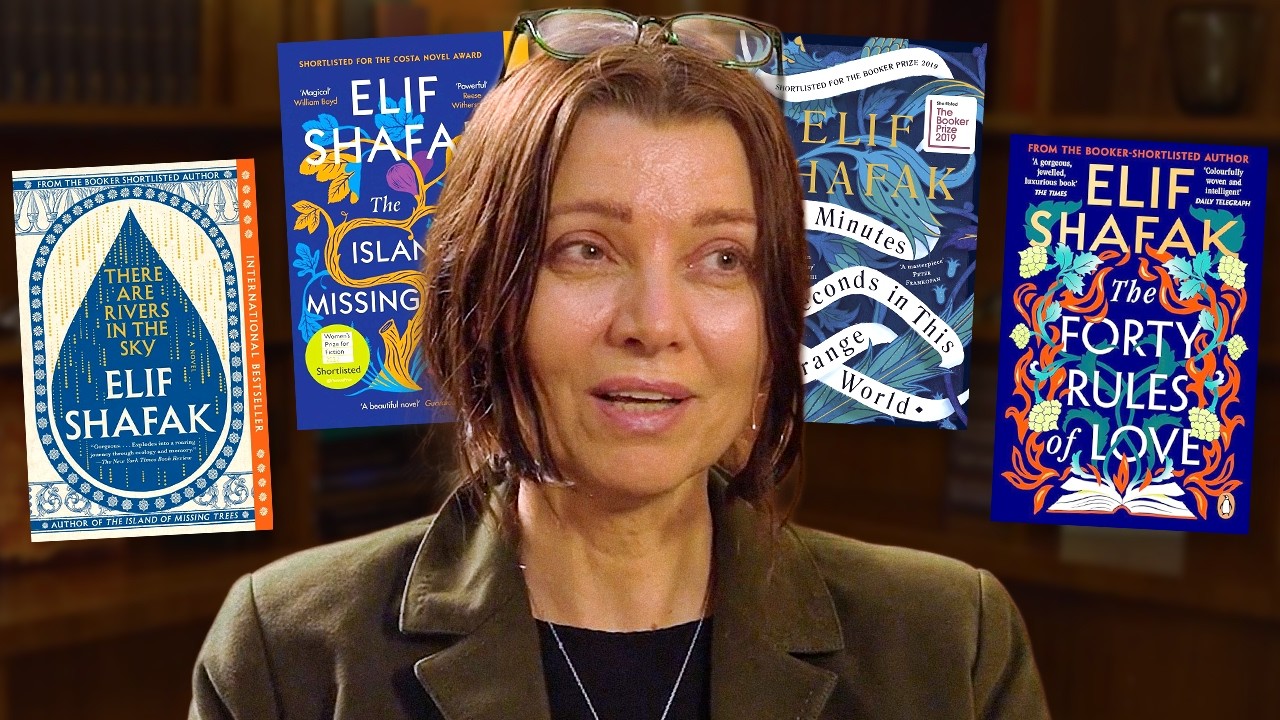
Elif Shafak is a Turkish-British novelist, author of more than 21 books, and president of the Royal Society of Literature. She writes in English (her third language, after Turkish and Spanish) and is known for infusing ordinary things—water, cities, everyday objects—with wonder and enchantment. Her advice to writers centers on freedom, intuition, and tapping into the ancient, universal art of storytelling rather than rigid technique or autobiographical confession.
Writing from the heart, not the mind
Shafak distinguishes between writing from the rational mind—which is constrained by identity politics, categories, and anxiety—and writing from the heart, which is broader, deeper, and more empathetic.
She sees herself as an intuitive writer, not an engineer: she doesn’t plan every character arc in advance. Instead, she lets characters surprise her, allows side characters to take over, and writes in a state she describes as being “a little bit drunk”—jumping into the story without fully knowing where it’s going.
This approach requires deep preparation—extensive reading, research, and listening—so that intuition has rich material to draw from.
She emphasizes that writing is not a linear process: even after 21 books, she cycles through weeks of confidence and weeks of despair, and she sees self-doubt as an inherent part of the journey.
Listening as a writer’s core skill
Shafak believes writers must be both good readers and good listeners.
Good reading means being eclectic: reading graphic novels, cookbooks, neuroscience, political philosophy—anything that speaks to you. She rejects the highbrow/lowbrow distinction and sees herself as an “intellectual nomad.”
Good listening means paying attention to oral culture—folktales, ballads, legends, riddles—and to what people don’t say. Silences, pauses, and ruptures carry as much meaning as words. She describes the novelist as a “linguistic cultural archaeologist” who digs through layers of memory and amnesia.
Characters and transformation
She doesn’t believe in heroes or purely good/evil characters. She’s drawn to moments of transformation: when a timid person shows courage, or a brave person is paralyzed by fear.
She’s more interested in the periphery than the center—the unseen, the unheard, what remains hidden.
When writing, she becomes her characters. She doesn’t stand above them; she’s inside the story with them. This extends even to non-human characters—she once included a talking tree in a novel, despite her agent’s alarm, because she heard the tree’s voice so clearly she couldn’t resist it.
She never judges her characters. She tries to understand them, even the unlikable ones.
The role of the senses and metaphor
Shafak activates all the senses in her writing. She notes that memory is often triggered by smell and taste (invoking Proust and the madeleine).
Her metaphors do two things: they help the reader see something hard to see, and they add an emotional hue that can be felt innately. Example: “clouds hanging over the city, the color of a neglected fish tank.”
She gives ordinary things—water, a grain of sand—cosmic significance. Water, in her writing, is a “consummate immigrant” that has traveled since time eternal; the same drops exist in the Mississippi, the Ganges, the Tigris, and in our tears.
Writing routine and environment
She has no precise schedule. She juggles writing with motherhood and other responsibilities, carving out time whenever she can—day or night.
She is nocturnal and prefers writing at night, when she can better hear the voices coming from the page.
She cannot work in silence. She listens to heavy metal (melodic death metal, industrial, Gothic) on repeat—sometimes the same song 70 or 80 times. She values its rawness, honesty, and emotional intensity, and finds it calming rather than agitating.
Editing and the loneliness of writing
She edits simultaneously as she writes, constantly rethinking and polishing, never moving in a straight line but jumping back and forth in a cyclical pattern.
Writing is the loneliest form of art (quoting Walter Benjamin). Though a book involves editors, copy editors, translators, translators, and designers, the act of writing itself is solitary.
She deeply values editors, copy editors (who catch historical details like curtain colors), and translators, acknowledging the collaborative effort behind every published book.
Freedom as the foundation of writing
Shafak argues that what writers need first and foremost is freedom: the freedom to read, write, and be. She has personally faced prosecution and trial in Turkey for things her fictional characters said.
She warns against taking freedom for granted. A culture that bans books, targets librarians, or prosecutes writers for fiction cannot produce genuine art.
She also warns against preaching in fiction. Writers should open up spaces of nuance, plurality, and multiplicity rather than delivering answers. Every reader brings their own gaze; meaning is co-created.
Writing in English vs. Turkish
She wrote her first four novels in Turkish (her mother tongue, the language of her childhood and grandmother) and switched to English more than 20 years ago.
Writing in English gave her cognitive distance—like stepping back from a painting to see it more clearly. It brought her closer to the land she comes from by creating space.
Her connection to Turkish is emotional; her connection to English is more intellectual and cerebral. She finds it easier to express sorrow and melancholy in Turkish, but humor, irony, and satire come more naturally in English.
She loves that English absorbs words from other languages (like chutzpah from Yiddish or kismet from Arabic) without resistance, whereas Turkey has purged many Arabic and Persian words from its vocabulary.
Poetry and the universal in the particular
Poetry is the ultimate barrier for an immigrant because of its reliance on rhythm, cadence, and melody—yet Shafak reads poetry in both Turkish and English.
She is drawn to William Blake’s idea of seeing “the world in a grain of sand”—finding the universal in the smallest, most ordinary things.
She values ancient philosophies and oral traditions that pay attention to nature: for example, Yazidi grandmothers who warn children to tread gently in April because “the earth is pregnant.”
Time: Kronos vs. Kairos
She distinguishes between Kronos (chronological, measurable time—clocks and calendars) and Kairos (deep time—the time of nature, storytelling, and cyclical repetition).
She believes history is more cyclical than linear. Example: the Thames was declared biologically dead, came back to life with nearly 300 species, and is now being polluted again by sewage—a cycle, not progress.
She questions the assumption that history bends toward justice, pointing to recurring patterns of forgetting and repetition.
Influences: writers and cities
Walter Benjamin: shaped her interdisciplinary thinking and his method of “reading” a city through its ruins and absences, not just its monuments. His unfinished Arcades Project showed her how to pay attention to what has been lost.
Rumi: she sees him as belonging to all humanity, not any single nation. His poetry transcends boundaries, and she is drawn to mystics who walk the thin line between faith and doubt.
Virginia Woolf: especially Orlando, which showed her a novel could be fluid across time, geography, gender, and genre. She also admires Woolf as a public intellectual.
James Baldwin: a “commuter” between cultures, like Shafak herself. She keeps a votive candle calling him “patron saint of exiles and poets.” His work on home, belonging, and exile resonates deeply with her.
Cities have shaped her as much as writers: Strasbourg (her birthplace, defined by absence), Ankara (a conservative neighborhood where she was an outsider), Istanbul (a layered city of contrasts and silences), London (where she found freedom), and Arizona (where the desert connected her to nature).
Spirituality, doubt, and agnosticism
She is not religious and is wary of dogma and certainty in any form—whether religious or atheistic.
She is interested in spirituality as something fluid and personal, and in secular acts of faith: starting a novel without knowing where it’s going, falling in love, moving to a new country.
She values agnosticism and mysticism—the willingness to say “I don’t know” and to keep learning. She sees humility as something modern culture has lost.
Melancholy and humor
She engages directly with sadness and sorrow in her writing, even though it affects her deeply psychologically.
But she always pairs melancholy with compassionate humor—not condescending or superior, but an all-embracing humor that recognizes everyone’s struggles. She sees humor as “oxygen.”
This combination reflects Istanbul itself, where absurdity underlies sorrow and humor underlies grief, often in the same moment.