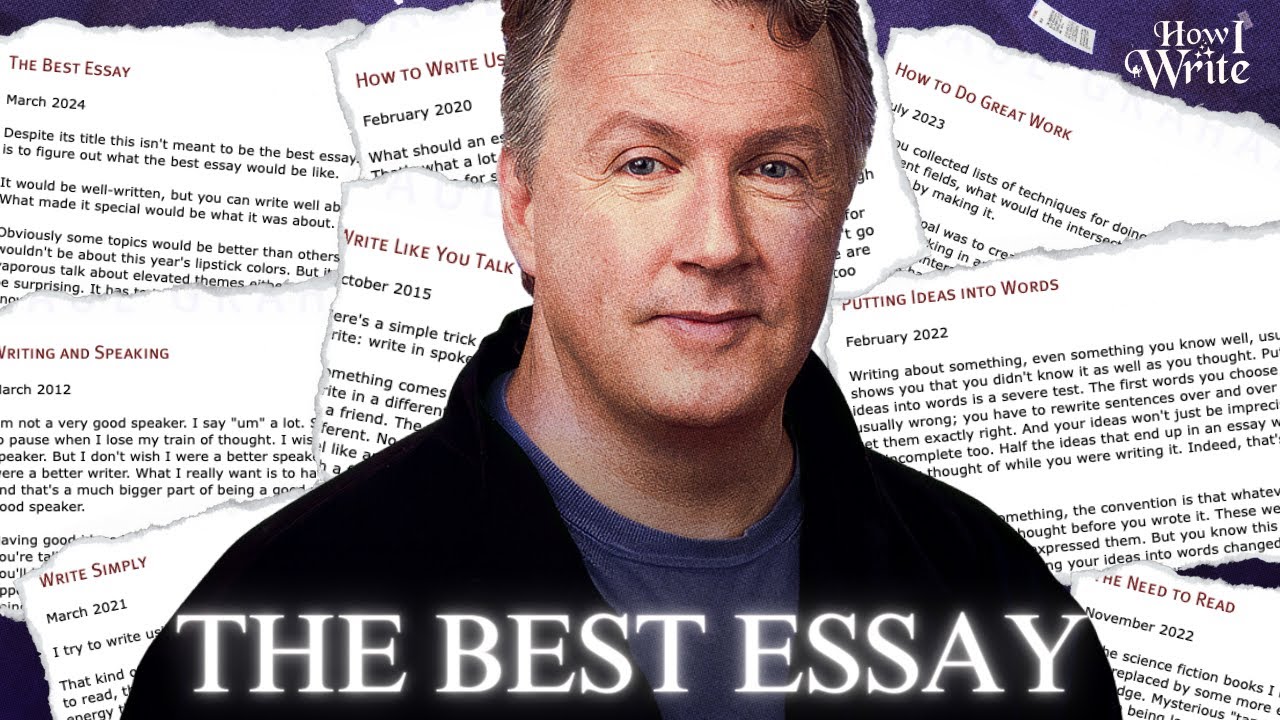
Paul Graham (PG) is one of the most influential writers on the internet, known for long-form essays on startups, wealth creation, and thinking — written in plain, conversational language and published for free online. He co-founded Y Combinator (which launched Reddit, Airbnb, Dropbox, Stripe, and more), and his writing directly shaped the startup world: YC was born from an essay, his readers were among its first applicants, and founders like Patrick Collison and Sam Altman were drawn to YC through his site. This episode breaks down PG’s writing philosophy into 11 lessons, drawn from his own words and practices, showing how he thinks, edits, generates ideas, and why his deceptively simple style is so effective.
Write simply
PG rejects the conventional wisdom that good writing requires jargon, complex sentences, or fancy vocabulary — the kind of writing people learn in school to sound impressive.
He argues that writing is information transfer: the reader has a finite energy budget, and the easier your writing is to understand, the more cognitive resources they can devote to your actual ideas.
Simplicity forces you to confront what you’re actually trying to say — you can’t hide behind ornamentation.
He compares it to high-end sushi (just fish and rice, no distracting sauces) and a great steakhouse (a plain fillet, not doused in A1 to mask low quality).
The simplicity of Casey Neistat’s videos is another analogy: Helvetica fonts, straightforward cuts, no filters — the work speaks for itself.
PG’s own early writing was needlessly complicated — short stories without plots designed to impress his English teachers, and an art school essay about Seurat written to sound intellectual. He later realized you don’t need complex sentences to express complex ideas.
Great writing comes from great editing
PG’s writing looks effortless, but that’s because of obsessive editing, not brilliant first drafts. He is a “great deleter” — the delete key is his most important tool.
He compares writing to line drawing: a Leonardo da Vinci portrait might be only eight or ten lines, but every line must be in exactly the right place. The slightest error collapses the whole thing. PG’s essays work the same way — everything unnecessary has been removed.
The paradox of writing: great writing looks effortless, so readers don’t appreciate how much refinement went into it. Most of what PG writes is probably not that good — the published version is the small percentage he chooses to keep.
Amateur writers want everything they write to be great. The goal is for everything you publish to be great. There’s a huge difference.
This is a game of slugging percentage, not batting average — it’s not what percentage of your output is good, but how good your best work is and how well you delete the rest.
PG sometimes rereads and rewrites his essays 50 times. “Good writing is rewriting. Good design is redesign.”
He prints out drafts to edit (rather than editing on screen) and highlights every spot where he feels stuck or frustrated, then goes back to fix those spots on the computer — separating the reading/identifying phase from the fixing phase.
He asks trusted friends (Patrick Collison, Sam Altman, Robert Morris, Jessica Livingston) two questions: What bores you? What seems unconvincing?
Boring parts get cut. Unconvincing parts he talks through with others until he gains clarity — the questions people ask reveal where his thinking isn’t clear, and the act of answering helps him refine the idea.
He also uses a technique from Tim Ferriss: ask friends what 10% they’d keep no matter what, and what 10% they’d cut if forced to — this makes it psychologically safe for them to give honest negative feedback.
He references Neil Strauss’s analogy: editing is like getting wrinkles out of a shirt — some come out easily, others take persistence, but you always get there.
The paradox of creativity: when your work is so simple the reader thinks they could have done it, they won’t appreciate how hard you worked. That’s the sign you’ve done a good job.
Writing generates ideas
PG estimates that 80% of the ideas in an essay come after he starts writing it, and roughly half of those turn out to be wrong — which is why editing is so important.
The first words you choose are usually wrong. Your ideas are imprecise and incomplete. “Indeed, that’s why I write essays — to find the ideas that I can only find by writing.”
The common misconception is that brilliant writers have fully formed ideas in their heads and simply transcribe them. In reality, writing is how you discover ideas. Rewriting is how you discover things you didn’t know you knew.
This means the problem with not writing is that you’re missing out on the ideas writing would have generated.
It’s not just that experts write — writing leads to expertise. PG is an expert on startups because he’s written so much about them, not the other way around.
PG’s chilling claim: “If writing down your ideas always makes them more precise and more complete, then no one who hasn’t written about a topic has fully formed ideas about it.”
Find ideas that are general and surprising
The holy grail for PG is ideas that are both general and surprising.
Surprising but not general = gossip (interesting but narrow).
General but not surprising = platitude (“work hard, be kind” — true but boring).
General and surprising = insight.
How to find them: pay attention to what you find interesting, not what you think others will find interesting. Follow your curiosity, even about apparently minor questions.
Darwin noticing all the different finches in the Galápagos is an example — an innocuous question that led somewhere enormous.
If an idea feels incomplete or half-baked at the start, that’s normal. You just need a starting point.
Shower thoughts matter: PG says “it’s hard to do a really good job on anything you don’t think about in the shower.” The things your mind wanders to unprompted are often what you should write about.
Write about what’s actually on your mind, not what you think you should write about to look impressive. Write your shower thoughts, not your boardroom thoughts.
PG loves questions that seem naughty — counterintuitive, overambitious, or heterodox. He’s comfortable exploring ideas other people reject as pointless or politically incorrect.
Find generative people to talk with — not just smart people, but people who help you generate new ideas. For PG, that’s Robert Morris (YC co-founder), who is credited on many of his essays.
You don’t need a complete thesis to start writing. You just need a gap, a wedge, an interesting question about something people take for granted.
He compares this to professional traders who won’t trade unless they have an “edge” — a convincing story about why they’re more likely to make money. Writers should approach topics where they have some edge: a new insight or way of seeing something.
Jim Simons (founder of Renaissance Technologies, the most successful investment firm ever) wasn’t the best mathematician or trader — his unique skill was excellent taste in picking problems. He had a knack for distinguishing good problems from ones no one would care about.
A surprise is something you didn’t know that also contradicts something you thought you knew. Laughter while reading a draft is a good sign — as Tom Stoppard said, “laughter is the sound of comprehension.”
Two ingredients for great writing: (1) a few topics you’ve thought about a lot, and (2) the ability to discover what’s unexpected and surprising about them. That’s where insight comes from.
Being a little rebellious helps: “Don’t do as you’re told. Don’t believe what you’re supposed to. Don’t write the way you’re taught in school.”
Try painting
PG studied painting at art schools in Florence and at RISD (dropping out of both), focusing on still life. Painting taught him to see more carefully — in everyday life, low-level brain processes handle most visual perception without conscious detail, but painting forces you to notice things you’d normally overlook.
“You can still be noticing new things after days of trying to paint something that people usually take for granted, just as after days of trying to write an essay about something people usually take for granted.”
Good writing is really good seeing: making readers notice something they’ve always known but never consciously realized. It was always there, but they could never put words to it.
Robert Caro (Lyndon B. Johnson biographer) exemplifies this: in interviews, he’d repeatedly ask “What would I have seen if I was there?” — pushing past generic descriptions to visceral, specific details (no water, rats crawling, sewers backing up, carpets ripping).
PG’s oneliners work the same way: “Make something people want” takes something everyone in the startup world already knows but no one had synthesized into a clear maxim.
Do hard things
PG’s writing is grounded in deep, firsthand experience: building Viaweb (sold to Yahoo), working with Lisp, co-founding YC, reading thousands of applications, and having countless conversations with founders during office hours.
His essays are the fruit of those conversations — he’d hear the same questions from multiple founders, feel that his answers weren’t clear or well-articulated, and then go to the keyboard to work out his thinking.
He explicitly says he poured over the ideas in Hackers and Painters with friends for years before writing it. The acknowledgement section of his book is full of people he worked with, not just editors.
The principle: to write a great essay, you must first become the essay — do the hard things that give you the raw material and the edge.
PG wrote these essays while building YC, which makes the output even more remarkable.
Cultivate your taste for great writing
PG rejects the idea that taste is purely subjective. Once you start getting better at something, you realize your old ways weren’t just different — they were worse. There is a hierarchy of quality.
He discovered this through painting: copying masters like Rembrandt and Da Vinci, he could see they were genuinely better, and he worked to deconstruct why.
To refine your taste: make lists of what you love and hate — after a museum visit, name five paintings you loved and five you hated, and articulate why. Trust your own intuition about quality, not critics or authorities.
Read widely and study writers who excel at one thing in particular — the more you read with discernment, the better your taste becomes.
Copy what you like
PG initially copied what he thought was impressive (short stories in school, wordy philosophy papers in college) rather than what he genuinely enjoyed. He now says: only copy things you actually like.
Separate what you like from what you think is impressive. There’s writing that’s difficult and scholarly but that you don’t enjoy — don’t copy that just because it seems high-status.
He distinguishes two kinds of books:
Books you enjoy having read more than reading them (e.g., Ulysses — you feel proud at page 274, but it’s a slog).
Books you enjoy reading so much you’re upset when they’re halfway done — these are your genuine preferences, and these are what you should study and imitate.
The stranger and lower-status your guilty pleasure, the more likely you’re onto something real. If other people think it’s boring or lame, that’s actually a signal.
Ask yourself: What seems like work to other people but doesn’t seem like work to you? For PG, it was writing school papers for friends — he loved doing homework for classes he wasn’t even taking. That’s where his real interest lived.
The writing equivalent: what is interesting to you but boring to other people? Write about that.
Write briefly
“Say what you mean and say it briefly.” But brief does not mean short — many of PG’s essays are long. Brief means no wasted words.
He compares it to a standup comedy special: an hour-long set made of 30-to-90-second story loops, each one tight and self-contained.
In software engineering, shorter code is often more correct because it eliminates conflicting assumptions. PG wonders if the same is true for writing — the shorter something is, the easier it is to see the moving parts and evaluate them.
Don’t try to develop a personal style
At art school, PG saw painters trying to develop a recognizable personal style (like Picasso’s instantly identifiable work). He rejected this as gimmicky.
His view: if you just try to make good things, you’ll inevitably do it in a distinctive way, just as each person walks in a distinctive way. Michelangelo wasn’t trying to paint like Michelangelo — he was trying to paint well, and his style emerged naturally.
“The only style worth having is the one you can’t help.” Focus on writing well and writing truthfully. The style will take care of itself.
When an ending appears, grab it
Learn to recognize the approach of an ending in your essay, and when one appears, stop. Don’t keep writing past the natural conclusion.
What Sam Altman learned from Paul Graham
Sam Altman (YC president, now leading OpenAI) started his personal blog specifically to practice writing, inspired by watching PG’s writing be so powerful for helping startup founders and attracting good ones to YC.
PG never taught a formal class, but Altman and a whole generation of people copied PG by reading his essays — his style resonated that deeply.
What Altman took from PG: clarity, precision, density. No posturing. Interesting ideas said clearly. Nothing wasted. Nothing fake. Comparing an average business book to a PG essay is like comparing “different species.”