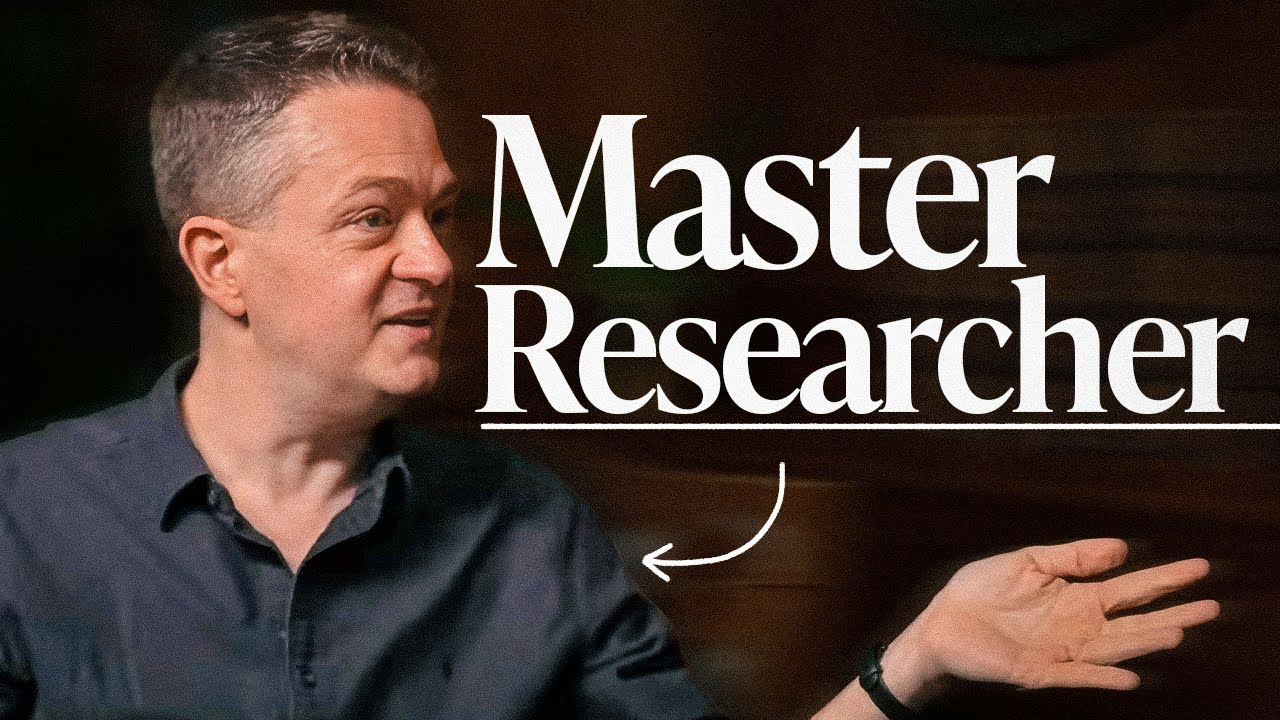
Johann Hari is a journalist and author who writes deeply researched non-fiction books about systemic problems—addiction, depression, attention, and obesity—by traveling the world and conducting hundreds of interviews for each book. His method is rooted in personal curiosity, radical openness to his subjects, and a commitment to letting people be complex and contradictory. He doesn’t start with a thesis; he starts with a question from his own life, then follows it wherever it leads, often arriving at insights that challenge conventional wisdom.
How Hari chooses and develops his books
Every book begins with a personal question Hari wants to answer in his own life, not with a systemic critique.
Chasing the Scream (addiction): grew up with addiction in his family; nothing he tried helped his loved ones.
Lost Connections (depression/anxiety): noticed rising rates across the Western world and felt depressed himself.
Stolen Focus (attention): wanted to understand why he could no longer read or concentrate.
Magic Pill (weight loss drugs): wanted to understand the physical and psychological implications of new drugs like Ozempic.
He writes out a list of core questions for each book and pins them to his door—they anchor him throughout years of research.
Example from Stolen Focus: Is our attention really getting worse? Why? Who is doing this to us? How do we fix it? Where in the world is it being fixed?
He identifies the types of people who can carry the story (a drug dealer, a cop who supports the drug war, a cop who doesn’t, a cartel member) and then finds them through chains of referrals.
He does 200–300 interviews per book; roughly 80% don’t make it in, but they provide essential context and leads—like a police investigation where you don’t know in advance which interview will crack the case.
His interviewing philosophy
Start from a position of love and curiosity: every person knows something you don’t, whether they’re a homeless person in a tunnel or a professor at Yale.
Prepare thoroughly, but go in with radical openness—don’t interview for an angle or to illustrate a pre-existing point.
People can tell if you genuinely care about them and think they’re important; one way you demonstrate that is through preparation.
Physically lower yourself when possible—Hari sits on the tunnel floor with homeless people in Vegas, for example—to avoid standing over anyone.
Ask open-ended questions: “How did you feel?” rather than “Did you feel bad?” to avoid leading people toward expected answers.
Use Robert Caro’s question: “What would I have seen if I was there?” to draw out vivid, concrete detail.
Let people be complex and contradictory—resist the urge to capture someone’s “essence” as purely good or bad.
Example: Sheriff Joe Arpaio ran horrific prisons, but Hari learned Arpaio’s mother died in childbirth and he was told his entire childhood that he killed her—this doesn’t excuse his actions, but it reframes them and reveals a deeper reality.
Demonization and valorization are both oversimplifications; the dignity of real people lies in showing them as they truly are.
Explain at the start of an interview why you care about the subject—this helps the interviewee emotionally invest.
For Chasing the Scream, Hari would say: “I had a relative who was severely addicted. My earliest memory is trying to wake one of them up and not being able to.”
Send people what you plan to quote them for—not to give them veto power, but to ask if there’s anything they want to add or correct. This often surfaces new, more nuanced reflections.
Listening as a core skill
People are profoundly lonely—42% of Americans agree “no one knows me well”—and most conversations involve alternating monologuing rather than genuine listening.
Demonstrate listening by reflecting what people say, tuning in, and sometimes challenging them provisionally (“I could be completely wrong, but…”).
The goal is to guide and lead people as little as possible, creating space for unexpected answers.
His research process
Read enormous amounts—books, academic papers, journalism—before identifying who to talk to.
Whenever possible, sit with people in person; you get 90% more than over the phone or email.
At the end of every interview, ask: “Who else should I talk to?” This creates chains of referrals.
Keep returning to the same people over years—often the eighth interview is when someone reveals something truly important.
For his Vegas book (in progress for 14 years), Hari listened to interviews from 2011 alongside ones from last year with the same person.
Publish audio of all interviews on his book websites so readers can hear the voices of the people he writes about—he sees himself as a concierge connecting readers to remarkable people.
Writing and editing
To manage overwhelming amounts of material, Hari tells the story to a 12-year-old from memory and records it—a 12-year-old is smart enough to understand anything but has a short attention span, so boredom reveals what’s unnecessary.
Kill anything that isn’t serving the questions you’re asking and the story you’re telling—not just “kill your darlings” but kill anything irrelevant to the core inquiry.
Write the book from beginning to end in sequence to simulate the reader’s journey.
Editing process:
Put the manuscript aside for a month.
Print it out and edit by hand—cutting, rewriting, noting unanswered questions.
Print it again and edit again.
Read it on a phone (different format reveals different problems).
Rewrite again.
Send to three close friends with impeccable judgment, then to editors.
Rewrite again.
Send relevant sections to the people written about, then rewrite again.
Final fact-checking and copy editing.
Primary editing heuristic: clarity above all. The worst thing anyone can say is “I don’t understand you.”
Emotional connection is equally important—borrowed from “deep canvasing” work at the LA LGBT Center, where they learned to start by asking people about times they felt judged, creating an emotional bond before introducing the political topic.
Hari’s books all begin with a moment of vulnerability to create this bond, then establish a shared goal, then weigh evidence together.
On doubt and writer’s block
When Hari experiences doubt, he confesses it candidly to the reader rather than hiding it—this is more persuasive than false confidence.
Example: He was blocked from going to Portugal to research decriminalization because he was afraid it wouldn’t work, which would make his book say “nothing works.” He told the reader about this fear; Portugal turned out to be a success.
Writer’s block contains wisdom—it often signals that what you’re saying is inauthentic or that you’re afraid of the truth.
To work through it: talk to friends, record conversations, argue with them. Friends often know you better than you know yourself.
Example: A friend told Hari he was framing his Ozempic book around health vs. risk when it was really about vanity—this broke his block.
The heuristic of always telling the truth: when you realize you’re afraid of the truth (of how it makes you look, or of what you might find), that’s where blockage lives. Writing the truth unblocks the plumbing.
On style and clarity
True intelligence is making complicated things comprehensible to everyone, not making simple things sound fancy.
This is rooted in Hari’s biography: raised by a grandmother who left school at 13, parents who left at 15; he grew up translating between class and language barriers.
Lyricism must be earned by the story—Hari only writes lyrically when the emotional truth of the subject has been established.
Style should be an expression of an underlying philosophy: democratic, clear, attuned to people’s emotional realities.
He’s influenced by George Siméon, who said he strikes out everything that “sounds like writing.”
On journalism and deeper currents
Early in his career, Hari wrote opinion columns (confident, argumentative) and reported from other countries. Over time, he shifted almost entirely to reporting—listening more, talking less, attending to complexity rather than fixing reality.
Most journalism focuses on surface events (the “winds”), but Hari is interested in the deeper “currents”—the underlying forces that are more predictive and definitive.
Most people’s opinions are expressions of deeper needs, narratives, and wants; addressing the deeper need is more effective than arguing about surface phenomena.
Example: A woman in Cleveland who said “when I was alive” instead of “when I was young” revealed she felt psychologically dead—her anger at politics made sense in that context.
We argue at the level of “maps” (abstractions), but Hari goes to the “territory”—hundreds of boots-on-the-ground conversations—to test whether the maps of reality are accurate.
Giving someone a more accurate story about their pain can be transformative, but it’s also painful—people are attached to the stories they’ve been told, even wrong ones, because those stories provide comfort and explanation.
The power of vulnerability
Hari opens Lost Connections with a story of nearly dying from a poisoned apple in Vietnam—projectile vomiting on a 91-year-old war survivor’s floor, kidneys shutting down, being told by a doctor “you need your nausea, it will tell us what’s wrong with you.”
That doctor’s insight became the thesis of the book: depression and anxiety are not malfunctions but signals telling us about unmet needs.
Making yourself vulnerable in public is hard and unattractive, but it creates a powerful bond—most people will lean in with empathy rather than punch you.