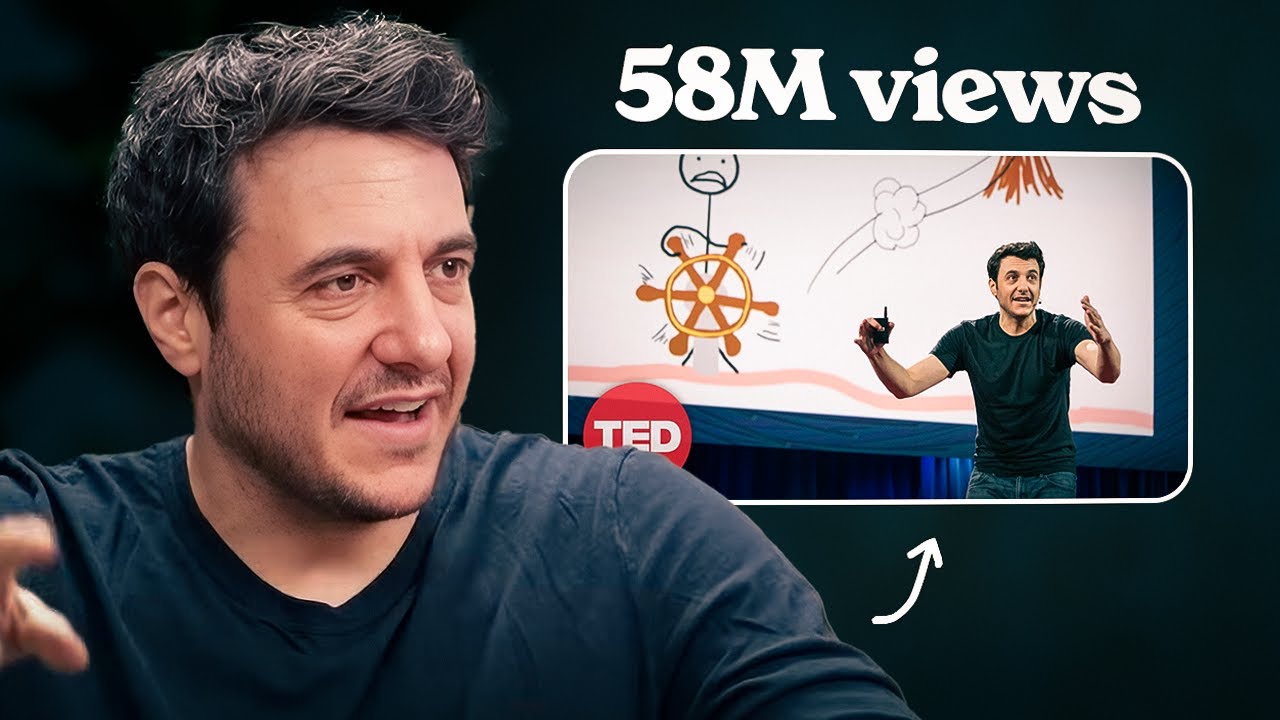
Tim Urban is the creator of the blog Wait But Why, known for long-form explainers on topics like AI, procrastination, and politics, paired with his signature stick-figure drawings. He’s also the author of the book What’s Our Problem? and the viral TED Talk on procrastination. In this conversation, he traces how his writing voice emerged almost entirely by accident, explains his unusual creative process, and reflects on what makes writing feel alive.
How Tim’s voice emerged from procrastination, not ambition
Before Wait But Why, Tim ran a personal blog from ages 23 to 29 where he wrote about 300 posts — but it was purely a procrastination activity, not something he took seriously.
He wasn’t trying to be a writer or build an audience; he was just having fun, like sending funny emails to friends but doing it publicly.
Because there was no pressure, he experimented freely: he tried listicles before they were ubiquitous (“19 Things I Don’t Understand”), and only near the end of that era did he discover he could upload hand-drawn cartoons to a blog, which readers loved.
His distinctive style — goofy stick figures, colloquial tone, personal vulnerability — emerged organically from six years of writing without the identity of “writer.”
He argues that taking something too seriously can literally shut down parts of your brain. The moment you’re supposed to produce a good idea, you get blocked. The freedom to play without stakes is what let his real voice surface.
Even now, when he catches himself writing in a stiff, overly careful way (especially in his book), he has to remind himself to write the way he would on Twitter or in a casual explanation to a friend.
The writer as a character in the writing
Tim thinks about a spectrum: on one end, academic or journalistic writing where you learn nothing about the author as a person; on the other, writers like Hunter S. Thompson or his own blog, where the writer’s personality, quirks, and emotional state are central to the piece.
He doesn’t think one end is better — Daniel Day-Lewis reveals nothing about himself and is one of the greatest actors; Louis C.K. reveals everything on stage. Both work.
For Tim, the core of his writing is still “hanging out with readers.” Even when the topics get serious (AI, political tribalism), the reader experiences his emotional journey — his freakouts, his mind being blown, where he ends up.
Dopamine-hit density: the key to emotionally resonant writing
Tim’s writing process is built around a concept he calls “dopamine-hit density.” When he researches, most of it is dry or boring, but occasionally something clicks — a surprising fact, a connection, an insight — and he gets a jolt of intellectual excitement.
His job as a writer is to collect all those moments from months of research and pack them densely into a piece so the reader experiences the same arc of discovery in 45 minutes.
He compares this to stand-up comedy: an HBO special is the best of the best of the best funny moments a comedian has had over a decade, tested and refined. The audience gets a relentless stream of dopamine hits.
He cites Raymond Chandler’s rule: every page of his novels had to contain one moment of insight or it wasn’t dense enough.
Chapter 11 bankruptcy: when a blog post becomes a book
Tim’s book What’s Our Problem? started as a blog series called The Story of Us, attempting to explain why modern society feels so broken — tribalism, lies spreading, families fracturing over politics.
The first 10 chapters introduced new frameworks for understanding society. Chapter 11 was supposed to be a short “let’s apply this to the real world” chapter with a few examples.
Instead, he got sucked into specific political movements, their histories, and current events. That single chapter grew longer than the other 10 combined — over 100,000 words — forcing him to turn the whole project into a book.
Publishing the first 10 chapters online first was incredibly valuable: hundreds of comments, including substantive criticism, let him stress-test the arguments before committing them to a book.
One particularly thorough critical commenter (screen name Jacob Aziza) was so sharp that Tim reached out and asked him to review the full book draft. The book is better because of him.
Writer’s block and the feeling of being stuck
Tim describes three distinct flavors of getting stuck:
The daunting section: He doesn’t feel confident he understands the material yet, and the idea of researching more feels “icky,” so he avoids it.
The organizational swamp: He knows the material but can’t figure out how to structure it — too much to say, no clear order, and the prospect of wrangling it into something streamlined feels overwhelming.
The boring writing: He knows what to say and in what order, but the prose itself is flat. He can feel himself plodding, and he knows the reader will feel it too.
His test for whether a section works: if he’s fighting through it, the reader will fight through it. The best writing happens when he’s in flow — curiosity on the page, forgetting to eat or use the bathroom, having fun.
Advice he received about his TED Talk applies to writing: if there’s a part you always hate practicing, the audience will hate it too. Cut it or change it. Every minute should be fun to perform.
Drawings: the slog after the writing
Tim does all his drawings after the writing is done. While writing, he inserts bracketed descriptions of what the drawing will show.
The drawing process is a grind — he’s not naturally talented, and he has to power through multiple drawings per day like a workout.
He doesn’t make himself laugh while drawing; he’s usually stone-faced. But he unconsciously mimics the facial expressions he’s drawing on his stick figures, which his wife sometimes catches him doing.
Procrastination: mostly destructive, sometimes productive
Tim is famous for his writing on procrastination (the TED Talk, the blog posts), and he’s honest that it’s a real problem for him — not a cute quirk.
He distinguishes between productive and unproductive procrastination:
Productive: Extra research after he already knows enough, which often surfaces new insights; the perfectionist impulse that pushes him toward A+ work rather than B-.
Unproductive: Simply lacking executive function — he knows working now would make him happier later, but he can’t make himself do it.
He notes that highly prolific people he admires (Ryan Holiday, Adam Grant) may achieve that output partly through anxiety or shame, not perfect mental health. Humans aren’t built to be both perfectly healthy and perfectly productive.
His ideal is structured “black focus time” and “white free time” — clear boundaries — but he acknowledges he doesn’t always follow his own advice.
Ideas vs. writing: which matters more?
Tim’s honest answer: he’d choose great ideas over great writing, but truly bad writing makes even great ideas hard to absorb.
Great writing with okay ideas can still be enjoyable — wordplay, humor, the pleasure of watching someone rant interestingly even if the ideas aren’t original.
But a dry, dense academic paper with brilliant ideas? He won’t read it. The ideas can’t come through if the writing is bad enough.
The ideal is a balance: good ideas delivered in writing that’s fun and clear.
How he prepared his TED Talk
The TED Talk on procrastination was built on a framework he’d already written about (the Instant Gratification Monkey, the Rational Decision Maker, the Panic Monster).
He started with bullets, then talked it out loud while pacing, constantly re-envisioning himself speaking to an actual audience rather than writing on a page.
He went back and forth between speaking and writing, revising each time — what sounds natural spoken often reads awkwardly on the page and vice versa.
For most talks, he just uses slides as a loose outline and speaks extemporaneously. But the TED Talk was the “Super Bowl” — exact time limit, one take, permanent online — so he memorized it word-for-word and still had moments on stage where he lost his place.
The famous Google Earth/India example was written verbatim from his original blog post. Every example in the talk is a true story of things he actually did while procrastinating.
Music and writing: the pursuit of the non-obvious
Tim spent years composing music (film scoring, bands) before focusing on writing, and he sees strong parallels.
In music, he trained himself to avoid the obvious chord progression — the one your ear expects — and find something different that still sounds good. This is hard.
The composers who land major film scores are the ones who developed a unique sound, not the ones who made excellent copies of existing styles. The Beatles started as derivative and became revolutionary.
In writing, he tries to avoid stock phrases and figures of speech (“however,” “after all”) that signal “this is how writers write.” He’d rather be colloquial, weird, and distinct than beautifully written but interchangeable with other writers.
Tricks to get more of himself into his writing
Tim’s most “him” writing happens in iMessages, less so in group chats, and least in formal documents like Google Docs. The challenge is bringing that iMessage energy to longer work.
The key variable is confidence. When he feels like “this is my domain, I’m having fun, you’re welcome to join,” the writing is more original and personal. When he’s insecure, it becomes flat and matter-of-fact.
Practical tricks:
Having a few drinks can help lower inhibitions.
Taking a break and coming back, or asking himself: “How would I explain this to a friend in 2006 on my blog?”
Reading other writers who nail the colloquial, fun voice — Bill Bryson, Scott Alexander, Allie Brosh’s Hyperbole and a Half — to remind himself what that energy feels like.
Looking back at his own old writing when he was having fun.
He acknowledges this is easier for blog posts than books. A book has a slog element — you can’t have fun on every single page.
Writing tools: TextEdit and Microsoft Word
Tim writes in TextEdit — a bare-bones, no-formatting text editor — because he’s built a personal code over the years using bold, color, font size, and indentation to organize his work.
He’s tried other software and always gets frustrated by the friction of moving things around. With TextEdit, everything is saved automatically, opens exactly as he left it, and loads instantly.
For editing and collaboration, he uses Microsoft Word for track changes, despite hating it and despite its unreliable autosave (he’s lost writing to crashes and still manually hits Cmd+S constantly).
His assistant uses Workflowy for research notes and outlining, which he acknowledges is good software, but he personally can’t leave TextEdit.
Why Tim loves history (and why school ruins it)
Like many people, Tim graduated high school thinking he hated history because of how it was taught — memorizing dates, dry textbooks, no passion from teachers.
David McCullough’s biography of John Adams was a turning point in college. It combined a gripping big story (founding the US from scratch) with vivid, humanizing details (Adams writing in his diary about needing to stop hitting on girls and focus on his studies).
He realized history is the most interesting story ever — better than fiction — and we’re all characters in it. It’s drama, gossip, betrayals, surprise attacks, paradigm shifts.
He’s a devoted listener of history podcasts (Dan Carlin’s Hardcore History, Fall of Civilizations, Revolutions, History of English) and compares the experience to being addicted to a really good soap opera.
The more history you learn, the more interesting it gets, because each new fact has a foundation to attach to in your brain.
Horizontal history and the power of details
Tim coined the term “horizontal history” for taking a cross-section of a time period and seeing what was happening simultaneously across different domains.
A giant illustrated history book his mother owned growing up showed timelines of art, psychology, technology, and politics overlapping — letting you see, for example, that Cubism, Freud, and the Wright brothers were all active at the same time, and that Surrealism followed from Freud’s ideas.
This reveals stories and connections that isolated chronological narratives miss. People in the 1500s didn’t think of themselves as living in ancient times — they thought they were cutting-edge, just like we do.
On choosing which details to include in his own writing:
He uses his own taste as a filter. If a factoid gives him a dopamine hit — if it surprises him or makes him think “wow” — it probably makes the cut. If it’s just information he files away without excitement, it gets cut.
Example: learning that a chimp’s habitat is 8 square miles while a hunter-gatherer’s is 500 square miles — that ratio was striking and helped explain why bipedalism evolved (it uses one-quarter the energy of walking on all fours). That detail made the cut.
He assumes his readers share his level of curiosity and intelligence, which simplifies the filtering process.
Research as chasing surprise
Tim describes his research process as following his curiosity like a compass. He often can’t articulate why he’s drawn to a particular source or topic, but he’s learned to trust the feeling that “there could be gold over there.”
When researching something like the history of humans, he’ll start with a famous subject (like the Lucy skeleton) unsure of what’s interesting about it, and as he reads, his curiosity guides him toward what’s actually fascinating (Lucy was bipedal but not yet smart — we walked before we were intelligent).
If research feels dry and confusing, it might mean he needs to learn more foundation, or it might just mean that topic isn’t that interesting. He doesn’t force himself to include things out of perfectionism.
Advice for aspiring writers (especially young people)
If he had to teach 250 high schoolers to write in one day, he’d structure it around his own experience: he thought he hated writing because school made it boring, then discovered blogging was actually fun.
He’d have them spend a few minutes thinking about what they enjoy talking about with friends — what they find funny, what they’re curious about — and then just write about that with no pressure.
The goal would be to give them the experience he had: no stakes, no “being a good writer,” just creativity and fun. If even a few of them get tickled by their own ideas and want to keep going, the day was a success.
He thinks the seriousness around writing is largely a product of how it’s taught — as a kid version of academic writing, with thesis statements and rigid conventions.
Academic writing serves a purpose (organizing thoughts, proving arguments, peer review), but it’s a specific discipline, not the only way to write. Kids should maybe spend 20% of their time on structured writing and 80% on fun writing that still builds core skills.
The real lesson kids take from school is that learning sucks, which is crazy given how naturally curious they are.
The final edit: pretending to be the reader
When Tim does his last edit before publishing, he tries to read the piece as if someone sent it to him — would he enjoy reading this?
He’s looking for parts that aren’t interesting, aren’t clear, or where the energy dips. If he enjoys reading it, other people probably will too.
By the final pass, most of the substantive issues have been caught earlier. The last read is usually technical — tiny word changes, small fixes.