Andrew Hunter Murray — journalist, comedian, novelist, and host of the podcast No Such Thing as a Fish — talks about the craft of writing, drawing on his three novels (The Last Day, The Sanctuary, and A Beginner’s Guide to Breaking and Entering), his love of Edith Wharton and Jane Austen, and his years teaching writing. The conversation covers what makes a strong premise, how to make characters feel real, the difference between sci-fi and literary fiction, the role of humor, and why fiction can reveal truths about the present that data and reporting cannot.
What makes a good premise
A good premise should be explainable in one clear, concrete sentence — this helps both the writer stay focused and the reader understand what they’re getting.
Specificity matters: if you can’t articulate what your book is about without saying “it’s sort of…,” the idea isn’t ready yet.
Murray’s first novel, The Last Day, had a crisp premise: the Earth stopped turning 30 years ago, leaving half the planet in light and half in darkness. His second, The Sanctuary, was harder to articulate and harder to write because it lacked that clarity.
A strong premise generates its own momentum — once Murray had the idea for The Last Day, he immediately started asking “but what about this?” and spent a long time mapping out second- and third-order implications before writing.
He’s currently drawn to a premise about a world where no one can sleep, imagining the chaos of world leaders with their fingers on nuclear buttons after a week without rest.
Sci-fi vs. literary fiction
Sci-fi tends to begin with a premise; literary fiction often begins with a character or theme — though both can overlap.
Murray’s third novel, A Beginner’s Guide to Breaking and Entering, started with the character of Alex, a young man who lives in empty second homes when the owners are away. Alex “just arrived” in Murray’s head, and the premise grew from the character.
When writing longhand, Murray accesses sentences that haven’t fully formed in his conscious mind — a sensation of being “written through” that typing doesn’t produce in the same way. Typing nails things down; longhand keeps things fluid.
He keeps a messy, private notebook for each book — full of loose dialogue, scene ideas, and notes from other writers — a “soup” he can trash freely.
Making sci-fi feel real
The physics of a fictional world don’t need to match real physics, but they must be internally consistent and clearly communicated.
Murray contrasts the grounded, clear world-building of Alien with modern sci-fi films where floating cameras and CGI spectacle make things feel less impactful. The viewer needs a fixed point of view and a sense of scale.
He did real research for The Last Day, consulting his sister-in-law, an astrophysicist, who gave him eight plausible ways the Earth could stop rotating — enough to make the premise feel credible to readers.
Why fiction beats reporting
Murray’s Breaking and Entering books explore inequality, housing shortages, and the feeling that some people “get away with it” — but wrapped in entertainment, not policy analysis. He calls this “sugarcoated broccoli.”
He cites Philip Pullman’s metaphor: writing a book is like walking through the woods. You can look around at the scenery, but don’t leave the path to have a picnic. Research is vital, but resist the urge to show it all.
Fiction lets you look at real problems — housing, inequality, what it’s like to be young today — obliquely, through imagination and story, in ways that data and journalism cannot.
Pacing and structure
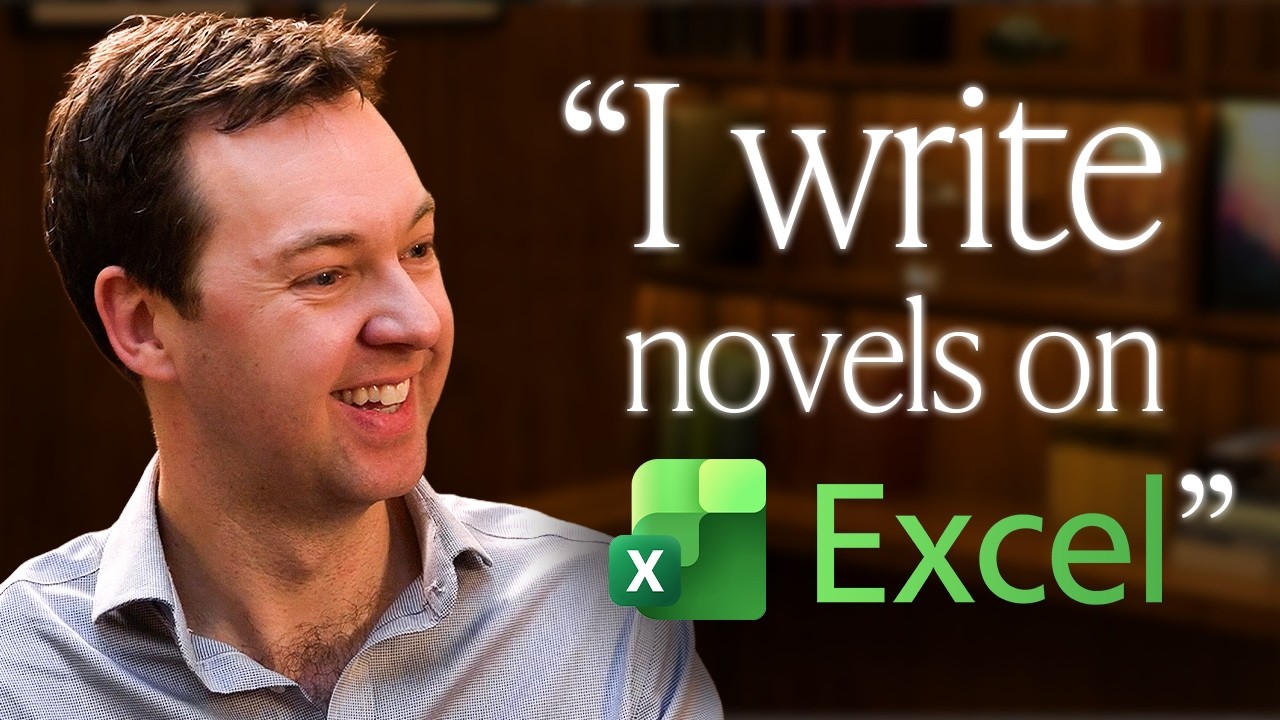
Murray uses Microsoft Excel to track every scene: which characters appear, what the reader learns, how it connects to the plot, and where the personal story is heading. He describes this as “braiding” multiple threads together.
Every scene must earn its place by moving the plot or character forward. A scene set in a fireworks factory is only justified if something comes out of it that pushes into the next scene.
He wants every character who isn’t just a background extra to have a moment of achievement, satisfaction, or development.
Writing real characters
Murray writes Alex in the first person but doesn’t see him as a self-insert — Alex is a rogue, while Murray describes himself as very law-abiding.
Alex’s lifestyle has consequences: he’s essentially friendless. His closest relationship in the first book is with a glazier he pays cash-in-hand to fix break-in damage.
A recurring theme across Murray’s work is characters “thawing out” — people held back from fully engaging with the world who begin to form proper relationships. He’s not sure why this preoccupates him, but it shows up in every book.
When writing a series, characters can’t repeat the same journey every time. Something must change — the premise must evolve. He admires how Mick Herron’s Slow Horses novels keep characters recognizable but deepen the reader’s relationship with them over nine books.
He also notes the power of withholding: in Slow Horses, we never get inside the head of Jackson Lamb, the crew’s leader, which makes him more compelling.
The role of secondary characters
Edith Wharton’s principle: “A far profounder effect is produced by the penetrating study of a few characters than by the multiplying of half-drawn figures.” Every character should be followed to the end of the tale and proven essential.
Secondary characters can be drawn in a few lines. A single illuminating detail — like a man who obsessively folds his shirts a certain way — can make someone unforgettable.
Murray gives an example from the film Train Dreams: a man appears for one scene, announces he’s looking for someone, shoots him twice, and explains the victim killed his brother 25 years ago. It’s the character’s only appearance, yet he’s vivid and pure.
More is not better. Characters fail when they become vehicles for plot rather than feeling physically real.
Techniques for character writing
Key instruments: how someone moves, gestures, reacts, what they wear, how they smell, how they talk.
Edith Wharton’s concept of “soul drama”: the most important moments are not action set pieces but what characters say to each other when they think it’s all over — people struggling with themselves, their vices, their regrets.
Murray points to the wristwatch in Die Hard as a small object that carries enormous symbolic weight about John and Holly McClane’s relationship.
Andrew’s personal mantra: “This is not the cake”
Murray keeps a neon sign above his desk reading “This is not the cake” — meaning: don’t compare your unfinished draft (flour and eggs) to someone else’s finished book (a cake).
This applies across a career, not just a single book. Writers can spend decades improving, and comparing your early work to another writer’s fifteenth book is self-defeating.
He forgets how to write between books and has to relearn each time, trusting that some layer is being set down that lets him stand a little higher next time.
Graham Greene’s first book is barely read today; he hit his stride around book four or five. Jane Austen wrote Northanger Abbey first, and it’s widely considered the weakest of her six novels.
Planning stage vs. writing stage
Murray is a heavy planner — plotting and structuring are the “awful bit” he likes least. Writing the actual sentences is the treat at once that’s done.
The planning stage doesn’t contain the jokes or the little observations about character — those emerge during the writing itself, especially in longhand in the morning.
He once tried writing without a plot: 30,000 words of world-building for The Last Day that read like a dry guidebook. He threw it out. Some structure is essential.
How to find crazy facts about reality
Read widely and talk to people about what they do. Everyone knows interesting things they’ve stopped noticing are interesting — their job, their hobby, their field.
Little jewels hide in news stories, on the backs of cereal packets, and in niche non-fiction books.
Murray’s podcast No Such Thing as a Fish has run for 12 years without missing a week, fueled by the joy of finding new facts and new jokes — and by the relationship between the four hosts, which listeners tune in for as much as the content.
Humor in novels vs. other forms
Murray writes for the funny magazine Private Eye and makes a comedy podcast, but his first two novels were gloomy end-of-world thrillers. His third novel brought humor back into his fiction.
He doesn’t see a fundamental difference between the humor in his novels and elsewhere — but in novels you can be “structurally funny,” where someone’s entire life is the joke, not just a single line.
Comedy is about yoking together two previously unconnected concepts. In a podcast, wit is based on speed; in a novel, you can go back and refine.
Most people are at their funniest in casual conversation with friends. All comedy is an attempt to recover that state.
A joke is like a horse jumping a canyon: pitch the distance wrong and no one’s impressed or the horse dies. Everyone’s optimal canyon width is different.
Sci-fi as a lens on the present
Ursula Le Guin said science fiction doesn’t describe the future — it’s a way of looking at the present.
The Last Day is really a climate novel disguised as sci-fi. The Sanctuary is about the power of billionaires and how extreme wealth warps minds. Both are set in the future but could be set today.
Sci-fi creates productive distance, like Tocqueville writing about America as a Frenchman, or Bill Bryson chronicling Britain as an American from Des Moines, Iowa.
Jane Austen
Murray spent a year performing in Ostentatious, an improvised comedy show that invents fake Jane Austen novels from audience-suggested titles (e.g., Bath to the Future, Godzilla vs. Mega Darcy). He and a co-performer had both studied Austen at university.
Austen’s sentences are densely packed with jokes that casual readers miss — reading aloud reveals how hard every sentence works.
She achieves great depth within a narrow field. Her concentric circles of characters move from real and grounded near the heroine to increasingly absurd and comic at the edges.
She never met another author, never saw her name on a book (early ones were published “by a Lady”), and couldn’t have imagined her lasting fame.
Murray believes Austen is underread by men. Many literary genres skew overwhelmingly female in readership, and Austen — who wrote about women for whom marriage was an existential necessity — is one of them. Her work remains relevant because it’s about difficult choices, compromises, and the absence of perfect options.