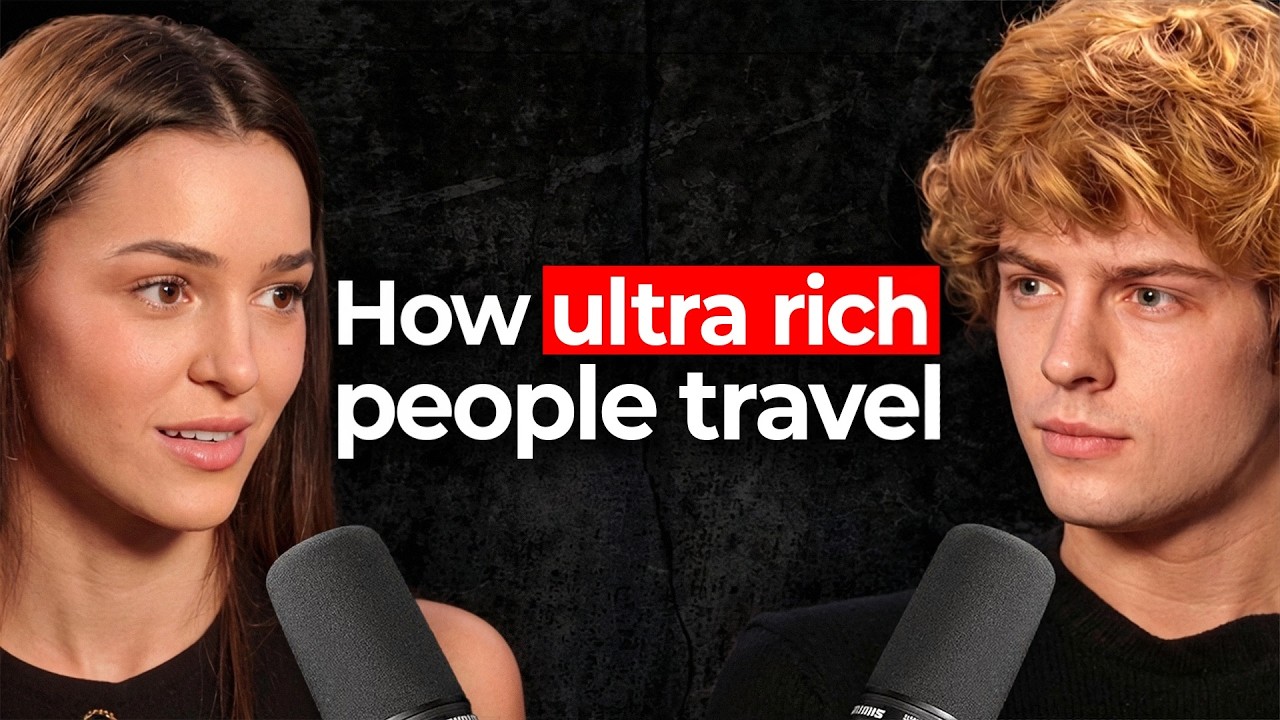
Olivia Fernie is a 25-year-old luxury travel agent and partner at a high-end travel company who manages travel for over 14 billionaires, A-list celebrities, professional athletes, and ultra-wealthy families. She grew up middle-class in small-town Ontario, Canada, with parents who were teachers, and entered the luxury travel world after meeting the company’s founder in Miami. The episode explores how the richest people on earth actually travel, the outrageous and sometimes impossible requests Olivia fields, the mechanics of her business, and what she’s learned about wealth, networking, and human nature from being embedded in this rarefied world.
How Olivia Works with the Ultra Wealthy
She typically works through executive assistants or chiefs of staff rather than directly with billionaires, becoming “an additional leg to their business” handling everything from dinner reservations to last-minute private jet bookings to preemptively buying Super Bowl merchandise in case a client’s team wins.
Her company’s specialty is securing accommodations at five-star hotels that are sold out year-round, leveraging long-standing relationships to get both access and better pricing than anyone else can offer.
She also arranges mega yacht charters, private jet bookings, and experiences clients don’t even know they want yet.
Most of her clients are bound by NDAs, and she works with people across industries: crypto entrepreneurs, tech executives, corporate teams, CPG brand owners, and celebrities.
She has over 14 billionaire clients and roughly 25 clients in her top-tier “Concierge Plus” program, where clients spend at least $5 million per year on travel.
What Ultra-Wealthy Clients Actually Spend Money On
Super Bowl: A low spender might spend around $1 million for a suite, first-class tickets, and two penthouses at the Four Seasons. A high spender might spend several million on multiple boxes (each box holds about 20 people). A $10 million Super Bowl package includes private jet slots, penthouses at the Rosewood or Four Seasons, prepaid dinner reservations, and two adjacent boxes for 40 guests.
Dinners: The most expensive single meal she’s seen was around $250,000, with 60-75% of that cost coming from alcohol—specifically vintage bottles of wine. Corkage fees, where rare bottles are shipped in and the restaurant adds a markup, drive costs up dramatically. She once had a sip of an extremely expensive bottle at XS in Vegas and said it was “really good” but not life-changing.
Hotel rooms: The most expensive was $125,000 per night at Atlantis The Palm in Dubai for a penthouse. That doesn’t include flights, food, or experiences, so a stay can easily become a million-dollar trip.
Flights: The most expensive ticket she’s booked was Emirates First Class from New York to Dubai at $25,000-$30,000, which includes a private suite with a full bed, unlimited caviar, and unlimited Dom Pérignon. Flying private across oceans can cost $500,000 or more.
A $500K romantic weekend she’d design: a private jet to New York City, staying at the new Faena hotel, dinner at Corner Store and the Polo Bar (Ralph Lauren), a private Met Gala tour, and lunch in Central Park before flying back.
Outrageous and Impossible Requests
A client once requested a helicopter pick him up from his hotel and lower him into the Super Bowl stadium like Céline Dion at the Olympics. This was physically impossible—the Four Seasons in San Francisco doesn’t have a landing pad—and the client had a $10 million budget but was told no.
She regularly arranges for celebrities to move through public spaces without being seen, which can involve disguises, 40 security guards, back entrances, or literally being put in a rolling cart and carried through crowds backstage (similar to how major performers reach the stage).
A crypto client once called with 24 hours’ notice asking her to throw a party in Marfa, Texas (population ~5,000-10,000) for 200+ people, complete with bartenders, live performances, a clown, a balloon animal artist, and a giant neon sign. She flew in on his private plane, shut down the town’s three restaurants to commandeered their chefs, and made it happen.
She’s received late-night 2 a.m. texts asking her to source drugs, which she ignores or deletes, assuming the client will be embarrassed the next day.
A scammer named Fernando spent two weeks building a convincing million-dollar itinerary, sent passports and passed a background check, then sent a fake wire transfer. During the booking process, Olivia was put on calls with Fernando, his new boyfriend, and his ex-husband—all asking her to spy on each other and create fake plane tickets. She described it as a “freaking soap opera.”
How the Ultra Wealthy Actually Travel and Stay
Hotels vs. private rentals: Surprisingly, most billionaires book hotels rather than private rentals. Olivia’s “holy trinity” is the Ritz Carlton, Four Seasons, and Aman because their concierge teams execute flawlessly. However, for island destinations in the Caribbean, private villas are easier to customize.
Specific client demands: Some clients are extremely sensitive to smells and require no cologne on drivers, no air fresheners in rooms, and no strong-scented foods nearby. Others want their hotel rooms to feel “lived in” before arrival—having friends sit on the furniture, lighting candles, or spraying scents. One client wanted another dog to sit in their dog’s bed before the dog arrived.
Aliases and privacy: For A-list celebrities, Olivia coordinates with hotels to use aliases in the system so staff don’t know who’s staying there. However, this only happens about 1-2% of the time. Most multi-millionaires use their real names, and hotels will Google high-spending guests when a penthouse is booked.
Hotel poaching: A recurring problem is that hotel concierge teams try to steal her clients by removing the amenities her company places in rooms, taking credit for them, and then marketing to the client after the stay. This backfires because it breaks trust and can expose clients who don’t want anyone knowing where they stayed (including those traveling with someone who isn’t their spouse).
Disneyland for the ultra-wealthy: Trips involve large security teams and paying for line-cutting access at every attraction. Olivia suspects that when regular families waited 15 minutes in lines as kids, it was likely someone wealthy cutting in front of them.
Signs of Real Wealth vs. Faking It
Signs someone is faking wealth: The biggest red flag is when someone says “no budget.” Olivia says every genuinely wealthy person has a budget—even Jeff Bezos. People who claim no budget often balk when she presents a $50,000 price tag. They also tend to be rude from the start.
Signs someone is ultra-wealthy: There’s no universal indicator. Some billionaires wear Gucci onesies. Olivia can identify wealth through contextual knowledge—seeing someone at exclusive White House parties, knowing they invested in a fund with a $10 million minimum buy-in—but your average person cannot easily spot the wealthy.
Common traits across all wealthy clients: They know exactly what they want and aren’t afraid to ask for it. Olivia provides hotels with detailed “deliverable lists” specifying everything from what’s in the fridge to what the driver should look like, and the best hotels execute these flawlessly.
The Business Model
Her company’s Concierge Plus program starts at $100,000 per year, with top clients spending $5+ million annually on travel.
The company keeps the program under 25 clients to maintain service quality.
They also have a separate hotel-only booking service for clients who want discounted rates at five-star properties (like a $100,000 Four Seasons trip) without the full concierge experience.
Olivia is on track to become a millionaire herself, though she distinguishes between money flowing through her accounts and having $1 million in cash saved.
The business carries real financial risk: she recently lost $650,000 when a $2 billion corporate client signed paperwork and paid for a Super Bowl suite, then switched to another broker at the last minute, paying $200,000 more than they would have through her. She managed to resell the suite at the last minute, but the experience was “hell on earth.”
Social Media and Going Viral
Olivia went from zero to a million Instagram followers in less than a year, with growth happening essentially overnight—50,000 followers in one night, 150,000 two weeks later, 300,000 a month later, and 700,000 within four months.
Her strategy: she studied what was going viral across completely different industries (OnlyFans creators, artists, designers) and adapted those content patterns to luxury travel. The breakthrough came when her business partner suggested she record their client calls. A woman screaming at them about either a meal for her dog or a bathtub big enough for her dog became the template for viral content.
Social media has transformed her business: billionaires now cold DM her, family members reach out saying “my daughter saw you,” and she’s being approached for influencer partnerships and sweat equity investments in companies rather than just being seen as an assistant.
She now has nearly two million followers across platforms, has a TV show coming out, and has launched books and podcasts—though she admits she’s been so focused on business she hasn’t fully processed her own fame.
Networking Advice from Someone Connected to Billionaires
Her core advice: “Get outside.” Stop cold DMing people (it works one in a thousand times) and go physically meet people. Even failed conversations bring you closer to success.
She used to sit at expensive hotels like the Faena and St. Regis, buying drinks to start conversations with potential clients and partners, even when she couldn’t really afford it.
She deliberately avoided marketing conferences (where everyone is competing for the same clients) and instead went to Medspa conventions and fashion and apparel trade shows where potential clients with money to spend were.
She believes in-person meetings are irreplaceable because she’s a “vibe person”—she can assess someone’s aura and energy in a way that’s impossible over the phone or DM. She practices making every conversation end with the other person feeling good, which helps turn strangers into clients.
She doesn’t like asking her existing clients for referrals because she wants her work to speak for itself, but many of her new clients come through word of mouth at exclusive events.
Where the Ultra Wealthy Vacation
Popular spots: St. Barts (Eden Rock, Cheval Blanc), the British Virgin Islands, St. Lucia, Miami, New York, Las Vegas, Bangkok, Tokyo, Cape Town, Davos (for the World Economic Forum), and Aspen/St. Moritz for skiing.
Overrated destinations: Bali is her top example—Instagram makes it look spectacular, but tourists who go off-resort chasing Instagram photos often end up with bugs and food poisoning. She also warns that holiday periods (Christmas, New Year’s, Valentine’s Day, Spring Break) make even the best destinations overcrowded and overpriced unless you’re on a private boat.
Hidden gems: The British Virgin Islands, specifically a private island experience where you stay in huts, boat over to a property with rescued circus zebras and miniature horses, ride horses along the shore, eat food grown on the island, and dine communally at a long table. It starts at around $6,000 for a couple of days. She also loves Colombia for its quality, affordability, and quick flight from Miami.
Favorite personal destinations: Muskoka, Canada (a cottage experience she calls one of her favorite places on earth), Miami, New York, Nashville, Tokyo, Bangkok, and Cape Town.
Cruises: She would never book a Carnival, Royal Caribbean, or Virgin cruise for a client. The luxury cruise market is different—the Ritz Carlton, Four Seasons, and Aman are all launching super yachts where trips cost around $150,000 (compared to $1 million+ for a truly private yacht charter). Crystal Cruises is another high-end option at $10,000+ per ticket with Michelin star dining.
Hardest Reservations and Experiences to Book
New York City is the hardest restaurant booking city in America because new hot spots open every six weeks, and by the time they’re on Instagram, they’ve been open for months. She has to know about them before her clients do.
Specific tough reservations in New York: Monkey, Corner Store, and the Polo Bar (Ralph Lauren’s members club in collaboration with Kith).
Miami and Los Angeles are relatively easy for reservations. Toronto is also easy.
She doesn’t personally handle every specialty—she has a network of 50-100 specialized hospitality contacts around the world who handle reservations, tours, and hotel relationships in their specific regions, and she pays them well.
For the Cannes Film Festival, hotels pre-reserve rooms for members, making it nearly impossible to get inventory. Her company has to play “war” with hotels, pre-booking blocks of rooms and sometimes having hotels refuse because they know what she’s doing.
The Human Side of Wealth
Penny pinchers: Some of the wealthiest clients obsessively book non-refundable rates to save $1,000 on a $150,000 vacation, then call two days later demanding changes when something comes up (like a child’s sports injury). Non-refundable bookings are nearly impossible to modify.
Spoiled children: Olivia acts as an intermediary between wealthy parents and their adult children, many of whom are on allowances. She’s had 22-year-olds on retainer (with parents paying) and regularly fields requests like “I want to spend $100K, my parents said $50K, can you just charge the card?” She sometimes functions as a family therapist, preventing blowups between parents and children who might “claw each other’s eyes out” if they had the conversation directly.
Cutting kids off: She knows cases where wealthy parents cut their children off, and the children went on to build successful companies worth $50+ million, driven by the hunger to prove themselves.
Relationship drama: She’s received late-night drunk calls from clients threatening to divorce their spouses during vacations, though none have followed through. She’s also been blamed for things outside her control—a driver being 30 seconds late, waves at a beach, or rain (“You need to stop it”—her response: “I am not God”).
The best memories aren’t the expensive ones: She’s observed that the most cherished moments for her clients happen on the way to the airport—a group of friends singing Katy Perry in the car, or a busy executive mom holding her sleeping kids on the drive home from a million-dollar trip. Money creates opportunities for incredible experiences, but the people you’re with drives the happiness.
Generosity: Despite the hate wealthy people receive, Olivia emphasizes that many of her clients are gracious, kind, and deeply focused on making sure the people around them—children, partners, friends—experience the wonder they felt the first time they had access to luxury.
Major Events the Ultra Wealthy Attend
Super Bowl, F1 (especially Vegas, Abu Dhabi, and Monaco), Davos, Art Basel, the Olympics, Wimbledon, the Cannes Film Festival, and LIV Golf tournaments.
She personally loves F1 Vegas as one of the best networking and party experiences of the year.
St. Moritz and other luxury ski destinations (Gstaad, Courchevel, Cortina d’Ampezzo) are major winter destinations where the ultra-wealthy ski and attend champagne-spraying parties.
Olivia’s Personal Journey and Advice
She grew up not knowing what a private jet was and thought a yacht was a small tin boat. Her parents were both teachers in Ontario.
She’s had moments of extreme stress where she considered quitting—particularly when clients blame her for things she can’t control, like weather. But she keeps getting signs from the universe to stay.
Her best piece of advice, from her mother: stay consistent. Life will bring loss, failure, breakups, and pandemics, but staying the course through all of it is what leads to success. Every failure is one step closer to success.
What keeps her consistent is the feeling of self-resentment she experiences when she falls off track—looking back six months later and realizing how much further along she’d be if she’d stayed focused. That discomfort drives her to keep going.