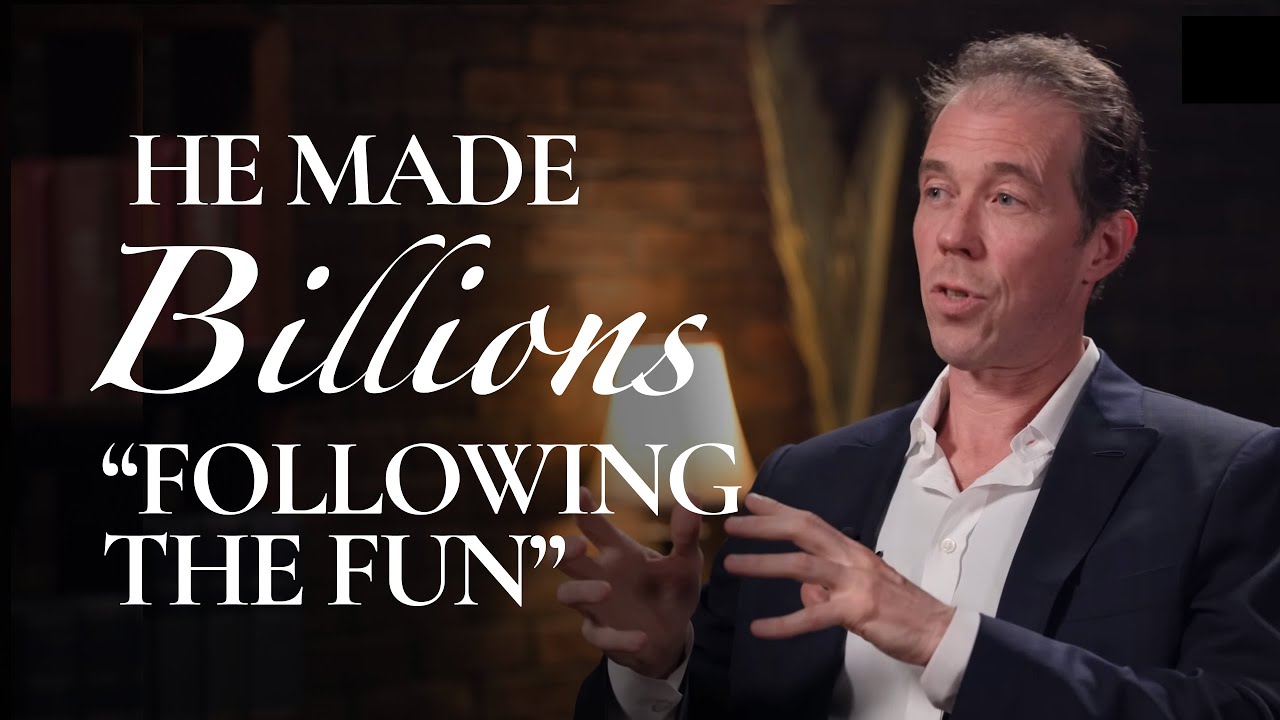
Colin Moran is a hedge fund manager whose unusual path to sustained success—running one of Wall Street’s best-performing funds for two decades—stems not from conventional financial aggression but from a contemplative, humanities-driven approach rooted in intellectual curiosity, cultural analysis, and Catholic faith. His firm, Abdiel Capital, is staffed largely by scholars of history, classics, theology, and music rather than quants or MBAs, and his investment philosophy centers on understanding companies as living human cultures rather than financial abstractions. What makes Moran distinctive is that his returns appear almost accidental—a byproduct of what he calls “following the fun,” pursuing genuine intellectual interests rather than chasing money directly.
Companies as Cultures
Moran’s core insight is that companies are best understood as human organisms with distinct cultures, not merely financial entities.
Traditional investing treats companies as balance sheets and income statements; Moran’s team treats them as ecologies where culture determines value creation.
The real drivers of a company—where energy lives, who actually calls the shots, how people communicate—are rarely visible on an org chart.
Shopify is a prime example: Moran invested because of CEO Toby Lütke’s unusual clarity of thought, sincerity of purpose, and the exceptional culture he built, even though the stock was expensive by conventional metrics.
This investment originated not from financial analysis but from an essay Moran wrote on creativity and religious traditionalism—he was exploring why certain cultures lose their creative vitality.
After finishing that essay, he decided to study only companies that were fascinating or inspiring, trusting that good investments would follow.
He found Shopify so compelling as a creative culture that he was willing to model a longer growth runway than he normally would, paying a higher multiple of near-term gross profits than his training suggested.
Moran describes this shift as “following the fun”—in the research process, pursue what genuinely interests you rather than what you think will make money, and good opportunities tend to emerge.
He draws a parallel to life more broadly: focusing on elemental good habits and genuine curiosity often gets you to the “mountain top” more effectively than marching straight at it.
Decoding Cultures: The Warshow Method
Moran’s approach to understanding companies is modeled on Robert Warshow, a 1950s cultural critic and former WWII cryptographer who wrote essays decoding popular culture (like the Western) as a way of understanding larger cultural truths.
Warshow’s method was to slowly probe a subject, listening to its “music” until a story begins to cohere and pixelate into focus.
Applied to investing, this means identifying the critical puzzle about a company—how good are they at product development? will the CEO keep executing?—and then investigating through direct engagement.
Moran’s team talks extensively to employees and customers, uses products themselves, and studies the company’s communications until a coherent narrative emerges.
Often the investigation fails to reach a conclusion, and they walk away—discipline in not investing is as important as investing.
On the question of whether morally flawed leaders can be good investment targets:
Moran acknowledges that distasteful or vice-driven behavior can produce excellent business results—he cites Mars, Inc. as a company whose top-level autocratic fear-based culture drove effectiveness.
Machiavelli’s dictum applies: if you must choose between fear and love, fear works, especially in businesses requiring disciplined execution rather than creative originality.
However, Abdiel has historically avoided companies where leadership achieves results through morally troubling means, as it “spooks” them.
On the VC claim that good founders come only from “autism, megalomania, and revenge arcs”:
Moran disagrees, pointing to Toby Lütke as a counterexample—a capable craftsman who stumbled onto Shopify while trying to start a snowboard company and initially didn’t want it to be large.
Successful founders often represent a fusion of a particular skill set, personality, and good timing rather than being “forces of nature.”
The Role of Faith in Religion & Investing
Moran studied intellectual history at Duke and Oxford, writing his undergraduate thesis on the failure of reason in Supreme Court decision-making and his master’s thesis on John Henry Newman’s theory of how reason operates.
On the limitations of reason in investing:
Moran warns against “system thinking”—macro prediction and big-picture economic forecasting—as a backdoor through which emotions corrupt reasoning.
Reason should be kept to what it can do well: analyzing specific, knowable things rather than grand unknowable systems.
He cannot do macro investing himself, though he acknowledges quants with heavy computing power may discern patterns he cannot.
A key discipline is matching conviction to actual understanding—a rare alignment that investing enforces ferociously through immediate financial feedback, unlike academia or punditry where wrong claims carry no cost.
He is highly concentrated and long-only, holding a select group of stocks—the investment equivalent of circumscribing reason to what you truly know.
A common fallacy: the more you’ve studied something, the better the investment. In reality, risk-reward is independent of how much you know; knowing a lot doesn’t entitle you to invest.
On faith versus epistemic humility:
Despite his epistemic caution in investing, Moran is a devout Catholic—a combination that might seem contradictory but isn’t.
He draws on Polish philosopher Leszek Kołakowski, whose father was burned alive by the Nazis: “I can understand why people don’t believe in God. I cannot understand why they don’t believe in Satan.”
Kołakowski’s point: if you cannot affirm that what the Nazis did was genuinely wrong, you have no ground to stand on at all. Moral claims require metaphysical commitments.
Moran argues that to live at all—not just invest well—one must make claims about what is good, beautiful, and true. These are not optional philosophical luxuries but prerequisites for a meaningful life.
Some people walk away from life not because of emotional malfunction but because they have nothing metaphysical to believe in.
The difference between investing and faith is not the difficulty of the claims but their necessity: he can afford not to predict interest rates, but he cannot afford not to have a conception of the good.
On John Henry Newman and certitude:
Newman grappled with how to have certitude in an age of scientific empiricism, where absolute proof seems impossible yet faith claims absolute truth.
Newman’s concept of the “illative sense”: knowledge that arrives through grounds you cannot fully articulate—like chick sexers who know the gender without being able to explain how, or a rock climber who reaches the top through a series of intuitive moves.
Newman redefined reason to include these experiential, non-articulable judgments, making metaphysical belief reasonable even without mathematical proof.
Newman described certitude as a state where more evidence would not increase your certainty—you are as sure as possible.
Moran does not claim Newman’s level of certainty about God’s existence (a priest told him Newman’s spiritual depth is rare), but he finds the framework useful.
He sees an analogy to investing: great investments are never obvious at the time. His old boss said, “You don’t make big money without big fear.” Even Abdiel’s best investment—buying Staras, a home heating oil distributor, at one times free cash flow during the 2008 financial crisis—was terrifying, requiring a third of the fund’s capital.
The combination of fear and serenity in that moment mirrors religious belief: you act without proof, and the feedback loops are slower and less clear than in markets, but they exist.
On competing religious traditions and the problem of equivalence:
Jonathan raises the ancient skeptical challenge (Sextus Empiricus): when multiple traditions make equally compelling claims, how do you choose between them?
Buddhists have karma to explain the same moral-psychological feedback loops Moran attributes to Christian metaphysics; Muslims revere Jesus as a prophet; each tradition’s scholars can match Christian theologians.
Moran’s response is not a bulletproof proof but a personal orientation: he has never been drawn to anything other than Christ at the center of things.
He references G.K. Chesterton’s argument that Christ represents something historically unique—a force that “hits the world almost like a bell”—distinct from other traditions.
He acknowledges this is not a rational demonstration but a kind of “tractor beam” quality he perceives in Christianity.
On whether one can confidently believe without exhaustively studying all other traditions: Moran suggests that basic intuitions—that existence is good, that there is such a thing as truth—lead you to trust what you’ve been given rather than requiring exhaustive comparative study.
Ideas Made Flesh: Law & Intellectual History
Moran’s intellectual biography reveals a consistent thread: he is drawn to ideas only when they are embodied in lived reality.
He came to investing through poker and Warren Buffett’s decision principle: wait for a sure bet, then bet heavily—something he’d been doing intuitively at the poker table.
He was attracted to investing because it enforces intellectual self-awareness—knowing where you stand on the spectrum of knowledge—and rewards the ability to burrow to the bottom of a subject.
His love of intellectual biography (he studied Newman, Augustine, Aquinas, Francis) stems from a need to understand ideas through the lives of the people who held them.
He cannot enjoy classical music without a human narrative context—Handel’s Messiah moved him only after hearing it in the film Manchester by the Sea; without that story, the music would have been empty.
This mirrors his investment approach: a founder’s company is their autobiography, their product is their personality, and understanding the person’s specific experiences and psychology reveals the DNA of the business.
The circumstances in which a CEO first succeeded tend to dominate their entire approach—they endlessly try to repeat that formula.
The best CEOs keep learning and are not prisoners of their own success; the worst keep applying a growth mindset even when their company has reached a stage where return on capital matters more.
His attraction to law, particularly the common law tradition, reflects the same sensibility: law solves discrete, small-scale human problems through an orderly process of opposing briefs that must be integrated—a form of applied reason that stays close to reality rather than floating in abstraction.
Jonathan observes that Moran’s entire trajectory—intellectual biography, investing, law, love of architecture and art—reflects a desire for ideas to be real, embodied, and lived. Moran agrees, noting this is essentially the Christian concept of the Word made flesh.
Wealth & Stewardship
Moran stands apart from the hedge fund archetype: he lacks the fundamental aggression, status-seeking, and materialism typically associated with successful money managers.
He describes himself as having been brooding and melancholic in youth—a disposition that serves investors well because they get paid for preoccupation with how things can go wrong.
Success has made him existentially more comfortable but not dramatically more satisfied—arriving at the “mountain top” revealed it wasn’t that different from below, which was an arresting experience.
On money and Christianity:
He interprets the biblical warning about rich men and the kingdom of heaven to mean that money is not truly yours—you are a steward, not an owner.
But stewardship is not indiscriminate giving: giving money away carelessly can harm recipients just as easily as helping them, and philanthropic organizations require the same diligence as for-profit investments.
He estimates massive waste in the nonprofit world—guesses that a third of Harvard’s workforce could be eliminated without damaging the mission.
On motivation:
Initially, money meant independence to Moran—not having to work on someone else’s terms—not status or luxury.
Even during the 2008 crisis, when the fund was down significantly and he worried about making rent, he and his partner were having “a great time”—the adventure and intellectual engagement mattered more than the financial outcome.
Today, he continues running Abdiel not just to fund philanthropy but because he genuinely enjoys the craft, the team he’s built, the responsibility to clients, and the challenge of doing the work well.
He contrasts this with the typical hedge fund model of raising as many assets as possible and milking fees—his original firm, Tweedy Browne, had a craftsman’s ethos that he ported into Abdiel.
On the social role of hedge funds:
Capital markets require many people thinking hard about how to price assets; when they don’t function, the prosperity of the whole society suffers (as in 2008).
Whether there are too many or too few hedge funds is a separate question from whether the function is legitimate—just as there may be too many bureaucrats at Google or too many administrators at elite universities.
National Conservatism
Moran identifies as a national conservative, a movement that challenges the standard Enlightenment narrative of progress.
The received story—that a retrograde, Christianity-trapped society was liberated by Enlightenment reason—is false from the national conservative perspective.
The Anglo-American tradition’s great political innovations (separation of powers, Bill of Rights, self-governance) were developed within England’s common law tradition, which was deeply shaped by the Bible, before the Enlightenment arrived.
National conservatism sees this pre-Enlightenment tradition as having its own affirmative vision of the good, not merely a reaction against liberalism.
How it differs from classical liberalism:
Both may agree on ideal institutions (private property, markets, democracy), but they disagree on prerequisites.
Classical liberalism is rationalist: it believes institutions can be dropped into any culture (exemplified by the hubris of the Iraq War—assuming American democracy could be copy-pasted into a radically different society).
Traditional conservatism recognizes that good governance must be an organic expression of the underlying culture, history, and religion—institutions should be bespoke, not universal.
Classical liberalism has no real use for the nation and could logically support global governance; traditional conservatism sees the nation as essential.
Classical liberalism deliberately takes questions of the good off the table when structuring political institutions; traditional conservatism has an affirmative vision of the good informed by biblical anthropology.
Moran was drawn to this framework through Yoram Hazony and the National Conservatism conference, which helped him articulate a distinction he’d felt intuitively—particularly after watching the rationalist hubris of neoconservatism produce catastrophic results in the Middle East.
Judaism, Christianity, and Islam
Moran frequently groups Jews and Christians together as a “cultural we”—those who seek the God of Abraham—while excluding Islam, which also claims Abrahamic descent through Ishmael.
Pragmatically, he notes that at First Things (the ecumenical journal he’s involved with), Muslim writers have been unwilling to contribute to a publication where Jews are prominent.
More deeply, he sees a continuity between Judaism and Christianity—historically, ethically, morally, and devotionally—that does not exist between Christianity and Islam.
Christianity is intellectually tied to the Hebrew Bible; all Christian liturgy derives from Judaism.
The antagonism between Islam and both Judaism/Christianity is not mirrored between Judaism and Christianity today, where there is much more cooperation and a sense of brotherhood.
Jonathan raises a counterintuitive theological point: Muslims affirm Jesus as a genuine prophet (even if they reject his divinity), while mainstream Judaism regards Jesus as a deceiver—suggesting Muslims might be easier theological allies for Christians than Jews.
Moran acknowledges the tension but argues that fundamental disagreement on one point (Christ’s divinity) does not negate fundamental agreement on others (the God of Abraham, the Hebrew Bible).
He sees the retention of the Old Testament within Christianity as one of the tradition’s greatest sources of creativity—a “fertile” challenge that has never disappeared despite attempts to suppress it.
Conservative Innovators
Moran is deeply concerned with the cultural fertility of religious traditionalism, which he believes is at a low point relative to its historical vitality.
He cites Pope Benedict XVI’s thought experiment: imagine if the Catholic Church disappeared—despite all its mistakes, what a purifying presence it is in the world.
His philanthropy aims to find “little embers” of creative energy within the tradition and give them oxygen—the same thing he does in the for-profit world with entrepreneurs.
Unlike public markets, his philanthropic investments often have a counterfactual quality: if he doesn’t fund these projects (like the Angelicum in Rome or First Things), they likely won’t happen at all.
On why the tradition has lost its fertility:
Success has a narcotic quality—worldly success, whether in entrepreneurs or in movements, is deadly to a sense of mission.
He sees a direct analogy to investing: the most dangerous time is when you’re way up. Success drugs you into thinking you can do no wrong, when in fact you’ve been lucky and risk-reward has deteriorated.
The Church after the Renaissance got sucked into being conservators rather than creators—the sloth induced by too much confidence in what was, and not enough focus on what needed to be.
On progressive versus traditional creativity:
Moran challenges the progressive claim that creativity belongs exclusively to those who break boundaries and experiment.
Progressivism equates creativity with change itself, making “disruption” a positive good and worshipping novelty—but novelty wears out fast (as evidenced in ugly, dated modern architecture).
True creativity, as exemplified by the Renaissance, is about recovery—reaching back to antiquity and giving new expression to enduring achievements, creating something both rooted and fertile.
Creativity should be oriented toward improvement and the objective good, not change for its own sake.
On whether great art requires virtuous artists:
Moran acknowledges Nietzsche’s insight that what makes great art and what makes a good person are different things—the Renaissance was driven by family rivalries, civic vanity, and pagan psychological forces, not Christian humility.
Great art requires orientation toward the transcendentals (truth, beauty, goodness) found in the tradition, not necessarily virtuous creators.
Why embodied culture matters for faith:
Moran is most viscerally responsive to architecture and music as carriers of ideas—he cites Allegri’s Miserere, which melts listeners and conveys something about religious faith that reading the Gospel alone cannot.
He references Churchill: “First we make our buildings, then our buildings make us.” Magnificent ideas in the tradition must live through actual forms—buildings, music, poetry, film—to be fully understood.
This brings the conversation full circle to Moran’s core intellectual disposition: ideas must be embodied to be real, whether in a company’s culture, a building’s form, or a person’s life story.