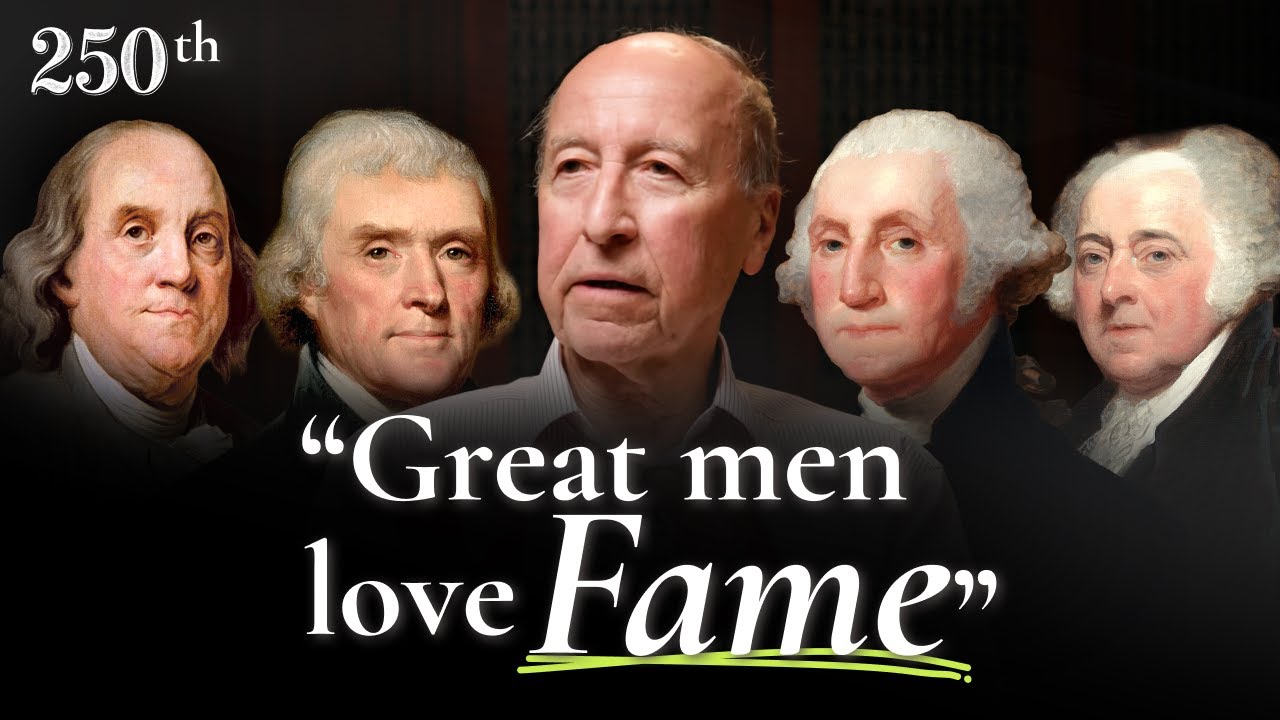
This is a conversation between a philosopher and a host exploring the tension between the active political life and the contemplative philosophical life, using figures like George Washington, Cato, Socrates, Lincoln, Jefferson, and Franklin as case studies. The central question is whether democracy can produce truly great individuals, what motivates such individuals, and whether the highest human life is one of political action or philosophical contemplation.
The Love of Fame and Greatness
Hamilton wrote in the Federalist Papers that “the love of fame is the ruling passion of the noblest minds,” likely with Washington in mind.
Washington’s love of fame was not mere desire for popularity but a desire to be recognized for genuinely admirable qualities.
This mirrors Adam Smith’s idea in Theory of Moral Sentiments: we want not just to be sympathized with, but to be sympathizable—to actually deserve the recognition.
The host pushes back on “ruling passion,” arguing Plato would say reason, not fame, should rule the noblest mind.
The philosopher agrees Hamilton’s view is somewhat two-dimensional and that Washington had a more nuanced understanding.
Washington’s model was Cato, who desired fame but was above all concerned with being the kind of person he wanted to be, seeking confirmation of that through recognition.
The great man’s desire for glory is paradoxical: he seeks recognition from those he considers lesser.
This echoes Hegel’s master-slave dialectic: the master cannot get the recognition he craves from a slave precisely because the slave has been degraded.
The great man avoids this tragedy if he seeks recognition from peers he respects and cannot dominate—figures like Hamilton or Jefferson in Washington’s case.
The philosopher argues this is the best argument against megalomania: seeing yourself as peerless robs you of the peers whose recognition actually matters.
Washington was more egalitarian than a classical figure would be—he genuinely valued recognition from ordinary people who knew what he had done, not just from elites.
This is described as “the self-interested case for egalitarianism”: if you want genuine cognitive fulfillment, you need to give others social space to affirm you.
Cato, Honor, and the Two Traditions of Honor
Cato was determined not to let others’ opinions guide his decisions, even though he still cared about reputation in a deeper sense.
He chose to die for the Roman Republic even though he knew it was a lost cause—Caesar would turn it into an empire.
This represents a high form of self-centeredness: wanting one’s soul ordered in the best possible way, which includes caring about others partly because one wants to be the kind of person who does that.
The host raises Machiavelli’s counterargument: sophisticated people honor noble losers, but politics is about winning and effects, so caring about winning makes for a better leader than being content as a noble loser.
The philosopher responds that some causes are worth fighting for even if losing, because they involve one’s own full development and flourishing, and because leaving behind an inspiring memory is itself a form of glory.
Cato’s suicide has two readings:
The dominant one: Cato was brave while his son was cowardly (Cato actually advised his son not to kill himself).
The alternative: Cato was vicious—if opposing Caesar made a good life impossible, why didn’t he tell his son to die too?
The philosopher suggests Cato judged his son’s character differently: his son could remain decent under imperial rule, but Cato himself could not imagine bowing to Caesar.
This could be seen as weakness—the Stoic sage should endure any betrayal—but the philosopher argues it makes Cato more human, since Stoic ideals may be impossible or tinged with fanaticism.
The philosopher’s reading: Washington and Cato both reveal “deeply enlightened self-interest”—a rich form of self-love concerned with what kind of person one is. They are not disinterested, but neither are they selfish in the ordinary sense. This self-love is perhaps their greatest gift to their countries.
Honor has two faces:
What other people think of you.
The code you follow as the most important defining dimension of your character.
The Declaration of Independence’s final sentence pledges “our lives, our fortunes, and our sacred honor”—the only thing called sacred in the document. Their lives and liberty they would give up, but never their honor.
Monarchical vs. republican honor:
Monarchical honor (as described by Montesquieu): hierarchical, inegalitarian, based on one’s specific rank with associated privileges and duties. Everyone has pride in their place, from king to footman.
Republican honor: egalitarian, fraternal, based on shared citizenship with associated privileges and responsibilities. “I am part of the team.”
Christianity, Altruism, and the Purity of Motivation
Honor is constitutively tied to pride; Christianity is constitutively tied to humility. There is a real tension between the two.
Churchill illustrated this in his history of WWII: at Munich, Chamberlain tried to follow the Christian ethic (turn the other cheek, abase yourself), but what was needed was honor—a proud refusal to surrender to what is right.
The host asks whether pure altruism exists—doing something purely for another’s sake, not for reputation or self-conception.
The philosopher argues there is real altruism, and the clearest example is Socrates in the Apology.
Socrates effectively committed suicide by giving a speech he knew would lead to conviction, then insulting the jury into choosing death over a lighter penalty.
He was 70, vigorous, had a wife and three children (one a baby), and could have had another 10 years. He ended his life for the future of philosophy—to protect and inspire future philosophers he would never meet.
The philosopher reads Socrates as purer than Washington because Socrates had thought through his motivations more deeply and could isolate moments of genuine altruism.
Washington’s altruism always proceeds through self-conception—he wants to be the kind of person who does great things. There is always a mix of self-interest, self-image, and genuine principle.
Socrates could say “I am ending my life for others”; Washington could never fully separate whether he was acting for self-fulfillment, obedience to principle, or genuine care for others.
The philosopher clarifies: by “purity” he means purity of understanding—not being in a fog about why you are doing something. The philosopher constantly asks “Why am I doing this now?” and sorts out motivations that the gentleman leaves blurred.
Democracy and the Production of Great Men
Can democracy produce great men? The philosopher says yes—Lincoln is proof.
Democracy didn’t squash Lincoln; it accepted and embraced him as a leader in crisis.
But Washington was not produced by democracy—he was formed classically, really by the British Empire, growing up as a loyal British subject.
The philosopher observes that children of the super-rich in democracies often come out malformed—either with extreme guilt or extreme extravagance—because of the tension between egalitarian assumptions and their inegalitarian position. Children in hierarchical societies are usually better formed because there is less tension.
Great men in democracies face a similar tension: a grand self-concept conflicts with egalitarian norms.
Nietzsche argued every high culture required slavery or a “pathos of distance” to achieve greatness.
Lincoln, however, did not come from an elite background and did not seem conflicted in this way.
The philosopher notes that truly great figures like Churchill or Lincoln are “comfortable in their own skin”—they don’t have complexes. Eisenhower, when asked if Churchill had a “Gallipoli complex,” replied: “Churchill is not a man to have complexes.”
Napoleon, by contrast, seems to have been less comfortable than Washington or Lincoln.
The philosopher argues there is a tension between democratic egalitarianism and the great man’s self-conception, but it is manageable.
Lincoln’s self-education was deeply shaped by Shakespeare, especially Macbeth, which taught him what political greatness is—and what to avoid.
Democracy’s unique challenge is intellectual rather than moral:
America is the only country rooted in principles rather than ethnicity, religion, tradition, or language. This gives Americans a special duty to study where their principles came from and what is strong or weak about them.
Earlier republics imposed harsher moral tests (frequent sacrifice of life, property, liberty), but America calls its citizens to “intellectual probity” and “a quest for self-knowledge as a people that is perhaps unprecedented.”
In Plato’s Republic, the highest type must be compelled to rule. The philosopher notes that Jefferson and Washington both viewed public service as a sacrifice—they were happiest at home on their farms.
Much of political life is boring routine: signing papers, attending meetings, pandering. The great moments are rare.
The Contemplative Life vs. the Active Life
The philosopher clearly ranks the contemplative life above the active life, following Aristotle.
The key argument: what makes us human above all is self-consciousness, and self-consciousness is most fully developed in the life devoted to understanding.
The philosophic life gives fullest self-awareness, self-possession, and being oneself.
It is also concerned with understanding the whole world to the greatest extent possible.
“The unexamined life is not worth living”—the examined life is the fullest because our minds are the fullest part of us.
The philosophic life is intensely social, not solitary: it requires friends (especially other philosophic people), teaching, conversation, reading, and study.
Socrates was deeply in love with his students, including those he would never meet.
The philosopher clarifies he is not making a blanket claim that everyone should live contemplatively. Most people are not suited for a purely contemplative life. Each person must find their own best level.
Xenophon is an example of someone who was not a complete philosopher but was a great military leader and orator who also wrote philosophically about Socrates. He understood Socrates well, and they had a deep bond, but both were clear that Xenophon was inferior.
Xenophon’s inferiority included being willing to inflict capital punishment himself—something Socrates could not do. This made Xenophon better at making society work and combating evil, but Socrates remains the higher type.
The contemplative life is more self-sufficient than the active life but not totally so.
It needs less “equipment” (money, power, apparatus) but has a strong need for friends, teachers, conversation, and the protection of a functioning society.
The philosopher’s own entry into the contemplative life came through meeting Allan Bloom, who was a mesmerizing teacher and interlocutor—more a “rhetorician of the soul” than a contemplative philosopher himself, with an almost Socratic gift for knowing human souls and arousing the desire to understand.
The contemplative life is not well-supported in the modern American university system, which is mercenary, departmentalized, and rule-bound.
It finds niches in some universities and think tanks, but there is no real social class or structure that supports it.
The contemplative life is oriented around truth—one’s own truth and the truth of one’s society—but truth is dangerous to the well-ordering of the city because it requires constant questioning of givens and supposed absolutes.
The city does need to be protected from philosophy, and the philosopher has a responsibility to consider how to teach dangerous ideas responsibly.
The philosopher teaches Nietzsche only in small groups, not in large public lectures, as a matter of social responsibility.
Esoteric Writing and the Philosopher’s Relationship to the City
Strauss’s idea of esoteric writing—writing in a way that the real meaning discloses itself only to careful readers who pick up on clues—is illustrated by Plato’s Phaedrus, which is the Platonic dialogue about writing.
Socrates critiques writing because it speaks the same to everyone, whereas philosophic communication must be adapted to the individual.
Esoteric writing includes the possibility of deliberate lies or selective truths tailored to different audiences.
The host assumed esoteric writing was primarily about protecting the philosopher from persecution by the city. The philosopher corrects this: it is primarily about teaching and protecting the city from the philosopher.
The philosopher writes to reach future students he will never meet personally, so the writing must be crafted to help them progress.
The philosopher also writes to strengthen the virtues of the city and discourage its vices—not just for intellectual reasons but altruistically, out of love for his own people and country.
The philosopher’s own work on the American founding and civic tradition was motivated more by duty to the polis than by pure contemplative interest. He finds reading Kant or Hegel more exciting than reading The Federalist, but he spent time on the latter because it matters for the country.
The philosopher owes his initial education to the city—a philosopher cannot grow up in the wilderness but needs a society with serious moral concerns.
Once developed, the philosopher owes the city the production of young people and peers with whom to share the essentially social character of philosophy.
The philosopher should try to strengthen the city’s virtues and discourage its vices, both in private and public communication.
Philosophers today should, to the extent they can, help guide the development of technology and other forces shaping society.
The Impossibility of the Philosopher King
Can the contemplative and active lives be fully combined in a philosopher king?
The philosopher says no. Plato’s Republic makes this clear: the attempt to combine philosophy and kingship is like pulling two saplings together to make them grow as one—it won’t work.
Key evidence: in the education of the philosopher kings in the Republic, dialectic is outlawed for anyone under 30. But Socrates was mainly interested in talking to teenagers (Alcibiades, Charmides, Glaucon, Adeimus). A true philosopher king could not do what Socrates did.
The philosopher kings must be brought up dedicated to the city, which means their beliefs cannot be constantly questioned. This is the Washington model—not undermining civic conviction.
The Straussian reading: the surface message of the Republic seems to recommend the philosopher king, but the real message is that it cannot be done. Plato’s intention is to help us understand the natures of philosophy and the city and why they are so opposed.
The best relationship between the philosopher and the city:
The city does not persecute the philosopher; the philosopher does not harm the city.
The philosopher speaks in ways that shape the city—sometimes through truths, sometimes through lies, depending on the audience.
The philosopher cultivates young political leaders, not to make them philosophers, but to make them the best political leaders they can be.
Socrates had to decide about Alcibiades: was he potentially philosophic, or should his political ambition be moderated and made more reasonable?
Washington as the best version of the ruler—a classical gentleman statesman.
Franklin and Jefferson were more intellectual but “great amateurs” in both philosophy and statesmanship, trying to engage in both fields without fully mastering either.
Jefferson’s later-life reflection: he referred to an earlier time when he valued the active life because “the esteem of the world was of higher value in my eye than everything in it.” With age, experience, and reflection, he set a higher value on tranquility and became an Epicurean.
The philosopher reads this as Jefferson acknowledging that his political involvement was motivated by a kind of false impurity—vanity—and that selfishly, it was almost a mistake.
Jefferson was notably unhappy as president. His understanding of self-interest was less enlightened than Washington’s: where Washington’s noble character made public service feel like fulfillment, Jefferson’s Epicurean self-interest made it feel like a loss.
The philosopher ranks Jefferson below Washington: Jefferson was more intellectual, but Washington’s character and self-knowledge were better. Washington was closer to Socrates than Jefferson was, even though Jefferson was the more intellectual of the two.
Jefferson’s tombstone lists: founder of UVA, author of the Declaration of Independence, author of the Virginia Statute for Religious Freedom—but not President.
Aeschylus’s tombstone notes he fought at Marathon—but not that he was a great tragedian.
The philosopher suspects Aeschylus assumed everyone would know he was a tragedian and wanted to remind people he was also a man of action—a possible sign of megalomania.
The host asks whether all political activity requires the false seduction of vanity or glory to draw men in.
The philosopher says no—there is real satisfaction in political life when things go well. He cites Frances Perkins, who gave America Social Security and was extremely happy in old age about what she had accomplished.