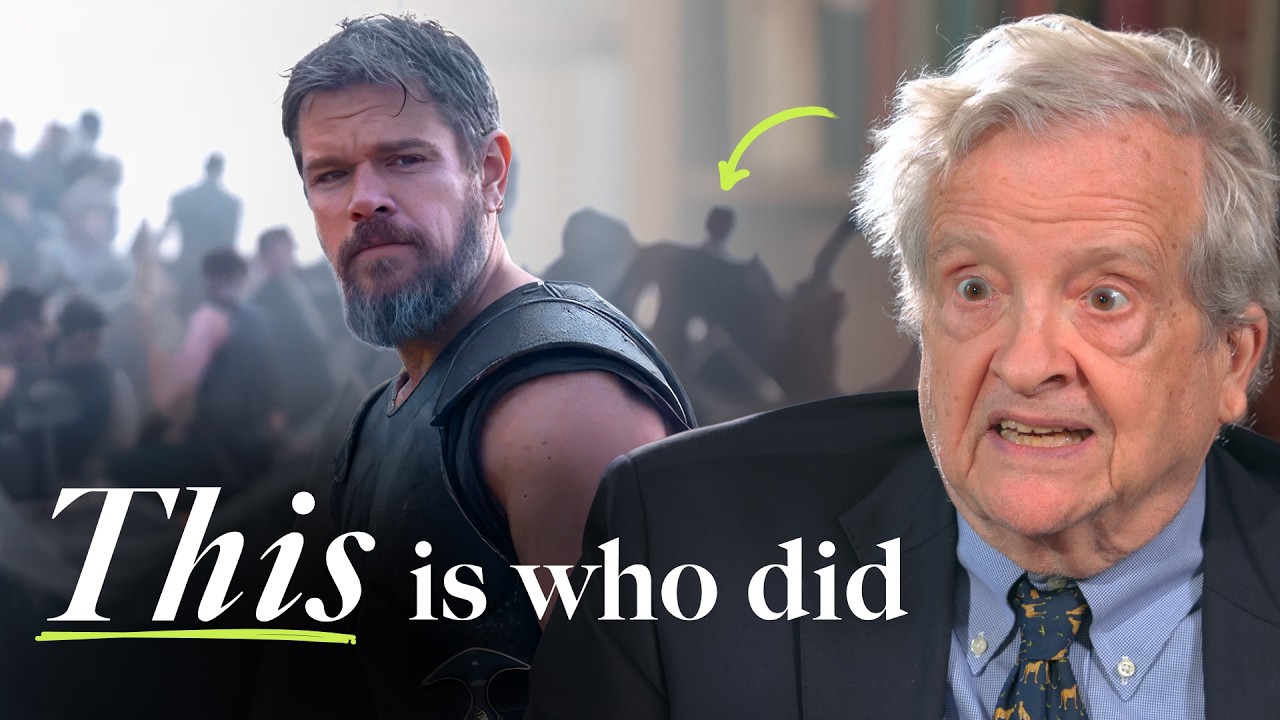
This episode features Harvard classicist Gregory Nagy explaining his lifetime conclusion that the Iliad and Odyssey were not written by a single author named Homer, but emerged from a millennia-long oral tradition that crystallized through performance at Athenian festivals, fundamentally changing how we understand creative work and cultural production.
Oral Composition and the Lord-Parry Discovery
Milman Parry and Albert Lord’s fieldwork in 1920s-30s Yugoslavia revealed living oral poets who could compose thousands of lines extemporaneously without writing, proving that epic-scale poetry can be created orally.
Abdul Majedovich, a Yugoslav singer, could perform 11,000-line epics on the fly, leading Lord to call him “our Yugoslav Homer” — a claim that outraged classicists who assumed textual composition was necessary for such complexity.
Oral poets use formulaic language (fixed epithets like “gray-eyed Athena” fitting specific metrical slots) and themes (repeatable narrative units) as cognitive scaffolding, enabling real-time composition within strict meter.
The economy of expression — one standard phrase per metrical position — is a hallmark of oral tradition; Virgil’s written Latin epic lacks this feature, confirming it as a literate composition.
Audience interaction drives expansion and compression: poets lengthen performances for engaged elite audiences (as Odysseus does for Alcinous) and compress for bored or hostile ones, a dynamic encoded in the Odyssey itself.
The name Homer (Homēros) etymologically means “joiner” or “hostage” — one who binds communities together; myths describe Homer volunteering as hostage, being blinded when the treaty fails, symbolizing the oral poet who sacrifices outer sight for inner vision.
Homer as Process, Not Person
Homer is not an individual but the name of a tradition and process spanning roughly 1600 BCE to the 2nd century CE, where each generation of poets collaborates with and competes against predecessors.
The poet invokes the Muse (goddess of absolute memory) not just for what happened but how to say it better to say it — improving on the tradition while preserving its core.
Formula governs form (meter-driven phrasing); theme governs meaning (narrative building blocks like “arming the hero” or “catalog of ships”); together they create a system where innovation occurs within constraints.
Ring composition (ABA narrative structure) reflects the circular motion of a chariot wheel (kuklos) — linear progress with recurring return — integrating social, poetic, and cosmic order (kosmos).
The Iliad and Odyssey are structural twins: Achilles and Odysseus occupy metrically identical formulaic slots, and the epics systematically avoid overlap while complementing each other (e.g., the “micro-Iliad” in Odyssey 8 compresses 15,000 lines into 10).
The Crystallization Model
Phase 1 (Early 2nd millennium – mid-8th c. BCE): Diverse local poets in taverns and courts generate the raw material; earliest genius (e.g., Hector’s farewell to Andromache in Iliad 6, with its historically accurate horsehair helmet detail) enters the tradition.
Phase 2 (Mid-8th – mid-6th c. BCE): Panhellenic festivals create interstate competition and collaboration; poets “shade over differences, highlight similarities” across city-states, forging a shared Hellenic repertoire.
Phase 3 (Mid-6th – late 4th c. BCE): The Panathenaic festival in Athens becomes the central crystallization point — a state-sponsored, relay-style performance of the entire Iliad and Odyssey by rhapsodes in fixed order, integrating athletic reenactments (apobatic chariot race) and civic ritual.
Phase 4 (4th – 2nd c. BCE): Post-Alexander, performance declines into recitation; Alexandrian scholars produce the “vulgate” standard text, but the living tradition has already fossilized.
Crystallization (Nagy’s metaphor): fluid oral tradition solidifies into a beautiful but fragile crystal — more coherent, more easily shattered — unless preserved by writing, which eventually replaces performance as the authority.
The Panathenaic Festival: Politics Elevating Art
Athens used the festival as cultural propaganda for imperial ambition, but its legitimacy derived from protecting the tradition, not exploiting it — politics elevates art when authority comes from custodianship, not instrumentalization.
The festival integrated feast, sacrifice, and performance: dais means both sacrificial feast and festival; the three songs of blind Demodocus in Odyssey 8 mirror the Panathenaic program, performed over dinner in a sacred context.
Hero cult grounded the epics in religion: heroes like Achilles and Odysseus were worshipped as proto-ancestors; performing their stories was ritual reenactment (mimesis), not mere entertainment.
Selection mechanism: not audience pandering but getting it right — the relay format demanded continuity; poets competed to “channel the original” better, where originality meant fidelity to the tradition’s root (radical) and origin.
Mimesis as authority: the staged lament of Andromache at the Panathenaia becomes the model for real-life laments; performance confers reality on life, reversing Plato’s claim that art imitates life.
Writing, Text, and the Fate of Oral Tradition
Early inscriptions (pre-550 BCE) were composed orally, then written — the text speaks through the reader’s voice; Dorian stonecutters even inserted obsolete digammas (w-sounds) into Ionic formulas, proving oral composition preceded writing.
Herodotus (5th c. BCE) still frames his Histories as oral performance (apodexis); Thucydides shifts toward writing as ktēma es aei (“possession for all time”), a vault for the privileged few.
The ontology flips: by the 4th century, writing becomes the authoritative medium; the Library of Alexandria treats scrolls as mummified words awaiting resurrection through reading aloud.
Plato’s Phaedo stages philosophy as the new mousikē (art of the Muses) on the eve of the Panathenaia, yet cannot escape Homeric metaphors — Socrates’ death becomes a reenactment of heroic sacrifice.
Genius, Tradition, and the Limits of the Model
Nagy allows skilled performers but resists the “romantic genius” model: even Ferdowsi (10th c. Persian poet) claims to be the “living transmitter” surpassing predecessors, yet still works within the tradition.
Shakespeare illustrates the written paradigm: his works survived in unstable quartos; Ben Jonson’s folio imposed textual fixity — the “bad Hamlet” vs. “good Hamlet” distinction reflects print culture, not oral fluidity.
Markedness (Jakobson): oral tradition is the unmarked (default) human mode; writing adds restrictions. Not all oral traditions use formulaic meter (Germanic stress-meter differs), but where formulaic density appears, it diagnoses orality — writing never produces it spontaneously.
Visser’s artificial Homeric catalog of ships proves the system is learnable, but Virgil would have rejected it as mechanical — the art lies in the living tension between formula and particularized epithet (e.g., polytropos for Odysseus at key moments).
The Core Insight
The Homeric epics are not products of a moment but of a civilization — a millennial conversation between poets, audiences, festivals, and institutions that turned oral improvisation into the West’s foundational literature.
Understanding this reframes creativity: tradition is not the enemy of originality but its engine; the “joiner” who binds past to present, individual to community, and performance to permanence creates something no single genius could.