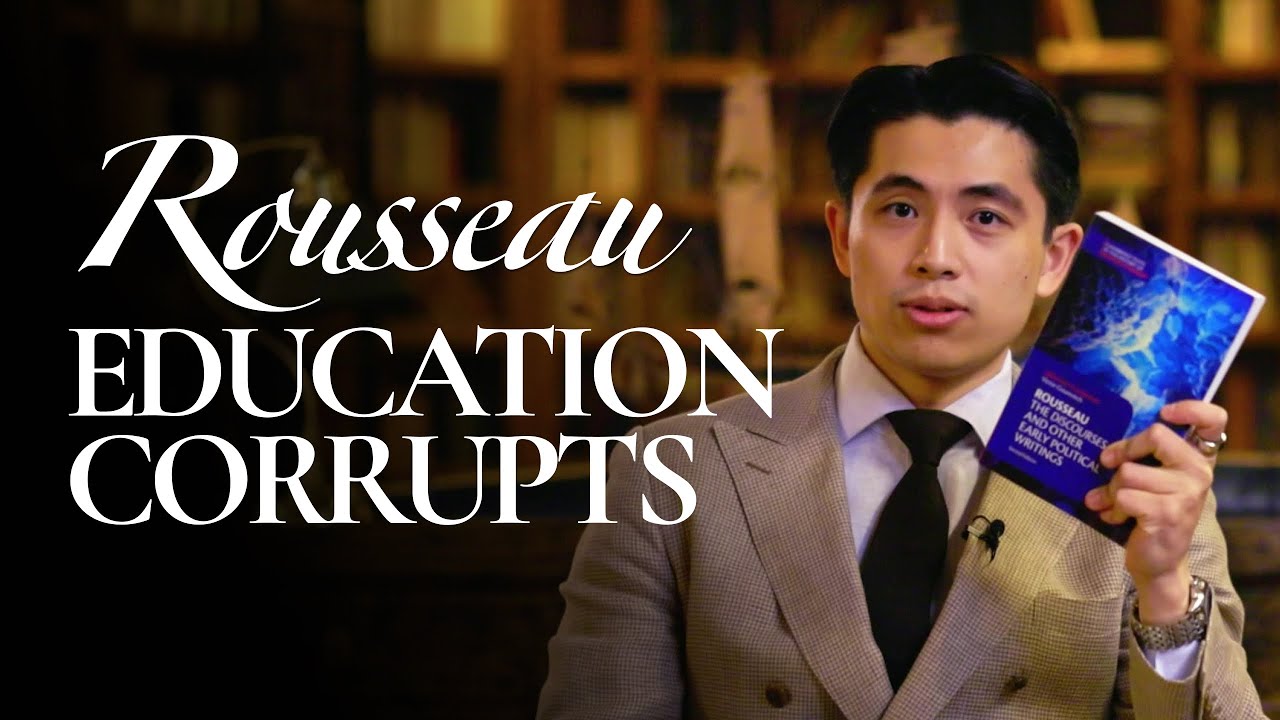
- Rousseau’s Discourse on the Arts and Sciences (the First Discourse) argues that the advancement of science, philosophy, and art has corrupted human souls rather than improved them—a deliberately shocking thesis from one of the Enlightenment’s most influential thinkers.
- Rousseau observes a historical pattern: civilizations that produce great art, philosophy, and learning—Egypt, Greece, Rome—subsequently collapse into foreign domination, internal corruption, and moral decay, while simpler, “ignorant” peoples like the early Jews, Spartans, and early Romans maintained virtue through action rather than study.
- The core mechanism of corruption is pride (amour-propre): intellectual life gives people tools to justify self-interest, seek distinction through contrarianism, and pursue recognition rather than virtue. Science and art do not fail because they are inherently bad, but because in the hands of most people they become vehicles for vanity, idleness, and social fragmentation.
- Rousseau’s critique is not a simple call to burn books. He distinguishes between a good state (small, homogeneous, virtuous—like Sparta or Geneva) where arts and sciences should be excluded, and a corrupt state (like Paris) where they can serve as distractions, minor edification, or quarantine for intellectuals. His own participation in Enlightenment culture is strategic: he uses the printing press, the theater, and the essay contest to push back against Enlightenment’s worst excesses.
- In the 21st century, Rousseau’s argument gains new force because science is no longer useless—through technology, it is now fused with worldly power. This means societies can no longer afford to reject science, but it also means the values that accelerate scientific progress (contrarianism, diversity of thought, rationalism, cosmopolitanism) are precisely those that undermine the shared identity, moral fabric, and virtue necessary for human flourishing. The terrifying possibility Rousseau raises is that modern values may have spread not because they are good, but because they are powerful.
How Arts and Sciences Corrupt: The Mechanisms
-
Self-interest and reason work together against natural compassion.
- Rousseau flips the common view that reason makes us more moral. He argues we naturally feel pity for others, but reason teaches us to justify ignoring that impulse—telling us the homeless person deserves it, or that our time is better spent earning money to help more people later. Intellectual development primarily teaches people to better advocate for their own interests and those of their faction.
-
Pride corrupts intellectual life through contrarianism.
- The desire to be recognized as better than others drives intellectuals to adopt shocking, uncommon positions simply to distinguish themselves. This is the “disease of contrarianism”: just as fashion creates ugly clothing for shock value, philosophers double down on outrageous opinions for fame. Examples include the Pharisees’ legalistic hair-splitting in Judaism, the proliferation of heresies in early Christianity driven by scholars trying to out-clever each other, and the explosion of Protestant denominations after the printing press democratized theological debate.
- Rousseau extends this to modern intellectual life: academics are incentivized to attack society for notoriety, publish perish for career survival, and adopt contrarian positions because the cultural reward structure favors distinction over truth or virtue.
-
Rational inquiry destroys the social fabric by undermining shared beliefs.
- Communities are held together by shared identity—common beliefs, values, heroes, customs, and even arbitrary symbols like flag colors. These beliefs need to seem obvious, eternal, and objective to have maximum force. Subjecting them to rational inquiry (“Why should we get married?” “Why these colors?”) opens vectors of valid attack and weakens their binding power.
- Rousseau distinguishes the truth of a belief from its usefulness: many false beliefs (like the Egyptian gods) were essential to their civilizations’ cohesion. Even beliefs that can be rationally defended (like “government should serve the people”) are dangerous to debate publicly because most people reason poorly, and contrarian opportunists will exploit the opening.
- This is why Rousseau’s ideal states are small, homogeneous, and closed off—he would hang the first European to enter Niger and the first citizen to leave. The immigrant is dangerous not because they are bad, but because they introduce foreign ideas and set an example of abandoning the community.
-
Science legitimizes an idle, self-indulgent life.
- Intellectuals pursue knowledge not out of public duty but for private pleasure—the joy of reading, the thrill of discovery. Rousseau sees intellectuals as closer to gluttons than to Mother Teresa. Elevating intellectual life means elevating a life of private indulgence over community contribution.
- Even today, much academic production is useless navel-gazing. Rousseau’s challenge: look at any college catalog and ask how many disciplines are genuinely useful. Fields that append “science” or “studies” to their name are often overcompensating.
-
Art is morally impotent and often makes people worse.
- Rousseau redefines art not as imitation of nature but as imitation of feeling. This flips the classical hierarchy: music (which directly incites emotion) is highest, painting and sculpture (static, limited) are lowest. This theory influenced modern art’s turn from realism to expressivism.
- Because art imitates existing feelings in a culture, it cannot teach lessons far removed from the audience’s current morals. Rousseau’s own novel succeeded only when he changed it from an ancient Roman story (inaccessible) to a modern love story (relatable). The inventor of Monopoly created it as an anti-capitalist pedagogical tool, but only left-wing intellectuals who already agreed with her played it; the bootlegged capitalist version spread globally.
- Most artists are driven by pride, not pedagogy. They choose popularity over edification, resorting to cheap emotional manipulation—fear, anger, lust—to keep audiences coming back. Social media platforms employ top psychologists to addict users through manipulated feelings; reality TV uses love or house-buying as a backdrop for drama, pettiness, and envy.
-
Art’s second-order dangers: deception, luxury, and hypocritical politeness.
- Deception: Actors make a living appearing to be what they are not. A culture that idolatizes actors normalizes appearing rather than being. Rousseau’s example: a friend who wanted to marry an actor prompted his observation that actors “deceive people for a living.” A community without actors has rustic simplicity; one with actors cultivates people-pleasing and two-facedness. California’s culture of constant smiling and superlatives masks the same meanness found more honestly in New York.
- Luxury: Art requires surplus wealth and creates further status symbols. High art serves as a vehicle for showing off wealth (buying a Picasso, having your name carved on the Met) under the guise of appreciating beauty. Luxury goods are by definition more useless than they appear—Kanye’s $300 t-shirts are not worth $300. Both luxury and art share the same form: appearing other than what one is.
- Hypocritical politeness: An artistic, people-pleasing culture develops a conformist surface-level agreement that prevents genuine virtue. Rousseau rejects the maxim that “hypocrisy is the homage vice pays to virtue”—hypocrisy is not a step toward virtue but an additional vice that makes reform impossible. A thief dressed in the livery of the house he robs is not paying homage to the master. Hypocrisy splits the soul into two, and living as a two-faced person means forgetting who you really are. The San Francisco example: 11,000 car break-ins in six months, 45 convictions, because officials raised in a culture of pleasing lack the strength of soul to enforce the law.
Rousseau’s Solutions: Living with Enlightenment
-
Rousseau is not a revolutionary—he is a strategist working within a corrupt world.
- He explicitly rejects revolution as “blameworthy to desire and impossible to foresee.” Revolution risks making things worse, lacks the weight of tradition, and cannot put Enlightenment back in the box. The Cambodian example: Pol Pot, a Rousseau admirer, killed a quarter of Cambodia’s population in an anti-intellectual purge and produced not a golden age but a nightmare.
- Rousseau’s own literary output seems to contradict his critique—he wrote philosophical treatises, composed plays, contributed to Diderot’s Encyclopédie, and won a prestigious essay contest with the First Discourse itself. He admits this but argues that what is right in a good state is not right in a corrupt one. He participates in Enlightenment to curb its excesses.
-
Four roles for intellectuals in a corrupt society:
- Prevention: Keep Enlightenment out of good states (e.g., Geneva should not get a theater).
- Distraction: In already-corrupt states like Paris, theater and entertainment can reduce crime by diverting passions. Rousseau’s analogy: if basketball keeps kids off the streets, let them play basketball all day—but that doesn’t mean an education consisting only of basketball is ideal.
- Quarantine: Academies serve as ivory towers that flatter intellectuals’ pride while keeping them away from the general population. They are “jail cells for crazies” that satisfy intellectuals’ desire for status while protecting society.
- Minor edification: Small nudges are possible—Rousseau’s novel Julie helped shift marriage from a familial arrangement to a love-based institution. But artists who paddle too hard against the current die in poverty and obscurity.
-
Art in the good state: make political life itself artistic.
- Ancient Athens had publicly funded, open-air theater for all citizens, about Greeks, by Greeks, winning public prestige rather than private money. This is better than modern isolated, dark theaters showing alien superhero stories.
- The ideal is to weave art into the fabric of social and political life so that art ceases to be deceptive. Ancient peoples made oaths before trees and stones, enveloped law in music and epic poetry (the Greek word nomos means both “tune” and “law”), and used sacred signs (thrones, scepters, crowns) to inspire obedience without force. Modern society, by abolishing these persuasive symbols, has shifted from persuasion to coercion—we keep our word not because of sacred oaths but because of the threat of state violence.
- Rousseau advises Poland to create a system of endless competition where citizens compete over virtuous actions for the community, winning public honor and eventually public office rather than private money.
-
Science and philosophy in the good state: elite, esoteric, and aligned with power.
- Philosophy should be practiced only by a small elite of genuine wise men who advise political rulers in private. These philosophers should be given wealth and status so their interests align with the state’s. Rousseau cites Cicero (Consul of Rome) and Bacon (Chancellor of England) as examples of intellectuals whose work benefited from political power.
- The danger of the Chinese Imperial exams: they were brilliantly meritocratic but too open, pushing the desire for enlightenment onto the entire population. This popular enlightenment led to military weakness and eventual conquest by the Mongols. The exams were “too meritocratic”—they made intellectual distinction the path to power for everyone, which corrupted the society.
- Rousseau does not want a public education system in philosophy. The few wise men do not need teachers; in fact, teachers would limit them. The constitutive quality of truly wise men is that they recognize the limitations of their own reason.
- The modern academic system is the worst of both worlds: intellectuals are overworked, underpaid, forced to publish perish, and culturally incentivized to attack society. They should be “bribed” like the capitalist class—given status and wealth in exchange for service rather than sedition.
Contemporary Relevance: The 21st-Century Dilemma
-
Science is no longer useless—technology has fused intellect with worldly power.
- Rousseau’s rhetorical question (“If you had never taught us these things, would we have been any less numerous or formidable?”) had a clear “no” answer in his time. Today the answer is “yes”—studying useless insect mating led to pheromone-based pest control; abstract algebra became the backbone of computing; neuroscience is making the paralyzed walk. Technology has joined power and intellect at the hip.
- Warfare has shifted from the logic of will to the logic of force. It is no longer about 300 Spartans holding a pass but about who has the better killer drone. World War II can be read as a race between Oppenheimer and Heisenberg to build the bomb first. The Taliban’s defeat of US-backed Afghans shows will can still triumph over force, but the acceleration of technology means states must invest in STEM to survive.
- Enlightenment used to pass from conquered to conqueror (Greeks to Romans, Romans to Gauls) because it made societies weak. In the past 300 years, it has passed from conqueror to conquered (Europe to everyone else) because it now confers power.
-
Rousseau’s strategy of conservation is no longer viable.
- No state today can afford to neglect science and technology. Standing still, let alone pushing back, means economic and military irrelevance. If you don’t control the latest productive technologies, your citizens do the lowest-value tasks. If you don’t control media technologies, your country is force-fed foreign faces, values, and stories.
-
Philosophy’s new role: guiding technology by clarifying choices.
- Philosophy will not make technologists more moral, but it can tell decision-makers which cup has water and which has gasoline. Questions that were “useless” for millennia—Is sentiment or reason the foundation of morality? (relevant for bioengineering humans.) Do we care about recognition from nonhuman sources? (relevant for AI companions.) Can deterministic agents be held morally responsible? (relevant for self-driving cars.)—are now critical.
- In a world where change can be arrested, philosophy should play a conservation role. In our world, where we must surf change, philosophy’s role is public elucidation: outlining to decision-makers the consequences of their choices.
-
The terrifying Rousseauian possibility: our values may be powerful, not good.
- Rousseau’s critique of the 21st century would be even more forceful than his critique of the 18th. In his time, the virtuous non-enlightened state could still triumph over the corrupt enlightened one—Sparta over Athens. Today, the statesman faces two untenable choices: cultivate science and grow power but destroy virtue, or reject science and protect virtue but get conquered by the corrupt.
- The values that accelerate scientific progress—contrarianism, diversity of thought, rationalism, cosmopolitanism, immigration—are precisely those that undermine shared identity, community feeling, and moral fabric. What if modern values spread not because they are good but because they are powerful? Asia adopted Western values in the 20th century not because they read Kant but because the Qing Empire was defeated on the battlefield and Japan was struck by Commodore Perry’s warships. Morals were imported because they made states more powerful, not because they made citizens more virtuous.
- We send our children to study arts and sciences not to make them better people but so they can “find faces of Jade and houses of gold”—get rich. The terrifying thought: science is not in the service of man, but man in the service of science. As we extend our dominion over nature through technology, the First Discourse becomes more, not less, relevant. Its question for the 21st century: For what shall science profit man, even if he shall gain the whole world, but lose his own soul?