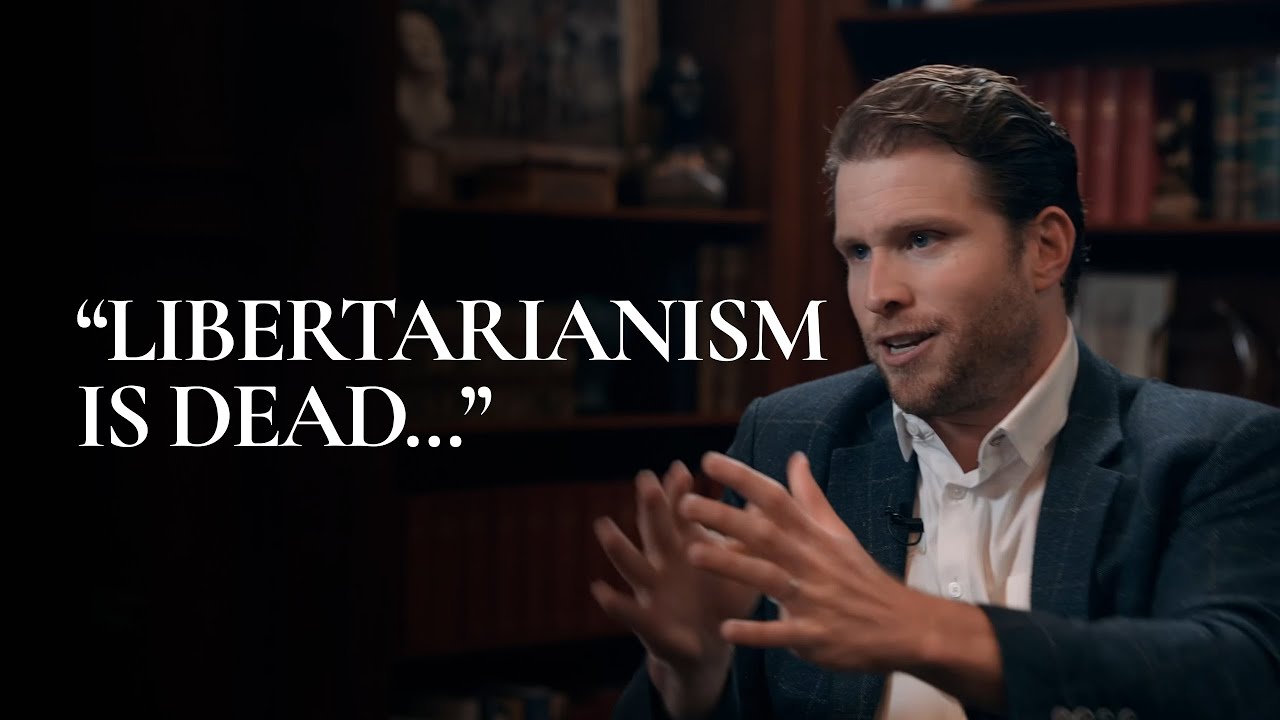
Joe Lonsdale — co-founder of Palantir, founder of the Cicero Institute, and builder of multiple defense and technology companies — argues that America’s core political problem is the loss of a functioning natural aristocracy. When the U.S. disposed of aristocracy, it did not unleash democracy but instead got bureaucracy: a geriatric, misaligned, unaccountable administrative state that suffocates competence and innovation. His political philosophy, drawn from Cicero, Xenophon’s Cyrus, and the American founders, seeks to restore virtuous elite leadership, inject market-like accountability into government, and fight what he sees as the twin evils of crony capitalism and bureaucratic incompetence.
The Aristocratic Vacuum
Cicero’s three-legged stool of government — commoners (who must have a vote), a natural aristocracy (a deliberative elite body), and an executive function — was the model the American founders tried to replicate with the House, Senate, and President.
The U.S. Senate was originally designed as an aristocratic body, elected indirectly to filter for competence and virtue.
Today that aristocratic function has collapsed, leaving only plebeian politics and bureaucratic administration.
What Lonsdale means by “natural aristocracy” is not hereditary privilege but a meritocratic elite — the smartest, most capable people across the political spectrum forced to deliberate and produce policy, as opposed to the lowest-common-denominator discourse of social media and celebrity culture.
He points to athletics and entrepreneurship as the two remaining natural selection mechanisms in American society.
Silicon Valley startup culture functions as a modern aristocracy: founders raise capital, compete, succeed or fail, and the successful ones eventually engage in politics and policy.
A new aristocracy has formed — the billionaire class — but it exercises influence through behind-the-scenes mechanisms rather than through an explicit, legitimate institutional role.
Lonsdale’s proposed compromise: a Senate where representation is weighted by taxes paid (so those funding government have formal power over it) alongside a House based on one-person-one-vote, with legal guardrails preventing billionaire capture of the popular chamber.
This mirrors the historical British model of House of Lords and House of Commons.
Machiavelli vs. Xenophon’s Cyrus
Xenophon’s Cyropaedia (c. 300 BC) was the classic Western text on leadership for 1,500 years — a portrait of Cyrus the Great as virtuous, merciful, disciplined, and wise, used to educate every young prince and aristocrat.
Machiavelli displaced this tradition with a cynical, instrumental view of power focused on deception and manipulation.
Lonsdale argues this shift is deeply damaging: most successful builders he knows are better understood through the Xenophon-Cyrus tradition of virtuous leadership than through Machiavellian cynicism.
He acknowledges the dialectic — Cyrus himself understood cunning — but insists the virtuous model is both more accurate for most leaders and more necessary for a healthy culture.
On the Augustinian critique that Roman heroic virtue is really vanity in disguise, Lonsdale pushes back strongly: if everyone competent adopted that view, society would be overrun by bad actors. The willingness to fight and build is how civilizations survive.
Bureaucracy as the Chief Enemy
Lonsdale’s primary adversary is not a foreign power or an ideology but bureaucracy itself — defined by lack of accountability, lack of competence, and lack of inclination to get things done.
Bureaucracy is actively defended by those who benefit from it: incompetent government contractors who use it as a moat, NGOs that profit from its expansion, and insiders who fear accountability.
The Pendleton Act of 1883 introduced merit-based civil service exams after the Civil War’s massive government expansion led to patronage overload. These exams were correlated with job performance and lasted roughly 100 years.
They were dismantled in the 1970s because outcomes were not equally distributed across racial groups, which was deemed unacceptable regardless of the tests’ predictive validity.
The result: a federal government that is simultaneously maximally incompetent and maximally large — the worst possible combination.
Historical cycles of expansion and contraction: competent government tends to emerge only under existential pressure (e.g., Churchill reforming the Royal Navy before WWI). America’s wealth and reserve currency status mean it can sustain dysfunction far longer than it should, removing the urgency for reform.
On the Department of Government Efficiency (DOE): Lonsdale supports the direction but argues it has been far too limited. Real cuts require congressional cooperation, which is blocked by the filibuster and lack of political will. Both parties have special interests feeding at the trough.
Pragmatic Libertarianism and the Cicero Institute
Lonsdale’s political evolution: from a 14-year-old libertarian who wanted to build a new city-state, to a 42-year-old realist who accepts that government is not going to be eliminated and must instead be made functional.
The pure libertarian argument — “government shouldn’t be doing any of this” — has been lost for 70 years and is not coming back. Medicare and Medicaid will not be deleted.
His pragmatic alternative: take the values of a free society (accountability, incentives, competition, outcome-based funding) and apply them to existing government programs to make them ten times more competent.
The Cicero Institute operates on two tracks:
A 501(c)(3) nonprofit that researches the ideal state of policy in a given area.
A 501(c)(4) advocacy arm (Cicero Action) that practices “the art of the possible” — hiring lobbyists in over 20 states, doing studies and polling, educating legislators, and iterating with them as partners to pass measurable bills.
Success is measured by bills passed, not white papers published.
Cicero as namesake: chosen because Cicero preserved and transmitted classical wisdom to the modern age, came from the middle class, believed in commerce, fought special interests stubbornly, and was a persuasive statesman. Lonsdale acknowledges Cicero’s flaws (as with Palantir’s name, both reference great things that ended badly).
Injecting Markets into the State
The core mechanism: take broken government systems and introduce market-like accountability, incentives, and competition.
Vocational education in Texas: 27 high-end technical schools are now funded in proportion to the salaries of graduating students, rather than graduation rates (which are gameable). Schools responded by partnering with businesses and teaching market-relevant skills.
Prisons: Lonsdale opposes current for-profit prisons (which profit from keeping people locked up) but supports a model where profit is tied to employment and recidivism outcomes — aligning incentives with rehabilitation.
Homelessness and the “vulnerability index”: Lonsdale is sharply critical of the Housing First model and the vulnerability index used by HUD and NGOs, which awards priority for free housing to people who are on drugs, not in recovery programs, or have committed violent crimes. He argues this inverts moral incentives, enriches NGO insiders, and fails to solve underlying problems.
Crony capitalism: Lonsdale agrees with Bernie Sanders that this is a major problem. Large companies lobby for regulations that function as moats, blocking competition and keeping prices high.
Healthcare scope-of-practice laws: doctors’ lobbies block nurses from using FDA-approved AI devices that could prevent diabetic retinopathy in rural areas, keeping prices high and care unavailable.
Financial regulation: companies like BlackRock employ hundreds of lawyers to navigate and shape regulations so complex that no startup can afford to compete. The regulatory state is oligarchic while pretending to protect the people.
Monopsony is as dangerous as monopoly: when there is only one buyer (e.g., the Department of Defense purchasing from a single contractor), there is no incentive to adopt better alternatives. Multiple competing buyers create accountability — decision-makers fear looking dumb relative to peers.
NIH as monopsony: the National Institutes of Health funds research through a single bureaucratic pathway that is risk-averse and rewards established labs. Alternative models like Damon Runyon (where top scientists choose the next generation of researchers to fund) produce 50-100x more results per dollar but are not adopted because bureaucrats hate being challenged.
Lonsdale advocates for multiple competing funding mechanisms within government, with outcomes tracked and resources shifted toward what works.
Palantir and the Philosophy of Technology
Palantir’s founding problem: after 9/11, the U.S. government was spending $38 billion annually gathering data on adversaries but had no system to use it competently. Islamist groups operated on a doctrine of perpetual conquest, and Western societies risked becoming like what they fought in order to survive.
The solution: build a system with strict permissioning, audit trails, and rules about who can access what data and how it can be shared — enabling the government to find and eliminate terrorist networks while constraining its ability to abuse data on its own citizens.
Palantir does not collect data itself; it governs access to data the government already holds across thousands of databases worldwide.
Technology as habit formation: software is never value-neutral. It trains its users into new habits and ways of thinking. Lonsdale cites St. Patrick’s approach to converting Ireland — overlaid Christian meaning onto existing pagan spirits and traditions rather than erasing them — as a model for how enterprise software must meet users where they are and nudge them toward better practices incrementally.
The Palantir name as cautionary tale: like the seeing-stone in Lord of the Rings, any powerful tool can fall into the wrong hands. Lonsdale acknowledges this risk but argues the alternative — not building the system — would have meant more successful terrorist attacks and potentially a more authoritarian, less free society as a reaction. The civil liberties safeguards built into Palantir’s architecture make abuse harder than with legacy systems.
Motivation and the Philosopher-Builder
Why Lonsdale does this despite reputational and financial costs: he argues that having clear values and principles attracts talent, allies, and the quiet majority who appreciate people willing to fight for what they believe. But the deeper motivation is an internal compass — virtue means deciding what is right and fighting for it.
The philosopher-builder: Lonsdale seeks to work with founders who approach problems from first principles, understanding how people, institutions, and systems work at a fundamental level. He cites Elon Musk and Charles Koch (who calls himself “philosopher in chief” of the largest private company in the U.S.) as examples. Philosophy, not just computer science or engineering, is what enables someone to “hack the world.”