-
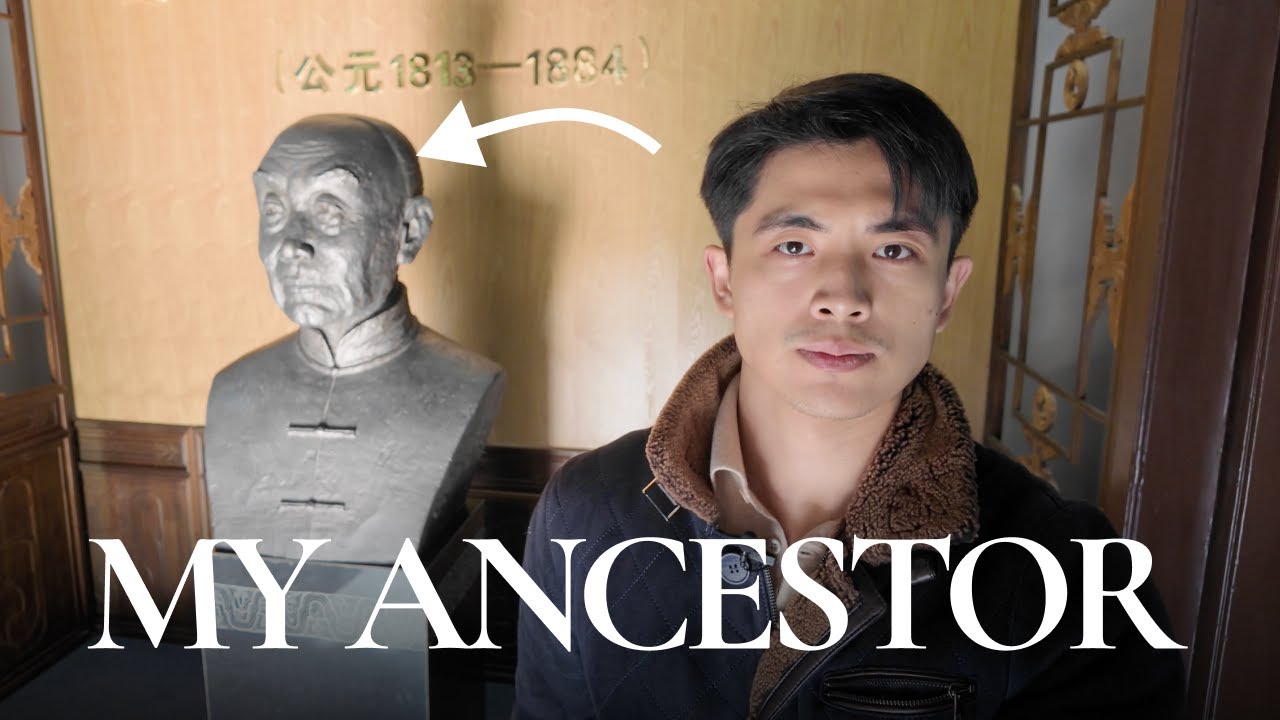
The speaker visits their ancestral home in China for the first time, tracing the legacy of their ancestor Chinati (also spelled Chundiati/Chundati), a renowned 19th-century Chinese epigraphist and classicist whose life’s work was rescuing ancient wisdom for modern use.
- Chinati was born roughly 100 years before the speaker’s great-grandmother, who lived to 103 and first told the speaker about him as a child.
- The speaker initially dismissed epigraphy—the study of ancient inscriptions—as a dry intellectual puzzle, preferring philosophy that offered a practical art of life.
- A recent book on Chinati changed this view, revealing that his approach to epigraphy was itself a practical art of life: he used the study of ancient inscriptions and antiques to recover lost classical wisdom and transform how people live.
- The speaker discovered a private letter Chinati wrote to his descendants near the end of his life, exhorting them to read the great books in a deeply personal way—reading “according to yourself,” using the classics as a mirror for self-examination rather than as detached scholarship.
- The letter was essentially an instruction manual for the family’s private academy (dash rule), urging grandsons and future descendants to keep the “fragrance of books” alive in the family.
- The speaker describes getting goosebumps reading it, recognizing a direct spiritual lineage: someone 200 years ago doing essentially what the speaker is trying to do now.
-
Chinati’s background and family legacy
- The Chun family produced about 19 jinshi (the highest rank in the imperial exams) over roughly 600–700 years.
- Chinati’s father, Trinun, was also a jinshi and a member of the Hanlin Academy—the emperor’s intellectual institution, serving as tutor to the emperor Daoguang and rising to deputy grand secretary and minister of personnel.
- Chinati grew up in Beijing because of his father’s court position, giving him a front-row view of political fortune’s rise and fall, which left him jaded about active political life.
- In his early 40s, after the emperor demanded enormous financial contributions to fund a war against the Taiping Rebellion (led by Hong Xiuquan, who claimed to be Jesus’s son), Chinati used this and other personal losses as reasons to enter self-imposed political exile.
- He left Beijing and returned to his ancestral home in Weyang, Shandong province, where he devoted himself entirely to scholarship.
-
The ancestral home in Weyang
- The speaker tours the Ding Clan family home, where the speaker’s great-grandmother and grandmother grew up—the last surviving great-house-style family home in Weyang.
- The family operated a private school (dash rule) with hired tutors to teach sons and grandsons the classics in preparation for the imperial exams.
- The speaker reads Chinati’s letter in full, explaining each passage:
- “The ancients studied the classics and many were wise; the moderns do not study the classics and most of them are foolish”—arguing that modern people are not inherently less talented, but waste their lives by not reading the classics.
- “To read according to yourself, you will be limitless”—the core instruction: don’t treat classics as intellectual puzzles; use them to examine your own life.
- “To read according to proper order, you will make progress daily”—this is not a contradiction; one must read the specific canonical texts in the prescribed order, but read them personally, as if each book is speaking directly to you.
- He writes the letter because his youngest son is still an infant, and he fears the “fragrance of books” (a Chinese expression comparing the smell of great books to the aroma of a mother’s cooking) will fade from the family.
-
Chinati’s intellectual achievements and the museum
- Chinati’s home has been converted into the Yinlou (Tower of 10,000 Seals), named for his collection of over 10,000 ancient seals and antiques.
- His core mission was transmitting antiquity (rescuing ancient virtue) rather than merely collecting antiques—using material artifacts to recover living wisdom.
- Discovery of Pottery Script: Chinati was the first to identify and decode this proto-language, the earliest known form of Chinese writing, engraved on pottery scraps roughly 4,500 years old.
- Groundwork for Oracle Bone Script: Chinati’s research and correspondence with his in-law and friend Wang Yirong (about 30 years his junior) laid the intellectual foundation for Wang’s discovery of oracle bone script.
- Oracle bone script, about 3,400 years old, contained far more complete texts than pottery script and became undeniable evidence of the Shang Dynasty’s historical existence—previously dismissed as legendary by Western scholars.
- It also helped overturn the rigid Confucian orthodoxy of the Song Dynasty by giving scholars better access to original linguistic contexts, revealing that many orthodox interpretations were simply wrong.
- Chinati wrote a poem capturing his insight: “From chaos to heavenly order was from language, and so too does language light up wisdom and understanding in man”—anticipating 20th-century linguistic philosophy’s central insight about the role of language in forming civilization and human intelligence.
-
The Mao Ling tripod: Chinati’s greatest discovery
- The Mao Ling is a bronze tripod created roughly 3,000 years ago in the middle of the Zhou Dynasty, when the empire was collapsing.
- The Zhou emperor Zhou Mu appointed a minister named Mao (after whom the tripod is named) and exhorted him to help resurrect the lost virtue of the founding Zhou emperors.
- Mao succeeded, extending the dynasty so that Zhou Mu became a middle emperor rather than the last one.
- Chinati was the first to recognize the Mao Ling’s historical significance and decode the inscriptions inside its belly.
- The tripod is emblematic of “transmitting antiquity” on three levels:
- The text itself: The emperor exhorts his minister to imitate the virtue of ancient ancestors—the same message as Chinati’s letter to his descendants.
- Why it was made: Mao commissioned it to record the honor bestowed on him, ending with a direct exhortation to his own sons, grandsons, and future descendants to remember these events.
- Chinati’s role: After being buried and lost for thousands of years, it was Chinati who identified and decoded it—a life dedicated to transmitting antiquity culminating in the discovery of an artifact that itself testifies to the power of transmitting antiquity.
- The speaker notes a personal connection: on their paternal line, family legend holds that their surname was given by the founding Zhou Emperor to his 15th son—meaning the Mao Ling was created in relation to the speaker’s paternal ancestors 3,000 years ago, and was uncovered by the speaker’s maternal ancestor.