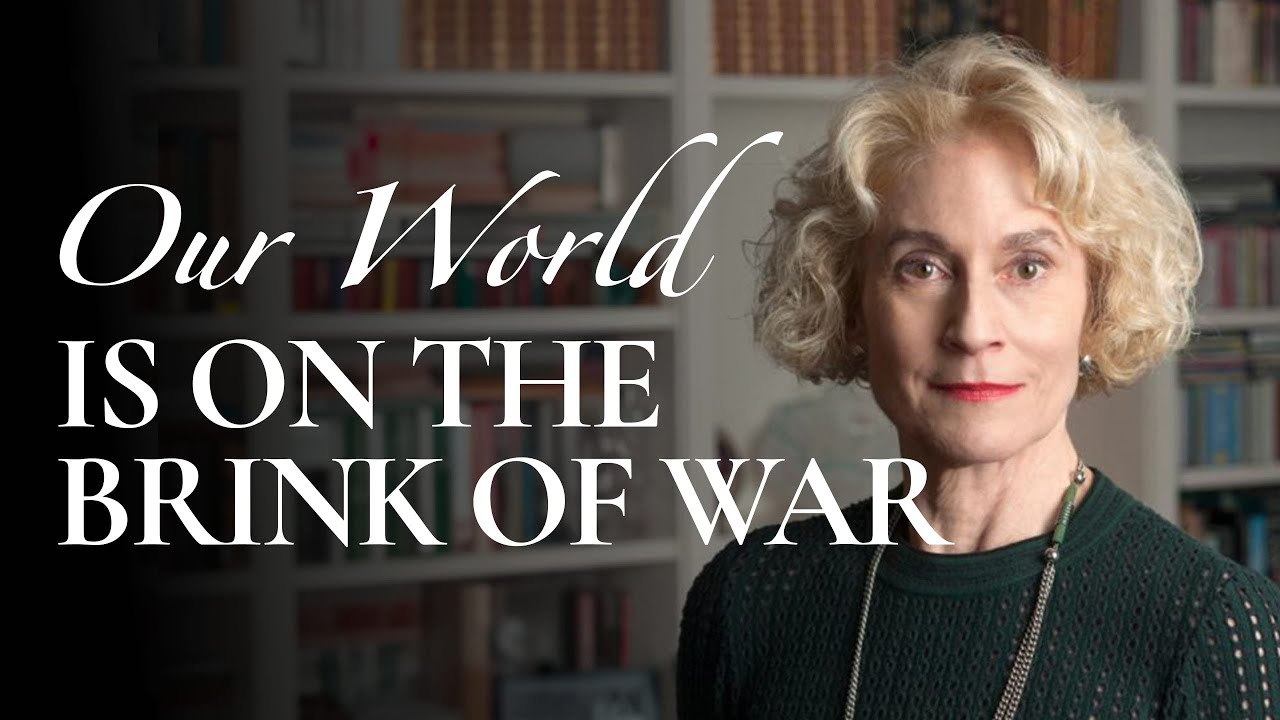
Martha Nussbaum discusses Benjamin Britten’s War Requiem, a 1962 choral work composed to rededicate Coventry Cathedral after its WWII bombing, which interweaves the Latin Requiem Mass with anti-war poems by WWI poet Wilfred Owen. The piece is a meditation on war, reconciliation, and the human cost of violence, and Nussbaum uses it as a lens to explore broader philosophical questions about pacifism, just war, and emotional self-governance in times of conflict.
Britten’s Vision and the Two World Wars
The War Requiem was officially commissioned for the consecration of the new Coventry Cathedral in 1962, commemorating the destruction of the original in the 1940 Blitz.
Britten used Wilfred Owen’s WWI poems—written in protest of that war’s futility—to frame his reflection on WWII, creating a conflation Nussbaum finds philosophically problematic.
WWII is widely regarded as a just war (e.g., against Nazism), whereas Owen saw WWI as a pointless slaughter driven by imperial elites.
Despite this tension, Britten’s ultimate focus was forward-looking: he envisioned reconciliation among former enemies—England, Germany, and Russia—through shared mourning and moral renewal.
He cast soloists from these three nations to symbolize postwar unity, though the Soviet soprano was blocked from performing at the premiere.
Pacifism: Action vs. Emotion
Britten was a committed pacifist influenced by Gandhi, but Nussbaum distinguishes between two forms of pacifism:
Pacifism of actions: the absolute rejection of violence, even in self-defense.
Emotional pacifism: the disciplined effort to overcome vengeful impulses, cultivating empathy and inner peace while still potentially engaging in justified defense.
Gandhi’s nonviolence was strategically effective against the British Empire (which had moral limits), but Nussbaum argues it would have been absurd against Hitler, who could not be “converted” by love alone.
She critiques Britten’s blanket pacifism as naive, noting that many leftists and artists (e.g., Pete Seeger, Iris Murdoch) supported WWII as a moral necessity.
The Psychology of Vengeance and Deterrence
Nussbaum acknowledges the difficulty of emotional pacifism: Nelson Mandela spent 27 years in prison working to uproot his desire for retribution.
Even disciplined nonviolent movements (e.g., during Indian Partition or South Africa’s transition) struggled with internal urges for revenge.
She argues that deterrence is better grounded in love of country and steadfast resolve than in threats of vengeance.
Churchill’s rhetoric (“blood, toil, tears, and sweat”) exemplified this: a defense rooted in national dignity, not hatred.
Similarly, Zelenskyy effectively rallies Ukrainians by invoking love of nation, not hatred of Russians.
This aligns with Seneca’s view: reason and love are more reliable motivators than anger, which is volatile and self-corrupting.
The War Requiem as Moral and Artistic Statement
Britten repurposed the traditional Requiem Mass—a text repudiated by both Anglican and Catholic churches for its vengeful imagery of divine wrath—to critique retributive justice.
He retained dramatic sections like the Dies Irae (depicting hellfire and judgment) but framed them as warnings, not endorsements.
The emotional and theological climax is the Agnus Dei, where Britten replaces the traditional “grant them rest” with “grant us peace” (dona nobis pacem), shifting focus from the dead to the living.
He sets Owen’s poem At a Calvary near the Ancre, equating the common soldier with Christ—both victims of pride, nationalism, and irrational violence.
The solo tenor (originally Britten’s partner Peter Pears) sings with ethereal simplicity, embodying the “noble” or “beautiful” (to kalon) that shines through suffering.
Reimagining Biblical Narratives
Britten and librettist Peter Pears radically reinterpret the story of Abraham and Isaac:
In their version, the angel offers a ram as substitute—but Abraham kills Isaac anyway, illustrating how obedience to wrath (even under divine guise) leads to moral catastrophe.
This underscores their critique of blind obedience and the irrationality of retaliatory violence.
Nussbaum, as a Reform Jew, treats the Hebrew Bible critically: its depictions of a vengeful God reflect historical context, not timeless truth.
She compares this to how philosophers engage Aristotle or Kant—learning from them without accepting their errors (e.g., on women).
Music as a Medium for Moral Reflection
Drawing on Schopenhauer, Nussbaum argues music uniquely accesses human emotion and will, bypassing rationalization.
The War Requiem uses orchestral force, choral dynamics, and vocal intimacy to make listeners feel the horror and sorrow of war in their bodies.
Yet she sides with Aristotle over Schopenhauer: while Schopenhauer saw human striving as futile, Aristotle believed tragedy reveals the enduring value of what is lost.
The War Requiem embodies this: it shows devastation but also the “shining through” of human dignity, especially in the Agnus Dei.
Britten, Pears, and the Politics of Love
Britten and Pears were a gay couple in a society where homosexuality was illegal until 1967; they faced stigma but maintained a 39-year creative and romantic partnership.
Their lives countered stereotypes of gay men as corrupt or tormented; their love letters (now in the Aldeburgh Museum) reveal mutual respect, creativity, and devotion.
The War Requiem becomes, in part, a testament to their belief that love—between people, and among nations—can embody beauty and moral clarity even amid persecution.
Nussbaum sees their resilience as analogous to her own experience as a woman in philosophy: sustained by mentors and allies, refusing to internalize societal disdain.
Relevance Today
Nussbaum rejects the post–Cold War myth that war was ending; conflicts in Ukraine, Gaza, Bosnia, and elsewhere show its persistence.
International cooperation may reduce war’s frequency and scale, but its abolition is naive.
The War Requiem remains urgent: it teaches that surviving war morally—avoiding both external conquest and internal corruption by vengeance—is as important as winning it.
True peace requires emotional discipline, empathy, and the courage to build shared futures from the ruins of conflict.