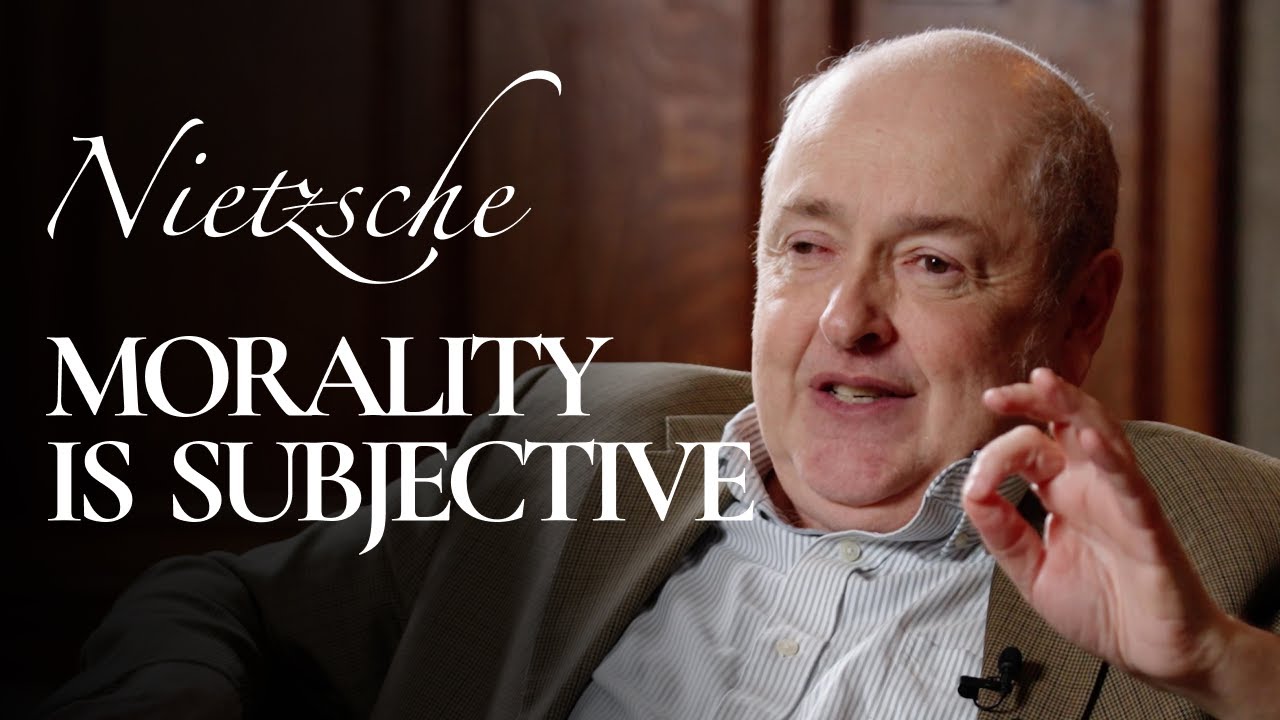
Brian Leiter, a leading Nietzsche scholar and philosopher, explains Nietzsche’s moral anti-realism — the view that there are no objective moral facts, only subjective emotional responses shaped by culture and psychology — and why Nietzsche wanted to convince people of this view not to promote tolerance, but to liberate creative geniuses (“higher men”) from the constraints of dominant moral systems so they could create and impose their own values, even through force.
Nietzsche’s Moral Views and Their Disturbing Content
Nietzsche is deeply anti-egalitarian, illiberal, and rejects altruism, compassion, and pity as moral ideals; he cares primarily about the production of higher men — creative geniuses like Beethoven, Goethe, and Napoleon — and believes slavery could be justified if it frees a smaller class to produce cultural greatness.
His claim that “slavery is a condition of every high culture” was descriptively accurate for his era, encompassing both literal slave societies and the exploited working classes of 19th-century Europe.
His concept of “severe self-love” is distinct from pathological narcissism (which he calls “the selfishness of the sick”); Beethoven is the paradigm case — someone who organized his entire life around his creative project, with everything else taking a backseat.
Nietzsche’s objection to egalitarian morality is that it is incompatible with the kind of extreme discipline and self-focus required for great creativity; if Beethoven had lived by Christian values, he would never have become Beethoven.
Nietzsche’s anti-egalitarianism presents a genuine philosophical challenge: once you abandon the religious basis for human equality (all souls made in God’s image), it becomes very difficult to explain why all human beings deserve equal moral consideration qua human beings.
Leiter notes that Nietzsche seems to have been wrong in predicting that egalitarianism would fade after “God is dead” — it remains a powerful commitment in secular modernity.
Leiter personally sides with egalitarianism, partly because he was raised with egalitarian feelings (which Nietzsche would say are just inculcated emotions with no rational foundation), and partly on pragmatic grounds: states that adopt anti-egalitarian policies do not have encouraging track records.
Nietzsche and Marx: Complementary Thinkers
Marx and Nietzsche are traditionally placed on opposite ends of the political spectrum, but they are complementary in important ways: Marx focuses entirely on social and economic structure while ignoring individual psychology, whereas Nietzsche focuses entirely on individual psychology and the unconscious while ignoring social and economic structure.
They share a critique of capitalism, but for very different reasons: Marx objects because it makes most people badly off; Nietzsche objects because capitalist and military culture pose aesthetic obstacles to cultural greatness.
There is a tradition of right-wing, aristocratic critiques of capitalism (including Tocqueville’s observation that America’s frenzied industry would never produce a thinker like Pascal), and Nietzsche belongs to this tradition.
Their profound disagreement is over egalitarianism: Marx’s post-capitalist world assumes widespread human flourishing and creativity, while Nietzsche thinks egalitarian moral culture is incompatible with the emergence of the next Beethovens or Goethes.
What Is Moral Anti-Realism?
Moral anti-realism, as Leiter characterizes Nietzsche’s position, is the view that there are no mind-independent or judgment-independent facts about value; whether something is morally right or wrong depends entirely on how human beings respond to it emotionally, not on any objective feature of the world.
This does not mean Nietzsche denies objective truths in general (e.g., dinosaurs existed independently of us); he denies only that values have this kind of objective standing.
Leiter clarifies the spectrum of anti-realist positions using the analogy of fashion: the extreme view (associated with Protagoras) is that morality is purely subjective — “wrong for you, right for me”; a more moderate view is that morality is relative to a community; Nietzsche’s view is closest to the extreme subjective position for fundamental evaluative judgments, while recognizing that many people share moral responses because of shared cultural conditioning.
Many moral beliefs presuppose factual claims (e.g., abortion is wrong because a soul exists), and those factual claims can be debated rationally; but Nietzsche thinks some evaluative beliefs are bedrock — like the moral equality of human beings — and at that level there is no objective fact of the matter, only conflicting brute attitudes.
When two people disagree at the bedrock level of valuation (e.g., Nietzsche says enslaving some is worth it for Beethoven; another says it is not), there is no rational argument that can resolve the disagreement — it is a conflict of brute emotional attitudes, not a matter of objective truth.
Why This Debate Matters
If values are not objective, many people worry that “anything goes” — that there is no basis for condemning Hitler or defending human rights; this is what Dostoevsky feared when he wrote “if God is dead, everything is permitted.”
Leiter argues that even without objective moral facts, we can still find Hitler abhorrent and act against him; the emotional response of disgust and the judgment that he ought to be stopped are sufficient without needing to claim objective moral truth.
The stakes are high because much of how we live — our views on slavery, abortion, equality, punishment — is premised on the assumption that we are discovering objective moral truths, and Nietzsche denies this entirely.
Arguments for Nietzsche’s Anti-Realism
The Superfluity Argument (Moral Facts Are Not Needed for Explanation): One of the legacies of the Scientific Revolution is that real features of the world should figure in our best explanations of what we observe. Moral facts do not appear to be needed to explain our moral judgments. Gilbert Harman’s “flaming cat” example illustrates this: when you see teenagers setting a cat on fire and judge it wicked, the best explanation is your inculcated emotional response, not the objective wrongness of the act. Similarly, apartheid collapsed because people believed it was unjust, not because it was objectively unjust — belief in injustice is sufficient to explain revolt, just as a desert traveler’s belief in an oasis (a mirage) explains his movement toward it.
A potential objection is that lower-level building blocks of moral fact (like pain and pleasure for utilitarians) might be real and objective; Nietzsche would dispute this, noting that people routinely choose painful things, undermining the claim that pleasure is necessarily good and pain necessarily bad.
The Sentimentalist Mechanism (Morality as Symptom of Affects): Nietzsche is a sentimentalist in the tradition of Hume: moral judgments are best explained by emotional or affective responses to states of affairs, which are themselves explicable in terms of psychological facts about the person making the judgment. The basic mechanism involves feelings of inclination (positive valuation) and aversion (negative valuation), which are inculcated from a young age and then layered with cultural meta-feelings — e.g., a Christian feels it is virtuous to turn the other cheek when confronted by an enemy, while a Homeric Greek would feel shame at the same impulse.
Reason can play a role at the level of meta-feelings and by correcting false factual beliefs that underlie moral judgments, but the bedrock of morality remains feeling, not reason.
This is why Nietzsche writes the way he does — using ridicule, polemic, insults, and jokes — because if morality is grounded in feeling, you can only change moral views by affecting people’s feelings, not through rational argument.
The Argument from Disagreement: The most striking fact about the history of moral philosophy is that after two millennia, philosophers cannot agree on foundational moral questions, unlike in the sciences and mathematics where consensus emerges across cultural boundaries. This persistent disagreement suggests there is nothing there to discover — no objective moral facts. Derek Parfit’s attempt to show that all moral theories converge is a notable effort that almost no one thinks succeeded.
Leiter distinguishes this from classical skeptical arguments aimed at suspending belief: Nietzsche’s argument is an inference to the best explanation — the best explanation of persistent disagreement is that there is no objective fact of the matter.
The religious analogy (multiple mutually exclusive religions, each with internally coherent theology and worldly success stories) illustrates the same pattern: the best explanation for why major religions disagree is that there is no “there” there.
How to Live If Anti-Realism Is True
Nietzsche’s Goal: Liberation, Not Tolerance: Usually anti-realism leads to tolerance — if my values are subjective, I should accommodate others. Nietzsche argues for anti-realism for the opposite reason: to free higher men from the constraints of dominant morality so they will create and forcefully establish their own value systems. If all values are subjective and reason is not the foundation of value, then one is licensed to use rhetorical or physical force to spread one’s ideas.
Nietzsche wants to disabuse his “rightful readers” of the idea that Judeo-Christian morality is objectively true or required by God (who does not exist), so they can embrace the idea that human beings are the source of all value and create new values accordingly.
Why Not a Noble Lie? One might think that believing in the objectivity of one’s values would help spread them (as most religious founders believed their systems were objectively true). Leiter explains that Nietzsche rejects this because he believes people are fundamentally different types: most are “herd animals” suited to herd morality, but higher men are so diverse that no single objective morality suits all of them. Moreover, Nietzsche thinks higher men have a greater tolerance for truth and will not fall for the illusion that some new set of values is objectively correct.
Human Nature: Nietzsche does believe in human nature — he thinks all humans share drives toward cruelty, power, and sexuality — but he rejects the Aristotelian move from “humans are essentially X” to “the good human life involves perfecting X.” Different individuals have different hierarchies of drives, so what it means to express power varies radically between types of people.
Tolerance vs. Force: Anti-realism can lead in either direction. Leiter thinks tolerance is preferable as a matter of state policy, but acknowledges limits — if disagreement with someone like Hitler is a brute conflict of valuative attitudes, then jailing or killing Hitler is justified even without claiming objective moral truth.
Thucydides as a Model of Objectivity: Nietzsche admires Thucydides as someone who could suspend his own moral judgments to understand how different parties really think (e.g., the Athenian dialogue with the Melians, where the Athenians dismiss talk of justice and assert that power determines outcomes). Thucydides presents all competing perspectives without moral prejudice, and this “excessive partiality” — seeing from many perspectives — achieves a form of objectivity that Plato and Aristotle, who pretended to abstract objectivity, actually lack. Leiter finds it ironic that the historians and perspectivists achieve greater objectivity than the philosophers who claimed to.
Nietzsche’s Reception and Leiter’s Scholarly Project
Nietzsche was extremely popular before World War II (H.L. Mencken, George Bernard Shaw), and there were many versions of Nietzsche — socialist, feminist, romantic, protonationalist. The Nazis enforced the protonationalist reading, which damaged his academic reputation.
Post-war scholars either whitewashed his ethics (Walter Kaufmann made him sound like a secular liberal), read him as a metaphysician (Heidegger), or as a skeptic about truth and meaning (Derrida). Leiter argues all of these are misreadings that necessarily distort Nietzsche to make him safe or to serve the interpreter’s own philosophical agenda.
The turning point for serious Nietzsche scholarship was Clark’s 1990 book Nietzsche on Truth and Philosophy, which began treating Nietzsche’s arguments with philosophical rigor and in historical context.
Leiter’s own work aims to present Nietzsche “with his fangs intact” — taking seriously his illiberal, anti-egalitarian, and disturbing moral views rather than explaining them away.
Leiter’s Personal Philosophical Position
Leiter is primarily a descriptive and explanatory Marxist in the sense that he finds Marx’s account of how capitalism operates and why it is unstable to be a plausible empirical theory, not a normative commitment. His egalitarianism is a bedrock evaluative commitment — he was raised with those feelings and they are hard to shake — and he thinks it is none the worse for not being objective, just as his preference for Japanese food over Thai food is not diminished by being subjective.