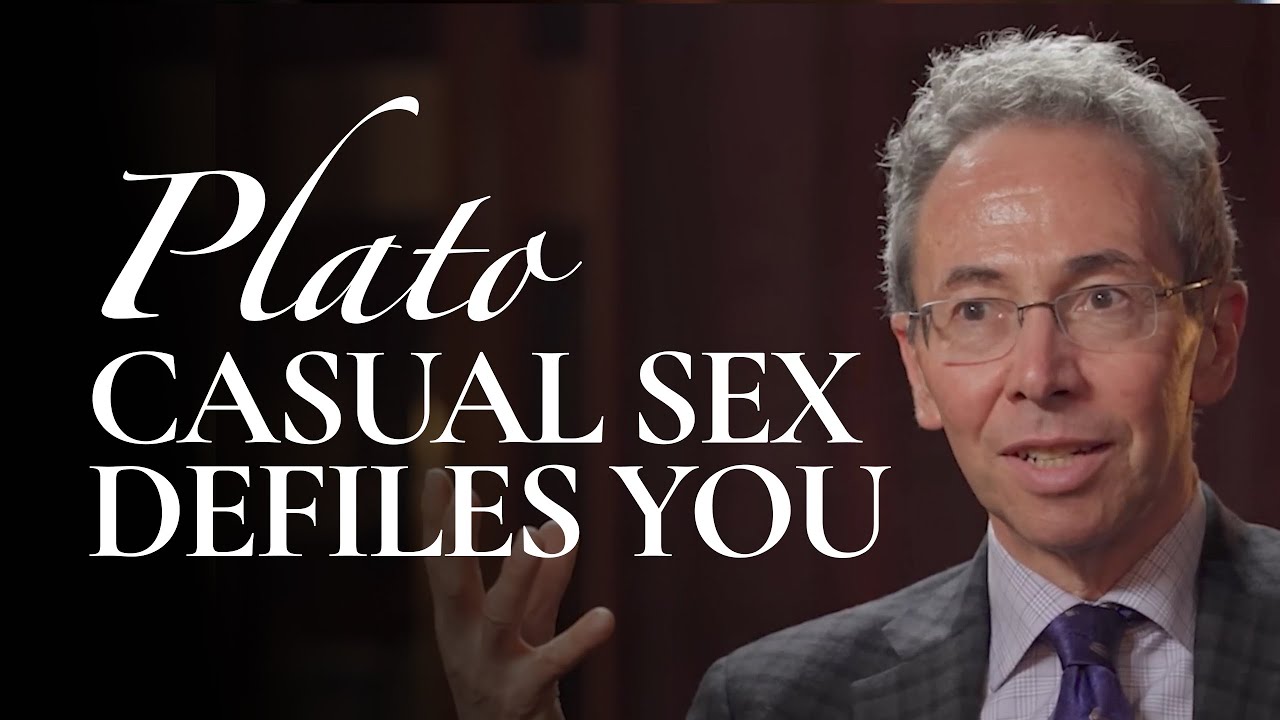
- Plato’s Phaedrus tackles a question that sounds strikingly modern: is it better to have sex with someone who loves you or with someone who doesn’t and therefore won’t get attached? The dialogue stages this as a debate between passionate lovers and “non-lovers” (friends with benefits), and ultimately argues that casual sex is a degraded, transactional exchange structurally akin to prostitution—and that even sex within a loving relationship should be redirected toward philosophy, which Plato presents as a higher, more sacred form of intimacy.
The Case Against Love: Two Speeches
-
Lysias’s speech (the non-lover’s argument): A purely economic case for casual sex—passionate lovers are fickle, jealous, and controlling, whereas a non-lover offers a stable, low-turbulence arrangement with all the benefits and none of the drama. The “payment” is sex for sex rather than sex for money, but the transactional logic is the same, making it a form of prostitution.
- This maps onto modern “friends with benefits” and hookup culture: the idea that you can disentangle sex from love and treat it as just another service, like Uber Eats or TaskRabbit, rather than something embedded in a committed relationship.
- The relationship in question is pederasty—a socially recognized bond in classical Athens between an older man (the lover) and a teenage boy (the beloved), where the boy provides sexual access and the older man provides social patronage and education.
-
Socrates’s first speech (also against love, but morally upgraded): Socrates argues that passionate love is a form of madness in which desire overwhelms reason, leading the lover to dominate, isolate, and stunt the beloved’s development—clipping his wings so he belongs only to the lover.
- This is framed as a moral argument (reason should govern desire) rather than a purely economic one, but it reaches the same conclusion: avoid passionate relationships.
- Crucially, Socrates delivers this speech in the voice of a fictional “non-lover” who is himself secretly in love with the boy—and as he speaks, his suppressed passion breaks through, his language becomes poetic and ecstatic, and he breaks off mid-speech, unable to sustain the charade. This foreshadows his real argument in favor of love.
Socrates’s Case for Love: Divine Madness and the Chariot
-
Divine Madness: Socrates’s positive argument begins by challenging the assumption that all madness is bad. He identifies several culturally recognized forms of beneficial madness—prophetic inspiration, poetic possession by the Muses, and erotic love among them. Divine madness can achieve results that sober rationality cannot.
- Philosophy itself requires a kind of madness: the philosopher, like the lover, neglects worldly affairs, behaves in socially inappropriate ways, and is driven by an overwhelming passion—not for a person, but for truth and the good.
-
The chariot myth: Plato models the soul as a charioteer driving two horses:
- The charioteer = reason, which desires wisdom and truth.
- The white horse = spirit/honor, which cares about social reputation and shame.
- The black horse = appetite, including sexual desire.
- When the charioteer (reason) approaches the beautiful boy, the black horse surges forward with lust. Reason and the white horse can restrain it temporarily through negotiation and appeals to respectability, but this only works so far—you cannot reason your way out of desire.
- The breakthrough comes when reason catches a glimpse of the boy’s beauty and is suddenly overwhelmed by a memory of Beauty itself—a transcendent, divine Form the soul once saw in a disembodied state. This vision is so powerful that the charioteer falls back, dragging both horses to the ground. Reason is “mad” in the sense of being completely overtaken—not by lust, but by awe before something sacred.
- The white horse (honor/social shame) has not seen this vision and cannot help here. Only reason’s direct encounter with the sacred can overpower both horses—not through negotiation but through a kind of holy terror at the prospect of desecrating what is beautiful.
Why the Philosophical Lover Abstains from Sex
-
The true philosophical lover is so overwhelmed by the sacred dimension of the beloved’s beauty that sex would feel like a desecration—a violation of something holy. The energy of the black horse (sexual desire) is not eliminated but is redirected entirely toward philosophical contemplation.
- Sex is “too powerful to be a cherry on top.” Plato’s analogy: heroin, not cheesecake. Once you indulge, the relationship becomes about sex; it cannot remain a stable addition to a higher-purpose partnership.
- The philosophical lovers hold hands and face outward—toward the world, toward the Forms—rather than facing each other in mutual absorption. Their partnership is oriented toward the joint pursuit of wisdom, not physical gratification.
- This is not masochistic punishment of the body (which would be asceticism proper); it is a judgment about the relative power of different pleasures and what the relationship would become if sex were introduced.
-
A retraction: Ferrari originally wrote that philosophical lovers achieve the “fullest realization of the philosophic life,” but he now clarifies: the philosophical lover lives a fuller human life (it’s a blessed contingency to fall in love with a fellow philosopher), but this does not make him a better philosopher. Philosophy as a practice is its own thing; love is a “cherry on the cake” of the human life, not of the philosophical life itself.
The Sacred, Awe, and the Limits of Human Understanding
- Beauty has a dimension of awe that borders on fear—the kind of awe Moses felt before the burning bush. It is not a prudential fear of danger but a sense of being small before something majestic and beyond full comprehension.
- The philosopher confronting Beauty (or the Good) is face to face with his own limits. He will never fully grasp it—he is not a god—but the ambition to understand it is what gives his life meaning. The disturbance is not failure but the appropriate response to something that exceeds you.
Why the Dialogue Turns to Rhetoric and Writing
-
The Phaedrus pivots from love to a critique of rhetoric and writing, which seems like a jarring shift but is actually a return to the dialogue’s starting point: the whole scene is framed as a rhetorical exercise. Lysias’s speech was a display piece by a professional speechwriter advertising his skills; Phaedrus wants to memorize it and show off.
- Plato is doing the same thing rhetorically—praising something unlikely (madness, love) to show how well he can write—but he is doing it honestly, because he genuinely believes in what he’s praising. Other rhetoricians use form without content; Plato masters rhetorical skill in service of truth.
-
Rhetoric vs. pastries: Rhetoric is to the soul what baking is to the body—it can be medicine (genuine care) or mere pastry-making (pleasing without nourishing). The bad rhetorician is like a modern influencer who will sell anything (erectile dysfunction pills, multi-level marketing schemes) regardless of whether it’s good for the audience.
-
The critique of writing: Socrates tells the myth of Thamus, the Egyptian king who rejects writing as a tool that will weaken memory and give people the illusion of wisdom without understanding. Written texts are “dead”—they say the same thing over and over and cannot answer questions. Living discourse between human beings is superior because a teacher can “sew a seed” in another soul that grows and spreads.
- The irony, of course, is that Plato himself wrote all of this down. Ferrari’s resolution: Plato chose to write because he recognized that written texts, done well, can preserve and spread philosophical ideas to a far broader audience than face-to-face conversation ever could. The written text is a material basis for the living word—not a replacement for it.
- The best kind of writing (Plato’s dialogues) conceals the author behind characters, invites interpretation, and provokes the reader to think rather than lecturing at them. It keeps many of the advantages of living discourse.
-
The modern academic as “dead” knowledge: The bad version of the book-writer is the modern academic publishing for tenure—solving puzzles that no one else cares about, treating philosophy as a technical discipline rather than a way of life. Plato was competing with Isocrates, a rival school founder, and wanted to show that he offered something more genuine than mere academic rivalry.
The Philosophical Life as the Good Life
-
Philosophy as constitutive of the good life: The search for the good life is not merely instrumental to achieving it—it is partly constitutive of it. This sounds paradoxical (if you’re searching, you don’t have it yet), but the point is that perfection is unembodiable for humans. The philosophical life—constant examination, reflection, and the pursuit of meaning—is the best a human life can be, precisely because the journey itself is the good.
- This contrasts with Buddhism, where the end state (cessation of suffering) is the good life. For Plato, there is no reachable end state; the embodied soul lives in a world ultimately unworthy of reason, so the ongoing search is itself the good.
-
The danger of the philosophical life: Just as sex can overtake the philosophical relationship, intellectual pleasure can become an end in itself—a form of disguised gluttony or lust of the mind. Phaedrus represents this corruption: he loves the image of intellectual life, runs a salon, gathers smart people to talk, but is attracted to the trappings rather than the substance. It’s vain glory, not genuine philosophy.
-
The cosmic view: The solution is to take a “cosmic view” of the goods that attend the philosophical life—friendship, the thrill of discovery, intellectual pleasure—enjoying them fully but not treating them as ultimate ends. Ferrari equates this with offering one’s life and its contingent goods to God: the friendships, the search, the good you can do have value precisely because they are offered up to something beyond themselves. Without that higher reference point, they lose their meaning and become dangerous distractions.
- This mirrors the structure of the love argument: just as sex is only made safe and good under the light of the sacred (the Form of Beauty), friendship and intellectual pleasure are only safe and good under the light of the divine.