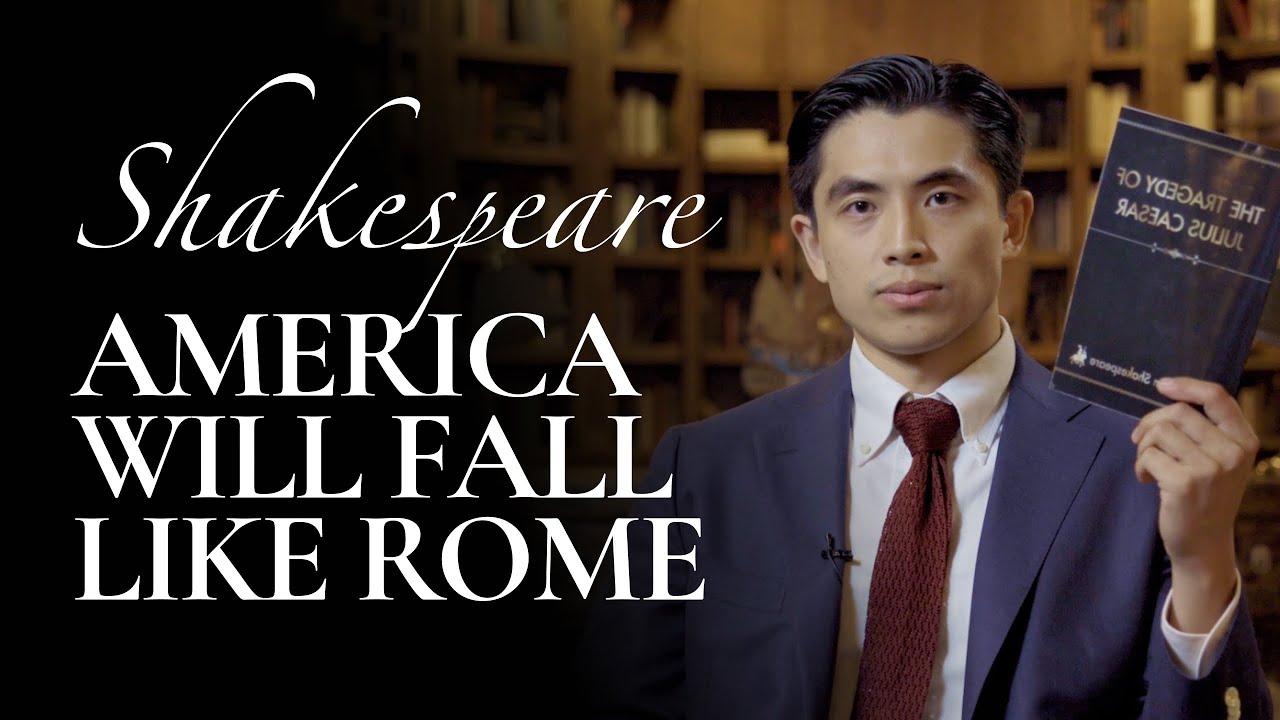
Shakespeare’s Julius Caesar is not merely a historical drama about the fall of the Roman Republic—it is a mirror held up to contemporary America, revealing how theatrical self-narratives, political decay, and the collapse of civic virtue can destroy a republic from within. The play’s central question—can liberty survive when a people lose their taste for freedom?—is as urgent today as it was in Rome, and studying it offers a diagnostic tool for understanding America’s own political trajectory.
Rome and America: A Frightening Parallel
The American Founders explicitly modeled the United States on the Roman Republic—its institutions, checks and balances, love of liberty, and aversion to monarchy. Both nations defined themselves by a founding act of liberation: Rome by Lucius Brutus driving out the tyrant Tarquin, America by casting off the British monarchy.
Shakespeare depicts a Rome in advanced decay: a century of civil wars (Marius, Sulla, Pompey, Caesar) has hollowed out republican institutions and values. Romans no longer think of themselves primarily as citizens but as followers of individual strongmen. The love of liberty has given way to personal allegiances.
A single line from Act One captures this decay with devastating precision: the Roman mob loves Caesar so unconditionally that “if Caesar had stabbed their mothers they would have done no less.” This mirrors modern political tribalism—the idea that a leader could “shoot someone on Fifth Avenue and not lose any voters.”
The problem is not any individual leader but what such loyalty says about the republic itself: its legal institutions lack integrity, its public lacks judgment, and its people are fickle and incapable of deliberation. Rome had already lost the independent, freedom-loving citizenry necessary to sustain a free country.
America today shows similar warning signs: declining patriotism among elites, rising politicization and division, a new generation less motivated by liberty, and a political culture where tribal loyalty overrides institutional legitimacy. The Roman Republic lasted roughly 500 years before its final century of crisis; America is about 250 years old.
Marcus Brutus: The Man Who Played a Role
Brutus is the true protagonist of the play—he has nearly four times as many lines as Caesar, and his decisions drive the plot. Yet he is also the most psychologically complex and ultimately tragic figure, because he cannot articulate good reasons for killing Caesar.
In his Act Two soliloquy, Brutus admits he has “no personal cause” against Caesar. His arguments are entirely hypothetical (“he would be crowned; how that might change his nature”) and abstract analogies (“the bright day brings forth the adder”). He even concedes, “to speak truth of Caesar, I have not known when his affection swayed more than his reason.” Yet he concludes Caesar must die.
In reality, Caesar has already given abundant signs of tyranny: he crossed the Rubicon, declared himself dictator for life, referred to the Senate as “my Senate,” offered himself a crown three times, and governed by arbitrary will rather than reason. Brutus ignores all of this.
The mystery deepens: Brutus is the person in Rome with the most reason to love Caesar (a paternal figure who pardoned him after he fought against him in the civil war and immediately promoted him to high office) and the most reason to hate him (as the descendant of Lucius Brutus, Rome’s tyrant-slaying founder). He is caught between personal gratitude and ancestral duty.
Cassius, motivated largely by envy, manipulates Brutus by writing fake letters from “the Roman people” urging him to act. These letters give Brutus a narrative to inhabit—the heroic liberator commissioned by the public will. Brutus is not so much convinced by argument as seduced by a role to play.
This theatrical self-conception leads to two disastrous decisions:
Excluding Cicero: Brutus vetoes including the wise, respected Cicero because “he will never follow anything that other men begin.” Shakespeare invented this reason—Plutarch’s historical account says Cicero was excluded due to timidity and age. The real issue is that Brutus cannot bear not being the leader. He needs the conspiracy to be his story.
Sparing Mark Antony: The conspirators want to kill Caesar’s dangerous right-hand man, but Brutus refuses, insisting they be “sacrificers, not butchers”—theatrical and clean rather than bloody and effective. He cares more about how the act appears than about whether it succeeds. Again, Shakespeare altered Plutarch’s more pragmatic reasons to emphasize Brutus’s obsession with appearances.
Brutus’s imitation of Lucius Brutus is superficial: he focuses on the title “king” rather than the substance of liberty, and he cannot imagine solutions (like making Caesar a constitutional monarch) that his ancestor never employed. His rigid role-playing blinds him to the diverse forms tyranny can take.
After the assassination, while Caesar’s body is still warm, Brutus and Cassius daydream about how “this our lofty scene” will be “acted over in states unborn”—they are already imagining the plays that will be written about them rather than securing the city.
Brutus fails because he is too caught up in playing Lucius Brutus to actually be a liberator. His vanity constrains his political flexibility, misaligns his priorities, and dulls his ability to read reality.
Julius Caesar: The Man Who Played Himself
Caesar, like Brutus, is trapped in a self-constructed narrative—but his is a narrative of superhuman constancy. He aspires not merely to be a king but something closer to a god: self-sufficient, unchanging, the fixed point around which everything revolves.
This self-conception causes him to ignore overwhelming evidence that assassination is imminent. The omens are historically attested and dramatic: dead rising from graves, lionesses whelping in streets, fiery warriors fighting in clouds, ghosts in the streets, a sacrificial animal found without a heart, and his wife Calpurnia’s vivid dream of his murder.
Caesar’s interpretation of the omens reveals his grandiosity. When told the sacrificial beast had no heart, he declares: “Caesar should be a beast without a heart if he should stay at home today for fear… Caesar is more dangerous than danger itself.” This is self-parody—the same overconfidence as Chuck Norris memes.
Calpurnia initially fails to persuade him to stay home, but then cleverly reframes her plea: “Call it my fear that keeps you in the house, and not your own.” By disentangling his absence from his self-image, she succeeds—Caesar agrees not to go.
The conspirator Decius Brutus then arrives and flatters Caesar by reinterpreting Calpurnia’s dream: the statue spouting blood does not mean Caesar’s death but that “from you great Rome shall suck reviving blood.” Caesar, craving this flattering narrative, changes his mind and goes to the Senate. Decius explicitly describes his method: “Flattery is to man what a net is to a lion”—the way to trap a beast of a man is through his self-conception.
Caesar’s ego is his fatal weakness. He dismisses a warning note about the assassination because “what touches us ourself shall be last served”—he must perform his own power by appearing unconcerned with his own safety. He refers to himself in the third person twice in one line, a tic that underscores his theatrical self-regard.
At the moment of assassination, Caesar delivers his most grandiose speech: he is “constant as the Northern Star,” more fixed than Jupiter, Venus, or Pluto. He is stabbed to death mid-declaration. His final words—“Et tu, Brute? Then fall, Caesar”—are spoken in the third person: he narrates his own death as if observing a character on stage.
Shakespeare repeatedly juxtaposes Caesar’s declared constancy with his obvious mortality: he almost drowns swimming in the Tiber, suffers seizures in Spain, and dies at the base of his rival Pompey’s statue. The contrast between his self-image and his fragility is the play’s central irony.
Yet this same overconfidence is also the source of Caesar’s extraordinary success:
As a young man captured by pirates, he bossed them around, demanded a higher ransom, and after release raised a fleet and crucified them.
At the Battle of Alesia, heavily outnumbered by Vercingetorix, he built a double ring of fortifications (a “donut fort”) to trap the enemy inside while defending against reinforcements—a feat of impossible audacity.
His calendar reform (creating the 355-day Julian calendar) required overcoming enormous political, cultural, and religious inertia, but he did it because he had the courage to defy convention.
The same trait that made Caesar extraordinary also made him unable to heed warnings. When your entire life has been a series of impossible feats achieved against all advice, ignoring a few omens seems trivial.
There is a deeper reading: Caesar the man is fragile and mortal, but Caesar the spirit—the ideal he erected—is genuinely constant. The word “Caesar” became a noun, a category of ruler (Kaiser, Tsar). The play is named after him despite his limited stage time. Two thousand years later, he still captivates attention.
Some scholars argue Caesar actively wanted to die—that he goaded the assassination to become a martyr and immortalize “Caesarism” through his adopted son Augustus. Whether or not this is true, the assassination did achieve this: by killing Caesar the man, the conspirators immortalized Caesar the spirit and brought about the very empire they sought to prevent.
Brutus himself articulates this irony before the killing: “We all stand up against the spirit of Caesar… Oh that we then could come by Caesar’s spirit and not dismember Caesar.” But by killing the man, he empowers the spirit. The conspirators’ post-assassination ritual—bathing their hands in Caesar’s blood and crying “Peace, freedom, and liberty”—is the exact fulfillment of Decius’s flattering dream interpretation, and it brings not liberty but civil war and empire.
The three founding fathers of Western civilization—Socrates, Caesar, and Christ—were all martyrs. Spectacular death is almost a necessity for that order of cultural influence.
Mark Antony: The Best Actor Is the One Who Knows He’s Acting
Antony is the play’s most effective political operator precisely because he is the only major character not trapped in a grandiose self-narrative. He is a soldier who likes women, drinking, and killing—a brute, not an ideologue. But this freedom from self-deception makes him the ultimate actor.
He gives two masterful performances: first, convincing the conspirators he is harmless after Caesar’s death; second, turning the hostile crowd against the conspirators in his funeral oration—all while maintaining plausible deniability.
Brutus’s funeral speech is abstract, philosophical, and boring: “As Caesar loved me, I weep for him; as he was fortunate, I rejoice at it; as he was valiant, I honor him; but as he was ambitious, I slew him.” The mob loves it only because they are fickle and Brutus is Brutus.
Antony’s speech is a masterpiece of rhetorical manipulation under constraint (he is forbidden from speaking ill of the conspirators):
Plausible deniability: He repeatedly calls Brutus “an honorable man” so many times that the word becomes an insult, yet he can always claim he meant it sincerely.
Emotional appeal: He feigns being too overcome with grief to continue, forcing the crowd to urge him on. He asks, “Why aren’t you mourning?”—shaming them into emotion.
The will: He mentions Caesar’s will, then pretends he shouldn’t read it. The crowd begs him to. He resists, then “relents”—giving the illusion that the crowd is acting on its own agency.
Visual theater: He displays Caesar’s blood-stained cloak, pointing to each stab hole and naming the conspirator who made it. He lies about being present at these moments and fabricates Caesar’s emotional reaction to Brutus’s betrayal—“the most unkindest cut of all.”
Inversion of values: Where Brutus addresses the crowd as “Romans, countrymen, friends” (abstract citizenship first), Antony says “Friends, Romans, countrymen” (personal bonds first). In the late Republic, allegiance to individuals matters more than abstract civic ideals.
Final manipulation: He claims he is “no orator as Brutus is”—a plain, blunt man—then says that if Antony were in Brutus’s place, he would “put a tongue in every wound of Caesar that should move the stones of Rome to rise and mutiny.” He tells the crowd not to mutiny while making mutiny irresistible.
Antony is a pathological liar and ruthless realpolitik operator. In Act Four, he calls his ally Lepidus a “load-bearing ass,” trades away family members’ lives, and rolls back promises made in his speech. He is the cynical face of populism: the dictator who champions the people not out of conviction but as a tool to destroy the old order.
The pattern is recurring in history: tyrants (Caesar, Napoleon, Stalin) who champion the cause of the disenfranchised against the elite, then discard the people once in power. What appear to be grassroots movements are often pawns in elite conflict—the top and bottom attacking the middle.
Antony wins because he has no fixed self-image to protect. Brutus and Caesar are doomed by their commitment to their roles; Antony’s freedom from self-deception gives him total political flexibility.
The Fall of Brutus: Becoming What He Hated
After being chased from Rome, Brutus raises an army against Antony and Octavian. Under pressure, his true motivations surface—and they are increasingly Caesarian.
He begins speaking of himself in the third person (“Marcus Brutus grew so covetous”), emphasizing his own constancy (“I am armed so strong in honesty”), and claiming his authority is self-justifying (“were you Antony the son of Caesar, you should be satisfied”).
Caesar’s ghost appears to Brutus and declares: “Thy evil spirit, Brutus”—symbolizing that Brutus has adopted the very Caesarism he sought to destroy.
Shakespeare makes Brutus and Caesar mirror each other in death: Caesar’s last words are “Et tu, Brute?”; Brutus’s last words are “Caesar, now be still; I killed not thee with half so good a will.” They have become twins.
Brutus’s motivations were always more Caesarian than he admitted. The pressure did not change him—it revealed him.
Will America Fall Like Rome?
The play does not give an answer but offers a method: diagnose a republic’s health by observing the revealed values, habits, and preferences of its people—not what they say, but what they actually do and care about.
Cassius’s famous speech—“The fault, dear Brutus, is not in our stars, but in ourselves”—is meant to assert human agency against fatalistic astrology. But the very need to say it reveals how far Roman values have already decayed.
In the healthy early Romans practiced augury (reading the will of the gods through birds), which concerned the fate of the entire polis. Astrology and horoscopes—individualistic, concerned with personal fate—arose precisely in the late Republican period alongside the strongmen who cared more about themselves than the republic. The shift in divination methods itself signaled decline.
The same pattern is visible today: the rise of astrology and horoscopes in contemporary America reflects an exaggerated individualism, self-obsession, and declining concern for the common good. Even for those who don’t believe in astrology, its popularity is a bad omen—a revealed preference that is incompatible with republican virtue.
If republican values no longer animate a people, the lesson is not to indulge in doomed imitation of the past (like Brutus) or to deny reality (like Cassius), but to look to the future with an open mind. Sometimes men are masters of their fates; sometimes they are slaves of history. Sometimes the fault really is in our stars.
The Positive Ideal: Relational Commitment
None of the play’s major characters offer a positive vision, but their failures point toward one. All three lack healthy relationships: Brutus deceives his friend Cassius and is alienated from his wife; Caesar’s marriage is transactional and his friends kill him; Antony treats allies and family with contempt.
The positive lesson is to aspire to ideals that are inherently relational and social—ideals that respond to the changing needs of others rather than fixed, unchangeable self-images. The play shows people managing spouses but not loving them, claiming constancy but refusing to heed advice, and playing the heroic liberator but refusing to adapt strategy to circumstances. A healthy republic requires citizens and leaders who can hold ideals while remaining genuinely open to others.