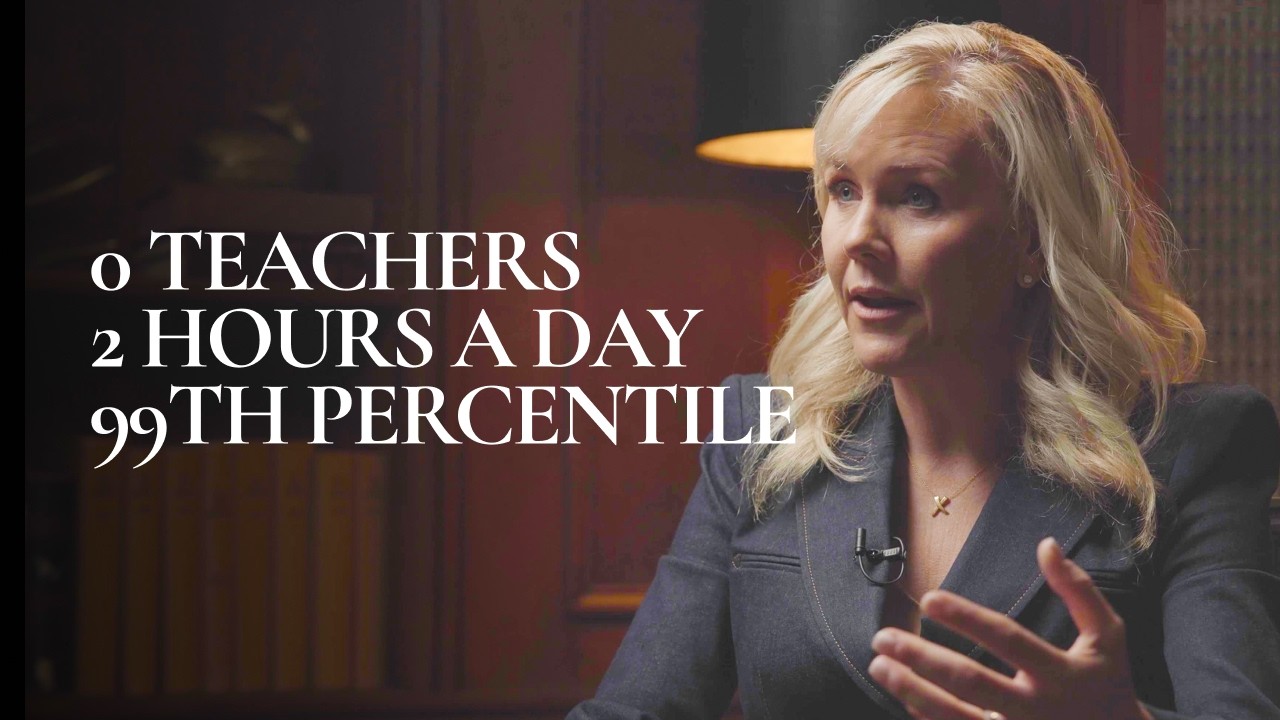
Alpha School is a K–12 school that replaces all academic teaching with AI tutors, enabling students to master core subjects in just 2–3 hours per day while consistently scoring in the 99th percentile on standardized tests. Co-founded by McKinsey Price, Alpha combines the personalized, mastery-based tutoring model of ancient Greek education (Socrates → Plato → Aristotle) with modern AI to make elite-level learning scalable and accessible.
The Problem with Modern Education
The current U.S. education system traces back to the Prussian model of the 1800s, designed not to cultivate free thinkers but to produce compliant factory workers during the Industrial Revolution.
Horace Mann imported this time-based, teacher-led classroom model to democratize education—but it retained authoritarian goals.
Figures like Rockefeller supported mass education explicitly to train obedient laborers.
Today’s system remains nearly identical: students sit in rows, follow rigid schedules, and progress by age rather than mastery.
Result: U.S. ranks 28th globally in math; one-third of students read below grade level—the worst performance since the 1990s.
Learning loss during COVID exposed how fragile foundational knowledge is when students miss key concepts early.
How Alpha’s AI System Works
Every student uses a personalized AI learning platform that:
Diagnoses exactly what a child knows and doesn’t know.
Delivers lessons at the right level, pace, and style for mastery.
It’s not a chatbot or generative AI teacher—it uses structured, pre-built curricula (Common Core K–8, AP in high school) with adaptive delivery.
No open-ended chat interface, which research shows students use to cheat.
Instead, it’s an analytical engine that tracks progress, adjusts difficulty, and ensures retention.
Generative AI customizes content to student interests:
A reluctant reader might get a story starring him and his soccer friends in an Avengers-style adventure.
A fashion-loving student learns math through design projects.
One daughter memorized AP History by singing AI-generated Taylor Swift–style songs about historical canons.
Mastery Over Time: Fixing the “Jenga Tower”
Traditional education assumes all students learn at the same pace—if you miss a concept, you fall behind permanently.
This creates a “Jenga tower” of knowledge: weak foundations collapse under advanced material.
Alpha uses mastery-based progression: students only advance when they’ve fully grasped a topic.
The system identifies and repairs gaps before moving forward.
Combined with spaced repetition and frequent quizzing, this ensures long-term retention.
Transforming Student Identity and Self-View
In traditional schools, struggle becomes identity: “I’m not a math person,” “I’m dumb.”
Alpha flips this: confidence comes from competence, not empty affirmations.
Students see daily proof that effort leads to results.
Example: A student who earns 99th percentile in science gains confidence to tackle harder subjects.
The school teaches that virtues like grit, agency, and resilience can be cultivated through the right environment.
Teachers (called “guides”) are trained to build ownership, handle failure, and set ambitious goals.
Students internalize: “If I put in the work, I can master anything.”
Motivation: The 90% Solution
Alpha believes motivation—not content delivery—is 90% of education.
Extrinsic motivators kickstart engagement:
Pre-K students earn school currency (exchangeable for toys or privileges).
Weekly goals unlock group rewards (e.g., trips to Six Flags).
One guide motivated a bird-obsessed student by tying academic goals to birdwatching time.
Intrinsic motivation emerges through success and autonomy:
As students see results, they begin to enjoy learning itself.
The school gives students ownership of their community via town halls (starting in 2nd grade).
Students set their own academic targets—and consistently raise them beyond adult expectations.
Social status and respect are powerful levers:
Public checklists show progress (not for shaming, but for inspiration).
High schoolers pursue “Alpha X” projects—ambitious, world-class endeavors (e.g., pitching to VCs, building apps with millions of users).
Even gaming can be leveraged: unmotivated students earned Fortnite time at school by hitting academic goals—some advanced multiple grade levels in months.
Teachers Replaced by AI for Teaching—But Not for Mentoring
AI handles all academic instruction: no teacher explains long division or grammar rules.
Human guides focus exclusively on emotional and motivational support:
They learn each student’s passions, fears, and learning style.
They coach growth mindset, resourcefulness, and perseverance.
This model frees teachers to do what only humans can: inspire, connect, and mentor.
Life Skills Replace Wasted Time
With academics done in 2–3 hours, afternoons focus on real-world skills:
Leadership, teamwork, public speaking, financial literacy, entrepreneurship.
Workshops include sailing expeditions (with pirate-themed challenges and water-gun attacks), managing Airbnb rentals, or running food trucks.
These aren’t “fun extras”—they’re rigorous, goal-driven experiences that teach adaptability and resilience.
Scalability and Equity
Alpha’s current schools are private ($40K–$75K tuition), serving a self-selected group.
But the AI platform is infinitely scalable:
Pilots in Malawi use Starlink and iPads to deliver personalized learning to refugee students.
Motivation can be low-cost: snacks, sports time, or social gaming.
The real bottleneck is human mentorship, not technology.
In traditional schools, teachers spend just 22 seconds per day one-on-one with each student.
Alpha’s model makes deep personal connection possible—even in under-resourced settings.
Preparing for the AI Age
Critics say AI makes memorization obsolete—but Alpha argues knowledge is the foundation of critical thinking.
You can’t think critically about physics if you don’t know basic math.
The goal is to “arm the brain” with facts so students can focus on higher-order skills: creativity, collaboration, communication.
Even elite universities are adopting AI tutors: Harvard students learned physics better from an AI than from a professor.
Philosophical Implications
Alpha challenges the idea that virtue can’t be taught—it shows that with the right system, traits like agency, courage, and grit can be systematically developed.
It rejects both pure nature (IQ determinism) and blank-slate tabula rasa:
IQ affects learning speed, but mastery-based systems ensure all students reach high levels.
Environment and support matter profoundly—but so does structured opportunity.
The school offers a third path between East Asian grind culture and Western “you’re amazing” self-esteem:
Hard work + personalized support + real achievement = authentic confidence.
Final Vision
Alpha aims to democratize the Plato-Aristotle model: one-on-one, mastery-based, passion-driven education for every child.
In five years, McKinsey believes every student worldwide could access personalized AI tutors via tablet.
The future of education isn’t more school—it’s better school: shorter, deeper, and designed around how humans actually learn and thrive.