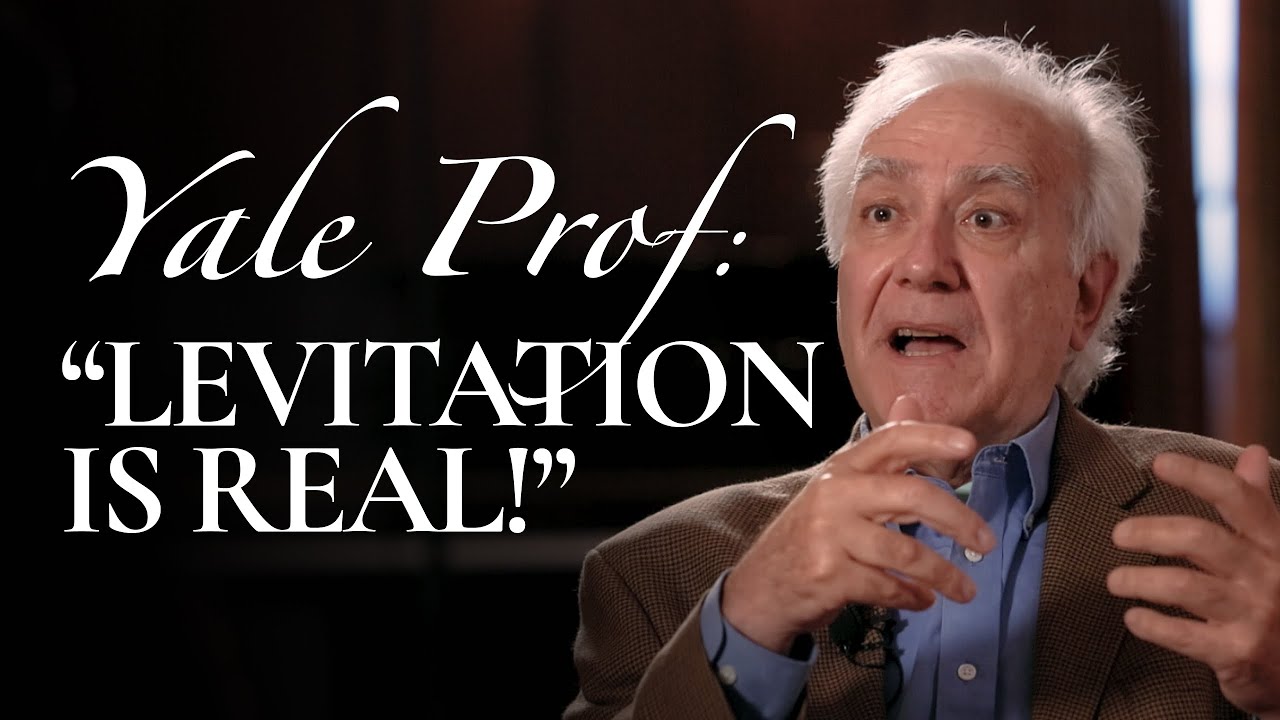
- This is a conversation between host Shamil and Yale historian Carlos Eire about Eire’s book They Flew, which investigates the historical evidence for human levitation and other miracles across religious traditions. Eire argues that the sheer volume and consistency of eyewitness testimony—especially from rigorous Catholic canonization inquests—makes levitation one of the hardest miracle claims to dismiss as mere fraud or delusion. The discussion ranges from specific case studies to broader questions about the relationship between miracles, science, technology, and religious epistemology.
The Case for Levitation
-
Joseph of Cupertino is the single most compelling case for levitation in the Christian tradition.
- He reportedly flew to the ceilings of large churches, moved horizontally outdoors, and once carried a heavy cross into its hole by flying—depicted in multiple paintings.
- One well-attested event involved him lifting a lamb into a tree while in ecstasy, requiring a ladder to come down; another involved levitating while healing a mentally ill young man, both rising together.
- Eyewitnesses included workmen, nobles, dukes, and viceroys—one royal retinue fainted after witnessing him fly 12 feet above their heads inside a basilica.
- The evidence comes from canonization inquest testimony (witnesses under oath, cross-examined), later cited extensively in hagiographies, and compiled by a modern scholar who dedicated his life to researching the original inquest documents in Rome.
- Joseph was eventually kept in solitary confinement because the demand from powerful visitors became unmanageable—mirroring Jesus’s need to flee crowds in the Gospels.
-
Teresa of Ávila is another major case, with published inquest records spanning three volumes.
- She did not want to levitate; she described it as a “mighty force” pushing her up, and resisting it caused her body pain for days.
- She asked her nuns to hold her down or pull her back, but they could not—this detail is independently corroborated by a nearly identical account from 1693 Boston, where Puritan minister Cotton Mather and other men tried to physically restrain a possessed girl from rising off a bed and signed affidavits describing the same phenomenon.
- The Puritans almost certainly had never read Teresa’s inquest (still unpublished in manuscript in 1693), making independent fabrication of the same specific detail highly improbable.
-
The argument for taking the evidence seriously rests on several factors:
- Levitation is difficult to confuse with other phenomena (unlike visions or stigmata, which have psychological explanations).
- The most credible accounts involve large vertical and horizontal distances, outdoors or in large spaces where rigging equipment was impossible.
- Canonization inquests involved sworn testimony, cross-examination, and an official “Devil’s Advocate” whose job was to probe for fraud.
- When fraud did exist, whistleblowers emerged—as in the case of Magdalena de la Cruz, undone by jealous fellow nuns.
- The alternative explanation—that hundreds of witnesses across centuries and cultures all independently lied in consistent detail—is itself statistically and psychologically implausible.
A Personal Encounter with a Miracle
- While researching the book, Shamil visited an Orthodox church in Taylor, Pennsylvania, to see a carved wooden icon of the Virgin Mary that exudes oil.
- The priest removed the icon from its case and walked around the room, dripping oil onto congregants’ hands for about 10 minutes—not a slow trickle but a steady drip.
- Shamil’s initial suspicion of fraud gave way to the conclusion that faking this for decades would require nearly the entire clergy to collude with no whistleblowers—a psychological violation greater than accepting a miracle.
- The icon reportedly changes its flow in response to the Christian calendar (drying before Easter, accelerating on Easter) and even geopolitical events (increased flow at the start of the Ukraine war).
- Eire notes that weeping icons, oil-exuding saints’ corpses, and bleeding Eucharistic hosts are well-documented phenomena across centuries, though not all have been subjected to rigorous scientific testing.
The Catholic Church’s War on Fraud
- The Catholic Church has historically been as aggressive in rooting out false miracles as any secular skeptic.
- Beginning in the 16th century, the canonization process was formalized with standardized questionnaires, sworn testimony, and the role of the “Devil’s Advocate” (officially the Promoter of the Faith).
- Witnesses swore oaths under penalty of eternal punishment (hell or purgatory), and the questions were open-ended (“tell us what you saw”) rather than leading.
- Teresa of Ávila herself was repeatedly denounced to the Spanish Inquisition as a heretic and fraud before her beatification silenced the accusations.
- In the 18th century, Prospero Lambertini—a former Devil’s Advocate who became Pope Benedict XIV—wrote the definitive manual still used in canonizations today, emphasizing heroic virtue over miracles as the primary criterion for sainthood.
- Modern canonizations focus on postmortem healing miracles because they can be investigated by skeptical doctors and scientists; the Church actively seeks atheist physicians to evaluate claims.
- One documented case involved a girl born without ear nerves who spontaneously developed them after prayers to Elizabeth Drexel—testimony from doctors called it medically impossible.
- Saints’ bodies are periodically exhumed and tested; Teresa of Ávila’s corpse has been dug up multiple times (most recently weeks before this interview) and remains incorrupt, with oil that once flowed copiously and performed healings.
The Devil and Demonic “Miracles”
- In early modern Christian thought, proving a miracle was not human fraud was only half the battle—it also had to be distinguished from demonic activity.
- The devil was understood to have “preternatural” powers: not the ability to transcend nature (only God can do that), but an ancient, scientist-like knowledge of how to manipulate natural laws.
- The devil’s signature strategy was disguise—appearing as Christ or a saint to deceive the faithful.
- Teresa of Ávila was told by confessors that her visions of Christ were demonic; one instructed her to give the vision “the fig” (the equivalent of the middle finger) next time. She did, and the figure responded, “Thank you for obeying your confessor, but tell him I am not the devil.”
- Martin Luther believed a black dog that appeared in his room was the devil; he threw it out the window and found no body below.
- Protestants generally held that all post-apostolic miracles were either frauds or demonic, since miracles had ceased with the apostles.
- Ironically, extreme belief in the devil’s power to deceive helped end the witch hunts: if the devil could make false witnesses believe they saw witchcraft, then no accusation could be trusted.
- The test for whether a miracle was divine rather than demonic was the saint’s character—heroic virtue, humility, and obedience. A proud or morally compromised miracle-worker’s wonders were suspect.
Miracles Across Cultures and Traditions
- Levitation is not exclusively Christian; it is attested across Buddhist, Hindu, Sufi, Jewish, and other mystical traditions.
- Shamil’s Buddhist teachers and masters gave him direct testimony of witnessing levitation.
- In Buddhist accounts, levitation appears more voluntary and controlled—closer to a cultivated skill—whereas Christian levitation is described as an involuntary gift or ecstatic state.
- This reflects different metaphysical frameworks: Christianity posits a sharp nature/supernature distinction where only God can override natural law; Buddhism treats such phenomena as natural but hidden, accessible through advanced practice and karmic understanding.
- Eire notes that mystics in all traditions seem to operate within “specific horizons”—their experiences are shaped by their religious framework, even when the phenomena described are similar.
- Shamil’s hope that miracles could arbitrate between Christianity and Buddhism was complicated when he discovered that both traditions have equally compelling miracle claims, leaving him in a state of “equipollence” within the miraculous realm itself.
Miracles, Technology, and the Age of Reason
- The peak period of levitation claims (16th–17th centuries) coincides exactly with the birth of modern empirical science and the Age of Reason.
- The first hot air balloon flight occurred around the time Joseph of Cupertino was being canonized—both produced the same awe in observers.
- Eire argues this is not a contradiction: the same epistemological upheaval that produced science also intensified religious phenomena, as both were responses to a world in which old certainties were being redrawn.
- Figures like Blaise Pascal—a brilliant scientist and mathematician—were also mystics who believed in miracles; Pascal and Descartes despised each other, illustrating how reason and wonder coexisted uneasily.
- Modern technology increasingly mirrors what was once called miraculous: magnetic levitation trains, sonic levitation of small objects, AI systems that respond to natural language as if inhabited by an invisible intelligence.
- Eire suggests that the gap between “natural” technological levitation and “supernatural” human levitation may be smaller than materialists assume—both may point to dimensions of reality science has not yet mapped.
- The James Webb Space Telescope is producing images that panic astronomers because they do not fit current cosmological models—another reminder that paradigm shifts are ongoing and reality is stranger than expected.
The Purpose of Miracles
- Within Christianity, miracles like levitation serve no didactic or practical purpose—they are signs pointing to another dimension of reality.
- Bilocation (being in two places at once) at least serves a functional purpose; levitation is “all show”—a manifestation of a power beyond human comprehension.
- The Christian answer to “why doesn’t God reveal himself more unambiguously” is the potter-and-clay argument from the Book of Job: humans are not in a position to question the creator.
- Pascal’s theology holds that God is deliberately hidden because overwhelming evidence would eliminate the need for faith.
- Religious experience, as William James argued, is incommunicable—it cannot be transferred to another person, only witnessed firsthand.
- All major mystical traditions train practitioners (through prayer, fasting, meditation, asceticism) to have transcending experiences, suggesting a universal human capacity for contact with something beyond ordinary reality.
Final Reflection
- Eire closes by noting that investigating the impossible yields more questions than answers, but none of these questions are trivial—even if modern secular culture aggressively treats them as such.
- Shamil’s journey through the book and his own encounter with the weeping icon left him in a state of productive uncertainty, his worldview shaken but enriched, unable to dismiss the miraculous and unable to fully systematize it within any single tradition.