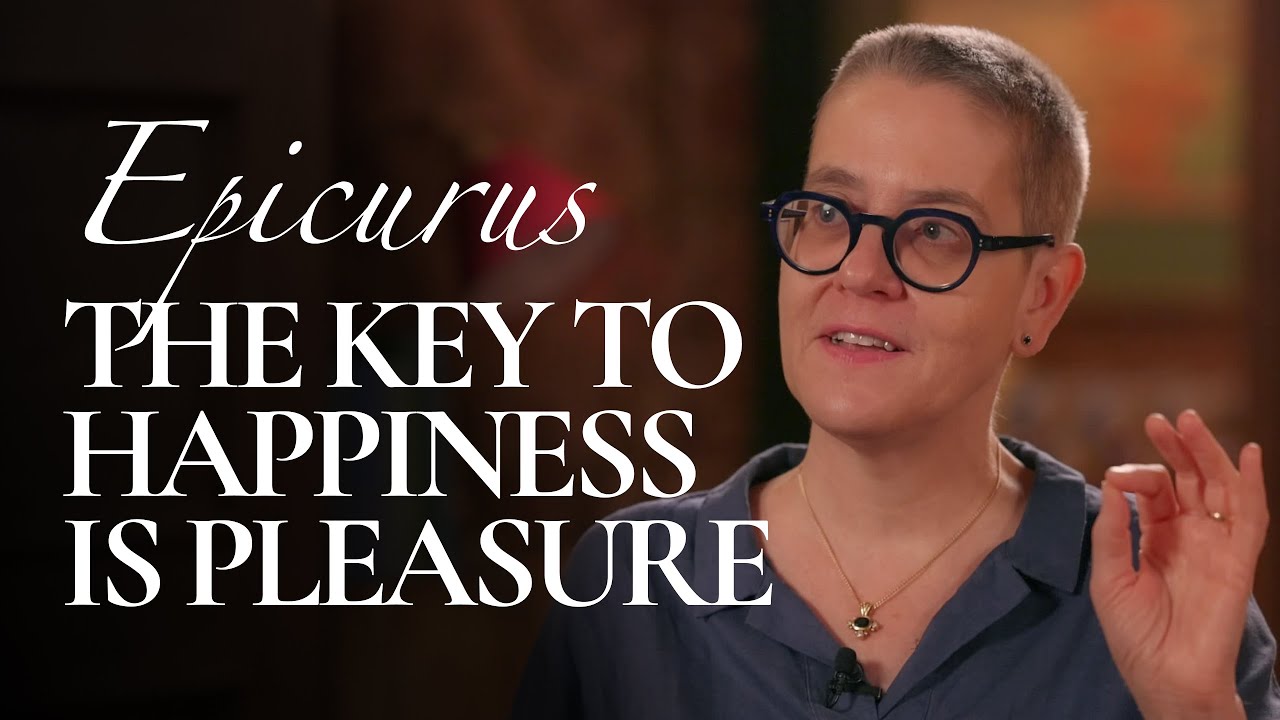
Epicureanism is a Hellenistic philosophy founded by Epicurus in the late 4th century BCE, centered on the idea that the highest good (summum bonum) is pleasure—but understood not as indulgence, but as the absence of physical pain and mental disturbance (ataraxia). It promotes a minimalist, self-sufficient life: avoid political ambition, marriage, and excessive desires; instead, cultivate friendship, live simply, and withdraw from public affairs. Despite this core doctrine of political withdrawal, a surprising number of Rome’s political elite in the late Republic—including figures connected to Caesar, Brutus, and Cassius—were Epicureans. This episode, featuring classicist Katharina Volk of Columbia University, explores how and why a philosophy of retreat became popular among those deeply entangled in Roman political life, and what this tension reveals about both Epicureanism and the nature of political engagement.
Core Doctrines of Epicureanism
The highest good is pleasure, defined primarily as the absence of pain (aponia) and freedom from mental disturbance (ataraxia), not sensory indulgence.
Ordinary pleasures—food, drink, sex, beautiful sights and sounds—are acceptable but secondary; the goal is a stable, tranquil state.
The philosophy emphasizes self-sufficiency: you do not need luxury, power, or status to be happy; desiring them leads to frustration and pain.
Epicureans are counseled to withdraw from political life, which is seen as dangerous, exhausting, and a source of mental disturbance.
They also avoid marriage and children, preferring small communities of like-minded friends living quietly, often in rural settings.
Friendship is highly valued but philosophically problematic: Epicurus treats it as instrumental to pleasure (for security and emotional support), not an intrinsic good—raising questions about whether true friendship can be purely instrumental.
The gods exist but do not intervene in human affairs, so religious rituals are socially acceptable but theologically empty for Epicureans.
The Social and Political Tension
Epicureanism contains an inherent contradiction: it depends on a stable, well-ordered society but offers no civic duty to maintain one—making Epicureans appear as “freeloaders” who benefit from public order without contributing to it.
Cicero and others criticized this stance; Cato sarcastically noted that Epicureans have an “emergency clause”—claiming they will step up in a crisis—but lack the experience or inclination to do so effectively.
Despite this, Epicureanism was one of the most popular philosophies among Rome’s upper classes in the late Republic, especially among the equestrian class (wealthy non-senators) and some senators.
Its appeal may have stemmed from political disaffection: many elites were disillusioned with the corruption and violence of late Republican politics and found comfort in a philosophy that validated withdrawal.
Atticus: The Quiet Power Behind the Scenes
Atticus (Titus Pomponius Atticus), a close friend of Cicero, was a wealthy equestrian, businessman, and committed Epicurean who lived in Athens for a time (hence his nickname).
He refused to enter politics but remained deeply connected to powerful figures on all sides—supporting both Brutus (Caesar’s assassin) and Mark Antony financially and personally.
His strategy of neutrality and behind-the-scenes support allowed him to survive the civil wars and proscriptions that killed many of his contemporaries.
Atticus exemplifies a model of influence without office—a precursor to later imperial courtiers like Maecenas, who wielded power as advisors and financiers rather than elected officials.
This raises the question: is such indirect influence a form of political engagement, or a clever evasion of its risks?
Politically Active Epicureans: Contradiction or Adaptation?
Some members of the senatorial elite were openly Epicureans yet actively engaged in politics—most notably Lucius Calpurnius Piso Caesoninus (Caesar’s father-in-law) and possibly Gaius Cassius Longinus (one of Caesar’s assassins).
This seems to contradict Epicurus’s explicit advice to “live a hidden life” and avoid public office.
Several explanations are possible:
Selective adoption: They embraced parts of Epicureanism (e.g., tranquility, skepticism of glory) while ignoring its political quietism.
Philosophical evolution: Later Epicureans, especially those with Roman patrons, may have developed a more lenient interpretation allowing political engagement under certain conditions.
The emergency clause: In times of crisis (e.g., civil war), Epicureans could justify action as necessary to restore the stability required for their own tranquility.
Virtue as instrumental to pleasure: Cassius argued in a letter to Cicero that virtuous action (like promoting peace) is inseparable from pleasure—so a politician who fosters stability is acting consistently with Epicureanism.
Cicero mocked this reasoning, claiming that if someone does the right thing for its own sake, they are not a true Epicurean—since Epicureans only pursue virtue as a means to pleasure.
Caesar and the Epicurean Attitude Toward Death
Julius Caesar reportedly said he had “lived enough for both nature and glory”—a statement interpreted by some as reflecting an Epicurean attitude.
Epicureans hold that death is nothing to fear (since it is the end of sensation) and that one should recognize when life has offered sufficient satisfaction—like a guest leaving a party while still enjoying it.
Lucretius, the Epicurean poet, personifies Nature telling an aging man: “You have had your share; now depart.”
This mindset may have enabled Caesar to take great personal risks, unburdened by excessive fear of death.
However, Caesar’s pursuit of glory is fundamentally un-Epicurean; the philosophy explicitly warns against ambition and the desire for fame.
Piso’s Rejected Triumph: A Test Case
Piso was awarded a Triumph—a supreme military honor involving a grand parade through Rome—but refused it, a highly unusual act.
Cicero, his political opponent, attacked him viciously: “You never wanted a Triumph? You criminal! You plague!”—implying that rejecting such an honor showed a lack of proper Roman ambition and respect for tradition.
This reveals a deep cultural clash: in Rome, not desiring glory was itself suspicious. Even if ambition was morally questionable, its absence suggested alienation from Roman values.
Piso’s moderation—avoiding excessive honors, seeking peace during civil strife—may reflect an Epicurean approach to politics: fulfill duties quietly, avoid unnecessary exposure to envy or danger.
His case shows how Epicurean behavior could be misread as apathy or subversion in a culture that equated virtue with public service and glory.
The Roman View of Glory and Political Motivation
Roman political culture expected elite men to pursue honor (gloria) and public service as natural and noble goals.
However, there was tension: excessive personal ambition (like Caesar’s) was criticized as tyrannical, while no ambition at all (like Piso’s) was seen as deviant.
Philosophers like Cicero attempted to redefine glory: true glory comes only from virtuous actions that serve the res publica (the commonwealth), not self-aggrandizement.
Similarly, true friendship must align with the public good; aiding someone against the state negates the friendship.
These philosophical refinements allowed thinkers to critique figures like Caesar while upholding traditional values—but they also exposed the difficulty of reconciling personal ethics with political reality.
Epicureanism’s Legacy and Modern Resonance
Epicureanism declined as Christianity rose, due to its atomism, denial of divine providence, and rejection of an afterlife.
It experienced revivals: in the early modern period (e.g., Gassendi), the Enlightenment (as a foundation for secular ethics), and in modern minimalist and anti-consumerist movements.
Though no major modern movement identifies as Epicurean, its core ideas dominate contemporary Western life: materialism, focus on personal well-being, skepticism of political engagement, and prioritization of private happiness over public duty.
This widespread quietism may reflect the same disillusionment with politics that made Epicureanism appealing in the late Roman Republic—suggesting a cyclical pattern in which political dysfunction drives philosophical retreat.
Final Reflection: Can You Have Your Cake and Eat It Too?
The episode explores whether it’s possible to live an Epicurean life—focused on tranquility and friendship—while still contributing to society, perhaps through scholarship or education.
Strict Epicureanism rejects this: teaching is only justified if it serves the community of Epicureans, not the broader public.
Yet historically, figures like Cicero (in exile) used intellectual work as a form of indirect civic contribution—showing that withdrawal need not mean irrelevance.
The central question remains: Is political engagement ever truly compatible with Epicurean principles, or does adopting the philosophy inevitably lead to quietism?
The Roman example suggests that even committed Epicureans found ways to justify involvement—revealing the flexibility (or inconsistency) of philosophical ideals when confronted with real-world pressures.