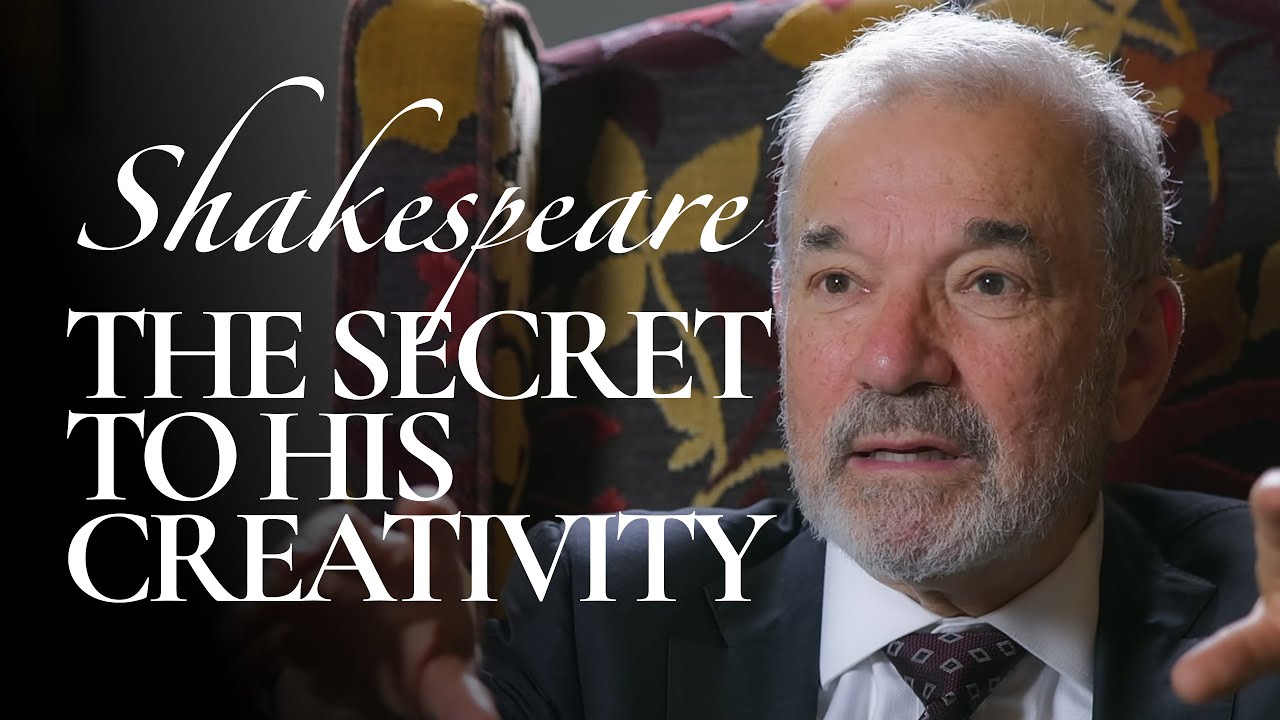
Stephen Greenblatt, one of the world’s foremost Shakespeare scholars, argues that Shakespeare’s genius cannot be reduced to a single explanation but emerges from a rare combination of poetic intelligence, deep human understanding, and an unusual sensitivity to both high culture and the chaotic world around him. The interview explores the gritty theatrical world of Elizabethan London, the collaborative and imitative nature of playwriting at the time, the role of rote memorization in shaping Shakespeare’s verbal artistry, and the deeply personal origins of Hamlet in the death of Shakespeare’s son Hamnet.
The Theatrical World of Elizabethan London
The theater in Shakespeare’s time was not high culture but part of a rough Entertainment District on the south bank of the Thames, outside the control of city authorities who associated theaters with plague, traffic, pickpockets, and public disorder.
Theaters existed alongside brothels and animal baiting events—spectacles where blinded bears were tied to stakes and attacked by dogs, or where bulls and horses were chased for sport. One visitor described a “play” that involved fireworks, rockets, apples falling from a burning rose, and men and women fighting each other in the same venue.
Some venues doubled for both theatrical performances and animal baiting; Ben Jonson wrote a play performed in a theater that still smelled like bear. Shakespeare himself references bear baiting when Macbeth says, “I am in blood stepped in so far that, should I wade no more, returning were as tedious as go o’er”—and earlier, Macbeth compares himself to a bear tied to the stake.
The playwrights in this world were often brilliant but self-destructive: Robert Greene (who coined the phrase “upstart Crow” to attack Shakespeare), Thomas Nasch, and Christopher Marlowe all died young—Marlowe was murdered at 29, Greene died destitute at around 32, Nasch in his early 30s.
Shakespeare stood apart from these figures: he was not a “company keeper,” avoiding the debauchery and dangerous entanglements (Marlowe’s homosexuality, religious provocations) that shortened the lives of his peers.
Shakespeare’s Unique Business Model
Unlike other playwrights who depended on aristocratic patrons, Shakespeare was an actor, the principal playwright for his playing company, a shareholder in the joint-stock corporation (meaning he received a share of box office receipts), and a part-owner of the physical theater itself.
This was an extraordinary and essentially unprecedented business model for a writer in the late 16th century—the idea of making a living as a professional writer without a patron is usually associated with the 18th century, not Shakespeare’s era.
Greenblatt speculates Shakespeare was motivated by a very practical desire: he was not interested in dying at 30, starving in an attic. He wanted a comfortable, bourgeois life.
Imitation, Collaboration, and the Question of Originality
Shakespeare’s plays were largely not original in plot. He borrowed from Plutarch, from earlier chronicles, from other playwrights’ works, and sometimes lifted lines directly. This was normal and unobjectionable in a period before copyright law existed.
Collaboration was the norm, not the exception. There is considerable evidence—including computer-driven stylistic analysis—that Shakespeare’s early history plays (the Henry VI series) were co-written with Christopher Marlowe and possibly a third person. Most plays in the period were written by multiple authors, much like modern television writing rooms.
Shakespeare was unusual in that his later plays appear to be almost entirely solo efforts, but he was careful about how closely he collaborated, likely aware of the dangers posed by his more reckless contemporaries.
Greenblatt challenges the modern cult of originality: while we praise originality today, our culture constantly produces imitations of imitations. In Shakespeare’s world, the expectation was pleasure and craft, not novelty of plot.
The Role of Rote Memorization
Shakespeare’s grammar school education was built on relentless rote memorization, endless drills, daily text analysis, and elaborate exercises in imitation and rhetorical variation—all backed by the threat of physical violence. One educational theorist speculated that the buttocks were created to facilitate the learning of Latin.
This training produced a population far more sophisticated than modern audiences at processing complex syntax and metaphorical language. Ordinary people in Shakespeare’s time could listen to his plays and understand them in real time because they had been forced to memorize vast quantities of material and stand up to perform it.
Greenblatt notes that rote memorization has been almost entirely abandoned in modern education, to our detriment. He cites examples: his older Italian friends can recite huge passages of Dante; Chinese friends can recite classical poetry; Bill Clinton, when asked by Greenblatt, recited a long passage from Macbeth that he had memorized in high school.
The result of this training was a poetic sensibility—an internalized sense of rhythm, taste, and verbal complexity—that Shakespeare possessed to an extraordinary degree and that enabled the dense, syntactically rich poetry of his plays.
Hamnet and the Origins of Hamlet
Greenblatt argues that Hamlet represents a step function beyond Shakespeare’s earlier tragedies (Julius Caesar, etc.)—a qualitative leap, not merely an incremental improvement. It retains more of Shakespeare’s inner life than anything he had written before.
The death of Shakespeare’s only son, Hamnet, at age 11 in 1596 is central to understanding Hamlet. The names “Hamnet” and “Hamlet” were interchangeable in the period (Hamnet Sadler, Shakespeare’s neighbor, is listed in town records as “Hamlet Sadler”). Shakespeare named his son and his twin daughter Judith after his neighbors Judith and Hamnet Sadler.
Hamlet was written several years after Hamnet’s death (around 1600–1601), and Shakespeare may not even have been present when his son died—he was in London, the cause may have been plague, and travel back to Stratford may not have been possible in time for the funeral.
Greenblatt’s book Hamlet in Purgatory explores what the play reveals about how Shakespeare’s culture processed grief after the Protestant Reformation abolished the Catholic doctrine of purgatory. Purgatory had been a middle space between heaven and hell where souls were purified by fire, and the living could pray for the dead and maintain a relationship with them.
When Protestant reformers declared purgatory a fraud and abolished it, the psychological need it served—the need to feel connected to the dead, to do something for them, to believe they were not simply gone—did not disappear. The feeling persisted even after the doctrine was officially rejected.
In Hamlet, the ghost of Hamlet’s father appears and describes being in a place where his sins are being burned and purged away—as close to purgatory as could be staged without using the forbidden word. The ghost says, “I am thy father’s spirit, doomed for a certain term to walk the night, and for the day confined to fast in fires, till the foul crimes done in my days of nature are burnt and purged away.”
Greenblatt speculates that Shakespeare, processing the loss of his son and anticipating the death of his own father, channeled this unresolved grief into the play. He was not a crypto-Catholic but a “post-Catholic” or “post-Christian” figure working through the emotional residue of a abolished doctrine.
Strategic Opacity: How Shakespeare Transformed His Sources
Greenblatt identifies a pattern he calls “strategic opacity”: Shakespeare was very good at identifying the element in a source that made the whole story coherent, and then deliberately removing or obscuring it.
In the original Danish source (Saxo Grammaticus), young Hamlet pretends to be mad as a survival strategy—his uncle has killed his father and would kill Hamlet if he knew Hamlet was a threat, so Hamlet feigns madness to be kept around as a harmless fool until he is old enough to take revenge. This motive is completely coherent and open.
Shakespeare throws this motive away. In his version, Hamlet’s madness serves no clear strategic purpose—it actually draws attention to him and makes him more suspicious. By removing the clear explanation, Shakespeare forces the audience to ask why Hamlet behaves as he does, and the answer becomes interior, psychological, and unresolved.
This pattern of strategic opacity—removing the clarifying element from the source to create mystery and interiority—is, Greenblatt argues, one of the key mechanisms of Shakespeare’s genius. It is not incoherence; it is the deliberate creation of depth.
The Sources of Shakespeare’s Genius
Greenblatt offers a synthesis: Shakespeare’s genius came from intimate familiarity with the greatest literary masterpieces and with a vast amount of low-quality material—he absorbed everything from the lowest level of culture to the highest, which is why he could write convincingly about both kings and peasants.
It also came from a superhuman sensitivity to his own inner life—his grief, his losses, his emotional depths—and to the chaotic, vivid world around him: the Greens, the Nasches, the Marlowes, the people selling bread, the bear baitings, the fireworks. He missed nothing.
The result was an artist who could cut something open inside himself, take something out, and put it into a play—and in Hamlet, more than in any other work, we can see him doing this.