-
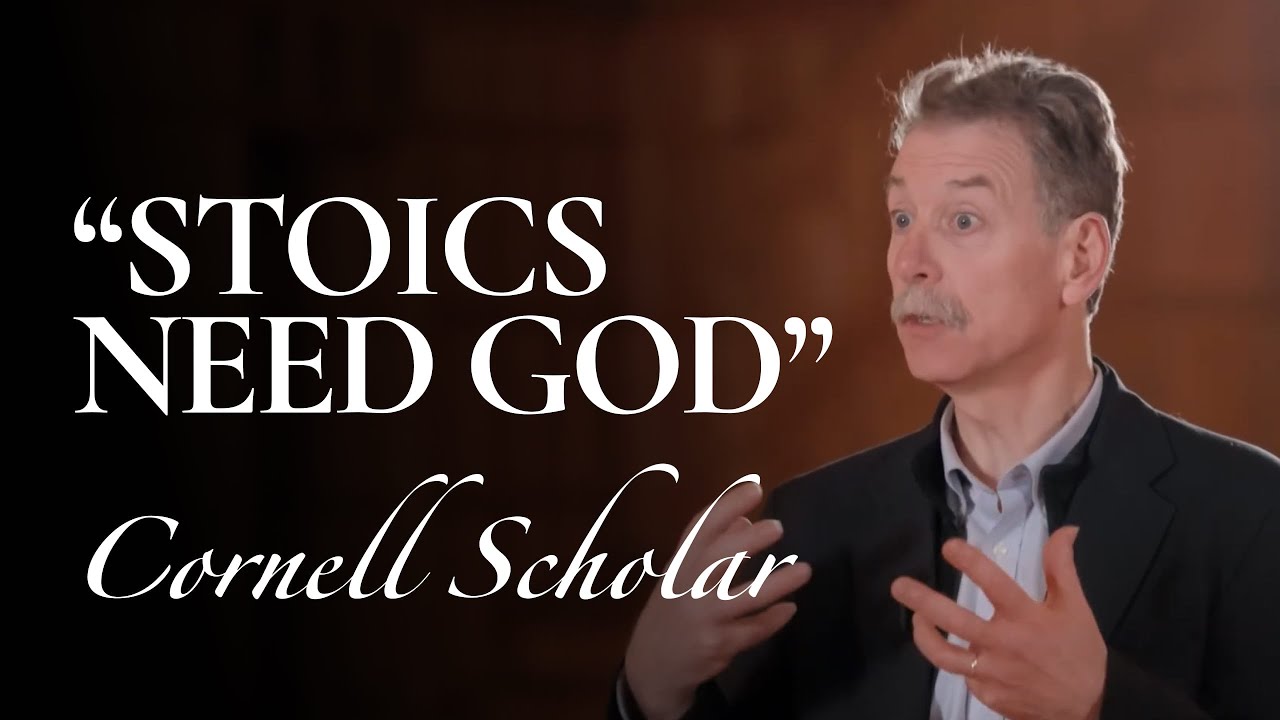
Stoic ethics is inseparable from Stoic theology — Tad Brennan, a Cornell philosopher and leading Stoic scholar, argues that the core ethical claims of Stoicism only make sense within a theological framework centered on Zeus as a providential, rational deity who governs the cosmos. Without this foundation, the system collapses or becomes a watered-up, philosophically uninteresting version of itself.
- The episode explores three classical formulations of the Stoic way of life — living in accordance with virtue, selecting things well (preferred indifferents), and living in accordance with nature — and shows how each depends on theological commitments.
- Brennan is clear that secularized Stoicism, the popular modern self-help version, is not Stoicism at all. The real thing is far more radical, far more systematic, and far stranger than most people realize.
-
Virtue is knowledge — but knowledge of what?
- Virtue, for the Stoics, is a kind of expertise: knowing how to handle things that are neither good nor bad (the “indifferents”) — health, wealth, illness, poverty, reputation, and so on.
- The only true good is virtue; the only true bad is vice. Everything else is “indifferent” — it contributes nothing to your happiness or unhappiness.
- This is not circular because the substantive content of virtue lies in knowing how to respond skillfully to indifferent circumstances, not in defining virtue itself.
- Brennan contrasts this with Aristotle, who holds that external goods are at least instrumentally necessary for happiness (you need money to be generous, health to function, etc.).
- The Stoics reject this entirely: virtue alone is sufficient for happiness, full stop.
- The reason is theological: what you truly are is your rational soul, a fragment of Zeus. Your body, your family, your property — none of these are part of “you” in the strict sense. So their welfare is literally indifferent to your happiness.
- Virtue, for the Stoics, is a kind of expertise: knowing how to handle things that are neither good nor bad (the “indifferents”) — health, wealth, illness, poverty, reputation, and so on.
-
Why virtue-only requires Zeus
- The claim that only virtue matters and everything else is indifferent is not something you can reach from secular, empirical, or commonsense premises.
- Aristotle gets closer to common sense by acknowledging that external goods matter instrumentally. Moving from Aristotle to the Stoic position requires a leap: the recognition that you are a fragment of the divine, that your rational soul is a small portion of Zeus’s nature.
- Without this theological framework, the Stoic position looks absurd — why would anyone accept that their child’s life or death makes no difference to their happiness?
- Brennan considers whether a transhumanist view (the mind as software independent of the body) could secularize this, but notes it’s a very different kind of move from anything the Stoics themselves made.
- He also considers a thought experiment: if you chemically destroyed someone’s capacity for joy (blocking serotonin, etc.), could they still be virtuous and happy?
- The Stoics might respond that happiness (eudaimonia) is not a feeling but a state of the rational soul — correct judgment and proper assent. You could be perfectly virtuous while feeling terrible.
- But they would also concede that sufficiently radical physical intervention (drunkenness, insanity, chemical tampering) can destroy virtue itself — at which point all bets are off. Virtue is harder to destroy than a bank account, but it is not absolutely invulnerable.
- The claim that only virtue matters and everything else is indifferent is not something you can reach from secular, empirical, or commonsense premises.
-
Preferred indifferents: why bother with things that don’t matter?
- After declaring everything other than virtue indifferent, the Stoics immediately bring back the idea that some indifferents are “preferred” (health, wealth) and others “dispreferred” (illness, poverty), and that the virtuous person selects among them.
- This looks like a contradiction, but Brennan gives several reasons for it:
- Theological: Zeus himself is intensely concerned with distributing indifferents throughout the cosmos — feeding some creatures, starving others. As a fragment of Zeus, rationally selecting among indifferents is what makes you godlike.
- Conventional: The Stoics want virtue to look roughly like what ordinary people expect — a courageous person fights for their country, a just person divides things fairly. This requires engaging with indifferents in the right way.
- Structural: Indifferents provide the “material” that virtue operates on. Virtue is an expertise, and an expertise needs a domain. The domain is the correct handling of things that don’t ultimately matter.
- This looks like a contradiction, but Brennan gives several reasons for it:
- Brennan uses the metaphor of a game: the leather ball in soccer is trivial, but the skill with which you maneuver it is the point. Similarly, money, health, and reputation are trivial, but the intelligence and grace with which you handle them is virtue made visible.
- He is not fully convinced by this — he thinks the theological motivation (following Zeus) is the strongest of the three arguments, and that without it, the system has a gap.
- After declaring everything other than virtue indifferent, the Stoics immediately bring back the idea that some indifferents are “preferred” (health, wealth) and others “dispreferred” (illness, poverty), and that the virtuous person selects among them.
-
Living in accordance with nature — but whose nature?
- The third formulation — live according to nature — also depends on theology.
- “Nature” for the Stoics is not just biological regularity; it is Zeus in action. When you observe that humans naturally love and care for their offspring, you are learning about the will of Zeus.
- Zeus, in Brennan’s reading, is not merely an abstract rational principle but something closer to a personal deity — he can appear in dreams, he governs through thunderbolts, and other gods (Hera, Apollo) are aspects of him.
- Nature includes both regularities and anomalies. When things go as expected (children live, people eat), you follow the default will of Zeus. When anomalies occur (a child dies young), you update your understanding of what Zeus wants.
- This is different from modern science, which seeks only regularities. The Stoic study of nature is always valueladen and normative — you are reading the divine plan, not just cataloging patterns.
- Even the appeal to nature, then, cannot be fully secularized. It requires a philosophical and theological framework for interpreting what nature means and why it matters.
- The third formulation — live according to nature — also depends on theology.
-
How the three formulations work together
- Ideally, all three — virtue, selection of indifferents, and following nature — converge on the same practical recommendations. When you eat breakfast, you are feeding your body (nature), treating food as a preferred indifferent (selection), and doing so virtuously (virtue).
- But in practice, the Stoics held that no one in their era was actually virtuous — sages appear perhaps once every thousand years, and everyone else is vicious, even if making progress.
- This means you cannot simply ask “What would a virtuous person do?” — you can’t do a virtuous action, and even a sage would deliberate about indifferents, not about virtue itself.
- So practical deliberation is about handling indifferents correctly, not about virtue directly.
- Brennan draws on Cicero’s De Officiis to suggest a model of Stoic deliberation that has an egoist core (pursuing your own preferred indifferents), side constraints (don’t harm others or seize their property), and an overriding concern for the utility of the whole society.
- But these side constraints are not deontological rights in the modern sense. Property, for instance, is not sacred — it’s a temporary, conventional arrangement of indifferents, like a seat in a theater. You don’t have a divine right to it.
- The welfare of the republic can override both self-interest and conventional constraints, but even that is not a foundational principle — it’s just another consideration within the practice of virtue.
-
Brennan’s assessment: beautiful system, repellent consequences
- What Brennan finds least satisfying: the claim that the welfare of your loved ones is literally indifferent — that you are no better off whether your children live or die. He calls this “crazy talk” and “inhumane.”
- The Stoics go further: if your child dies, you should rationally affirm it as part of Zeus’s providential plan. Brennan finds this morally repellent.
- What he loves: the sheer systematicity of Stoic thought. The ethics is deeply integrated with their physics, metaphysics, epistemology, and even their propositional logic (an area where the Stoics were pioneering).
- Brennan ranks only three great philosophers in antiquity: Plato (the greatest), Aristotle, and Chrysippus — the third head of the Stoic school — because of the extraordinary coherence and rigor of his system.
- The Stoics themselves insisted their system was all-or-nothing: take it entirely or not at all. Brennan respects this, even though he thinks they got important answers wrong.
- His final advice: “Don’t let your children be Stoics.” The system is philosophically magnificent but humanly deficient. The world is not as tidy or as rational as the Stoics believed — but their vision of it is beautiful and compelling nonetheless.
- What Brennan finds least satisfying: the claim that the welfare of your loved ones is literally indifferent — that you are no better off whether your children live or die. He calls this “crazy talk” and “inhumane.”