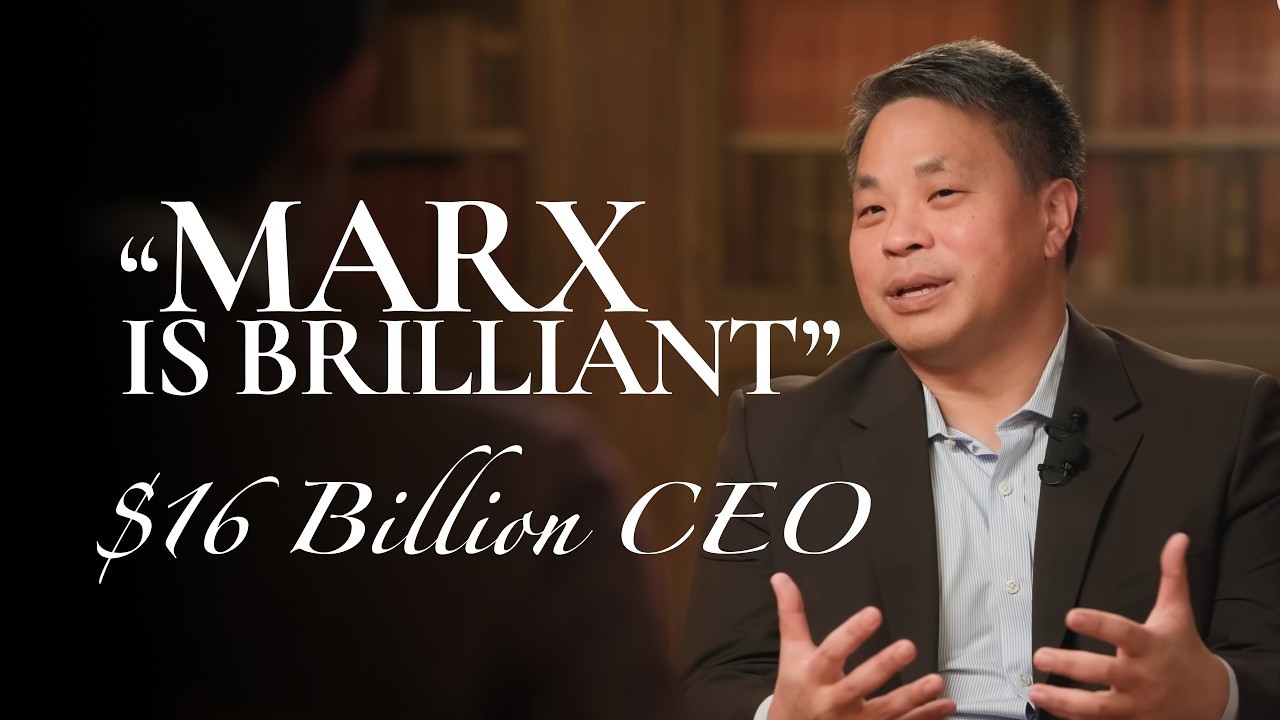
Marcus Ryu was top of his class at Princeton and Oxford, on track to become a philosophy academic, before pivoting to found Guidewire, a software company now worth over $15 billion. He argues that his philosophical training gave him a genuine edge in entrepreneurship—not through grand theory, but through basic propositional logic, the discipline of writing clear arguments, and the habit of interrogating internal coherence. At the same time, philosophy misled him: it made him overvalue intellectual charm in hiring, communicate in ways that were too cerebral for most audiences, and left him unprepared for the emotional and relational demands of building a company. The conversation explores how Marx’s critique of alienation shaped Guidewire’s early culture, why Ryu still calls himself a capitalist, how he reconciles deep insecurity with unreasonable confidence, what he gained and lost by leaving the academy, and why he thinks AI still falls short of genuine reasoning.
-
Marx, alienation, and building a company that tried to be different
- Ryu considers Marx one of the most brilliant thinkers he has ever read, not as a political program but as a diagnostician of capitalism’s structural tendency toward alienation.
- Marx’s core insight that Ryu finds enduringly true: under capitalism, most workers are divorced from the product of their labor, turning creative human faculties into mere instruments for someone else’s ends.
- Ryu extends this beyond factory work to modern gig work and knowledge work, where people can feel like interchangeable cogs even in white-collar settings.
- The deepest part of Marx’s critique, for Ryu, is that the capitalist is the most alienated person of all.
- The owner of the means of production no longer knows how to make anything; his only mastery is further accumulation.
- Ryu sees this pattern in extremely wealthy people he knows who are deeply unhappy despite astronomical abundance, because they have lost any constructive or creative faculty.
- Guidewire’s founding culture was an attempt to instantiate “unalienated labor” within a capitalist enterprise.
- Ryu and his co-founders explicitly told early employees: the work will be hard, the pay below market, the chance of failure high, but you will not be alienated here.
- Everyone would be treated as an end, not a means: full transparency about the project, shared stakes, leadership working harder than anyone else, and a collective commitment to succeed or fail together.
- Ryu believes this “crucible-like” collective feeling was genuinely powerful in the company’s formative years, even if it was naive in some respects and difficult to sustain at scale.
- Ryu still calls himself a capitalist because he does not see a viable alternative system, and because he believes unalienated labor is possible within capitalism even if Marx thought it was not.
- He parts ways with Marx’s utopian endpoint (the socialist fantasy of fishing in the morning and writing philosophy in the evening) while taking the diagnosis seriously.
- He also parts with the Hegelian idea that all suffering is necessary unfolding toward something better; sometimes things just go wrong with no sublation.
- Ryu considers Marx one of the most brilliant thinkers he has ever read, not as a political program but as a diagnostician of capitalism’s structural tendency toward alienation.
-
How philosophy helped (and hurt) as an entrepreneurial training
- Philosophy helped most through basic logical discipline.
- Philosophers in the analytic tradition write arguments as numbered propositions and check inferential validity; Ryu urges entrepreneurs to do the same with their market beliefs and strategy.
- This allows you to catch internal contradictions without even knowing whether the premises are true—a superpower in early-stage strategy and in evaluating other companies.
- Ryu uses a Socratic cross-examination style with founders as an investor, asking them to state their propositions, identify which are axiomatic and which are contingent, and consider what would count as contrary evidence.
- Philosophy hurt in at least two important ways.
- Hiring and judging character: Ryu was preconditioned to overvalue charming intellectuals—people who were scintillating conversationalists and intellectual peers—who turned out to be mediocre operators. The traits that actually mattered most were loyalty, work ethic, reliability, integrity, and personal accountability, which are orthogonal to intellectual brilliance.
- Communication style: Ryu initially communicated the way he wanted to be communicated with—long, inductively elaborated, first-principles explanations. What employees actually wanted was clarity, concision, and repetition: the same comforting strategic framework reiterated quarter after quarter. He also had a nervous habit of becoming more elevated and Oxford-like in high-pressure social situations, which alienated people.
- Philosophy also gave Ryu a useful relationship with difficulty and incremental progress.
- He describes Guidewire’s strategy as “tunneling through granite”—a full frontal assault on the hardest problem in the insurance software market, with no shortcuts and no guarantee of success.
- This is not masochism (fetishizing difficulty) but an embrace of what is necessary; the reward is that the completed tunnel is hard for others to replicate.
- Philosophy helped most through basic logical discipline.
-
The character question: how someone cerebral and introverted built a decacorn
- Ryu does not see himself as having the stereotypical founder personality; he describes the “messianic” founder model (one charismatic figure who knows the way and makes all decisions) as alien to his nature.
- Guidewire’s model was radically collegial, rationalist, and deeply opinionated about what the right product should be—more like HP or IBM in their prime than like a Musk company.
- Ryu acknowledges incomprehension of the messianic model rather than criticizing it, calling it a Wittgensteinian silence: “It works in a fashion that I do not understand.”
- What enabled him to succeed in both academia and entrepreneurship was not a consistent personality but a driving ambition to succeed, combined with a willingness to transform himself out of necessity.
- He describes the entrepreneurial life as a switch, not a synthesis: you cut off long inductive reasoning, you act, you sell, you get on the plane. You lose the ability to spend weeks in deep contemplation.
- He is grateful to have lived both lives—deep contemplation and intense action—but recognizes they are in tension, not seamlessly unified.
- The subjective experience of being an entrepreneur, for Ryu, is a simultaneous oscillation between two perspectives.
- First person: “We must succeed, because the alternative is unbearable.”
- Third person: “We are almost certainly going to fail; the base rates are terrible.”
- Holding both at once is enormously fatiguing and part of the loneliness of the journey.
- He notes that some entrepreneurs seem inoculated against self-doubt entirely; he does not know if this is a blessing or a curse, but it is a real and important character difference.
- Ryu does not see himself as having the stereotypical founder personality; he describes the “messianic” founder model (one charismatic figure who knows the way and makes all decisions) as alien to his nature.
-
Insecurity, confidence, and the hole that cannot be filled
- Ryu describes himself as both unreasonably confident and perpetually insecure, and sees no contradiction.
- Insecurity comes from awareness of the vastness of human achievement and the audacity of claiming to add something genuinely novel.
- Confidence comes from looking at how recklessly and incoherently others are approaching the same problem and thinking, “Surely we can do better.”
- Guidewire’s founding team recited a mantra: “This company is never going public; none of us will become billionaires.” That was the humility. The swagger was: “Look at the clowns who started the companies we used to work at.”
- External success changed the character of his ambition but did not eliminate it.
- Crossing the threshold of financial freedom—no longer living under continuous material necessity—was a binary, glorious shift, more rewarding than any consumption or experience.
- But the “hole” is not filled: he sees Guidewire as a company that should be doing better than it is, and he is surrounded by people who are orders of magnitude more successful, which creates a comparative tug he has to consciously choose to treat as a life force rather than a source of misery.
- The fearfulness of ambition has faded; the intensity has not. He has moved from minimizing negative outcomes to pursuing positive ones.
- Ryu describes himself as both unreasonably confident and perpetually insecure, and sees no contradiction.
-
Inequality, monopoly capitalism, and the epistemic crisis
- Ryu believes extreme inequality is corrosive to civil society, politics, and national effectiveness, and he says this as a very wealthy person.
- Some inequality is motivating and necessary for a meritocracy, but beyond a certain point it leads to political capture, cultural capture, informational capture, and profound estrangement of the majority.
- He sees a direct connection between monopoly capitalism and the epistemic collapse—the shattering of a shared factual reality.
- Social media platforms (Instagram, Facebook, X) are the most pernicious engines of inequality and epistemic fragmentation simultaneously, because the adtech model concentrates enormous influence over people’s basic understanding of facts in a tiny number of individuals.
- These information monopolies are more powerful than any extractive-industry monopoly of the past, and their dominance is deforming talent, entrepreneurship, and innovation.
- He worries that the Silicon Valley ideology—that no matter how mighty the incumbent, rebels can always blow them up—may no longer hold, because regulatory capture and concentration of power are only increasing.
- The clearest indicator of monopoly stagnation: Google was magically innovative in the early 2000s, but for the past 20 years it has been in extractive mode, and every product has gotten worse.
- Ryu believes extreme inequality is corrosive to civil society, politics, and national effectiveness, and he says this as a very wealthy person.
-
The academic path left behind, and what was lost and gained
- Ryu left the academy out of anxiety and fear of failure, not out of philosophical disillusionment.
- He saw early-career academics around him racked with anxiety about finding a home in the profession, and he lacked the hubris to believe he would be the exception.
- His parents, both academics, were dismayed that he would become a “salesman”; they came around, but the decision was painful and driven by a terror of not succeeding on the path he had been on.
- What he misses most about the academy is depth of contemplation.
- In the academic world, serious thinking takes serious time; you are a participant in a vast river of human thought, and your goal is to add one pebble to the edifice.
- In the entrepreneurial world, you are always on the clock. During COVID, Ryu discovered he had lost the faculty for deep, immersive reading and had to struggle for months to get it back.
- What the entrepreneurial path gave him that the academy could not.
- It tested him in an extreme way: he gambled his career, his self-conception, and his family’s hopes on an improbable outcome, and surviving that test was the defining experience of his life.
- It forced him to interact with people utterly unlike him—different regions, religions, life experiences—and to meet them on their own terms, which made him more empathetic, self-aware, and capable in any setting.
- This mirrors Hegel’s argument in the Philosophy of Right that the market has an educational, formative role precisely because it forces you to interface with the wider world.
- He does not regret the path he took, even though he recognizes the tragedy of only getting to run the tape once.
- Ryu left the academy out of anxiety and fear of failure, not out of philosophical disillusionment.
-
Wittgenstein, the limits of dissolving questions, and why some problems remain
- Ryu wrote his Oxford dissertation on Wittgenstein, focusing on the philosophy of mind and free will.
- Wittgenstein’s later philosophy aims to dissolve philosophical problems by diagnosing confusions of language: the goal is not to solve the problem but to show that the question itself was ill-formed.
- Ryu’s conclusion: this works for many lesser philosophical questions (e.g., the private language argument about pain) but fails for the deepest ones—subjective consciousness, the existence of mind in a material world, the freedom of the will.
- These questions remain genuinely weird and unsettling no matter how carefully you analyze the language around them; Wittgenstein’s method does not produce tranquility about them.
- Wittgenstein’s broader project—an end to philosophy in the sense of dissolving its traditional problems—resonates with the ancient skeptics’ goal of tranquility through suspension of judgment.
- Ryu came to admire math and physics more than philosophy during this period, seeing them as more serious and less “wishy-washy,” though he retained his philosophical disposition.
- He also came to see that being a great professional philosopher would require a long monastic journey among truly elite minds (Nagel, Parfit), and he was not sure he could be great at it.
- Ryu wrote his Oxford dissertation on Wittgenstein, focusing on the philosophy of mind and free will.
-
Postmodernism, its migration from left to right, and growing out of deconstruction
- As an undergraduate in the early 1990s, Ryu was steeped in postmodern theory (Derrida, Blanchot, Foucault) and found it exhilarating.
- It gave him a sense of power: a scalpel to interpret the world along dimensions of power, domination, and hierarchy; no text or narrative was safe from radical reinterpretation.
- Foucault’s move of saying “schools are not institutions of edification but of domination” felt revelatory and empowering to a young, somewhat powerless person.
- He grew out of it by recognizing the pointlessness and impotence of endless deconstructive reading.
- Derrida himself said theory is “like play”—endless dancing from text to text with no resolution and no arrival at truth.
- Ryu realized that you can deconstruct infinitely and nothing happens in the world; it is ultimately sterile.
- He is struck by the contemporary migration of postmodern rhetorical tactics from the left to the right.
- The people now saying the most outrageous things, deconstructing shared reality, and arguing that sacred texts (like the Constitution) mean something different than previously understood are on the right.
- This inversion—where the arguments for greater diversity and equality are reframed as the true oppression—is, to Ryu, a fascinating, bewildering, and completely unexpected development.
- As an undergraduate in the early 1990s, Ryu was steeped in postmodern theory (Derrida, Blanchot, Foucault) and found it exhilarating.
-
Values at Guidewire: integrity, rationality, collegiality—and their costs
- Ryu is contemptuous of company values that are merely nice-sounding words hypocritically violated; the best values are ones where people recognize the trade-off and choose the harder path anyway.
- Integrity means telling the truth when it is extremely inconvenient—when it makes selling harder, exposes vulnerability, or disappoints someone. The trade-off is short-term pain for long-term trust. Ryu believes this is close to a universal constant: organizations that habitually lie to themselves rot causally, not karmically.
- Rationality means empowering people to second-guess authority by demanding reasoned explanations. The trade-off is that leaders seed their own power and take on the obligation of justifying decisions rather than simply issuing edicts.
- Collegiality means treating everyone as an end, not a means—taking deep accountability for hiring decisions, ensuring equality of treatment, and not allowing people to be responsive to superiors while neglectful of subordinates. The trade-off is that you cannot do ruthless efficiency layoffs or treat people as disposable, even when it would be convenient.
- He acknowledges that collegiality and rationality are closer to preferences or models—you can build spectacularly successful companies on purely transactional, non-collegial cultures (he cites Oracle)—but he believes integrity is non-negotiable because habitual self-deception is causally self-destructive.
- Ryu is contemptuous of company values that are merely nice-sounding words hypocritically violated; the best values are ones where people recognize the trade-off and choose the harder path anyway.
-
The enemy, noble lies, and the paradox of startup leadership
- Ryu believes startups must name an enemy to activate tribal energy and collective intensity.
- The most effective slide he ever used was a picture of Guidewire’s enemy: a green screen terminal (the legacy system they were replacing). The enemy does not have to be human.
- You cannot be a peaceful insurgent; there is a zero-sum, blood-lust quality to tearing down incumbents, and a startup must harness that.
- This creates a tension with the value of rationality and the duty of constancy.
- The leader must project calm, confidence, and strategic clarity even in the darkest moments—even when they do not feel it. This is, in a sense, a “noble lie” constitutive of the role.
- The one thing a CEO is allowed to be dishonest about is their own confidence level; they must always say “we will find a way” even if they do not believe it. The moment they are no longer willing to do that is the moment to resign.
- The ideal combination is what Ryu sees in Andy Grove: hyperrational, data-driven, calm prosecution animated by genocidal intensity—cold-blooded lethality guided by reason.
- Ryu believes startups must name an enemy to activate tribal energy and collective intensity.
-
Money, ownership, and the bitterness of unfairness
- Guidewire had six roughly equal co-founders; in the first financing round, they sold half the company for $4 million. By the time of the IPO, Ryu’s ownership was very modest.
- He describes this as deeply unfair by today’s standards—any founder hearing the numbers would do a double-take—but there was no alternative at the time.
- The bitterness came not from the absolute outcome (which turned out to be very happy) but from being second-guessed and impeded by investors he experienced as interlopers: “I am carrying a 50-kilogram load up a steep hill and someone just put another 10 kilograms in.”
- He coped through deferral—the romantic, multigenerational East Asian trait of enduring present hardship for future reward—and through the knowledge that eventually things would be on his terms.
- He uses his family’s history (his grandfather was not allowed to urinate at school because the nitrogen was too valuable for fertilizer) as a corrective against an inflated sense of what is fair.
- Guidewire had six roughly equal co-founders; in the first financing round, they sold half the company for $4 million. By the time of the IPO, Ryu’s ownership was very modest.
-
AI: what it can and cannot do, from a philosopher-founder’s perspective
- Ryu is dismissive of claims that AI can currently perform deep reasoning or genuine creativity.
- He sees remarkable summarization and directional, impressionist outputs, but not the tight logical structure of a rigorous philosophical argument.
- He spent a weekend trying to teach a leading model (o1) a blackjack card-counting strategy through prompt engineering; it made mistake after mistake while remaining confident, which he found disconcerting.
- From his vantage point in the insurance software industry, he sees substantial gaps before AI can handle the nuanced judgment his products required.
- Building Guidewire’s software involved countless decisions about generalization, configurability, and extensibility that required deep domain judgment; he finds it inconceivable that current LLMs could replicate this.
- AI is transformational for some tasks (e.g., converting complex commercial policy PDFs into structured data), but still far from the deeper judgment that insurance professionals exercise.
- He is skeptical of claims that AI will soon replace engineers, at least for the kind of complex, judgment-intensive software his industry builds.
- Ryu is dismissive of claims that AI can currently perform deep reasoning or genuine creativity.
-
Games as an art form and allegory of human experience
- Ryu is a passionate board game enthusiast who considers games an art form as important as architecture, music, or film.
- He defines games as having three ingredients: play (enacting something unreal within a magic circle), rules (structure and turns), and winning (a defined objective and endpoint).
- These three ingredients rarely coexist in other facets of life; their combination in games creates a unique allegorical space.
- Games allegorize huge portions of the human experience: decision-making under uncertainty, understanding other minds, negotiation, resource management, balancing short- and long-term trade-offs.
- He cites Cole Wehrle’s game John Company as an example: players inhabit the roles of families involved in the British East India Company and experience firsthand the tensions of cooperating while competing, the commercial orientation of colonial subjugation, and the moral complexity of historical participation in a way that reading a book cannot replicate.
- Games go a step beyond literature: you are not a witness to characters’ decisions but the agent of those decisions, which can produce revelatory understanding of historical moments.
- He sees the current era as a renaissance of board game design, producing works of incredible intricacy and historical sophistication.
- Ryu is a passionate board game enthusiast who considers games an art form as important as architecture, music, or film.